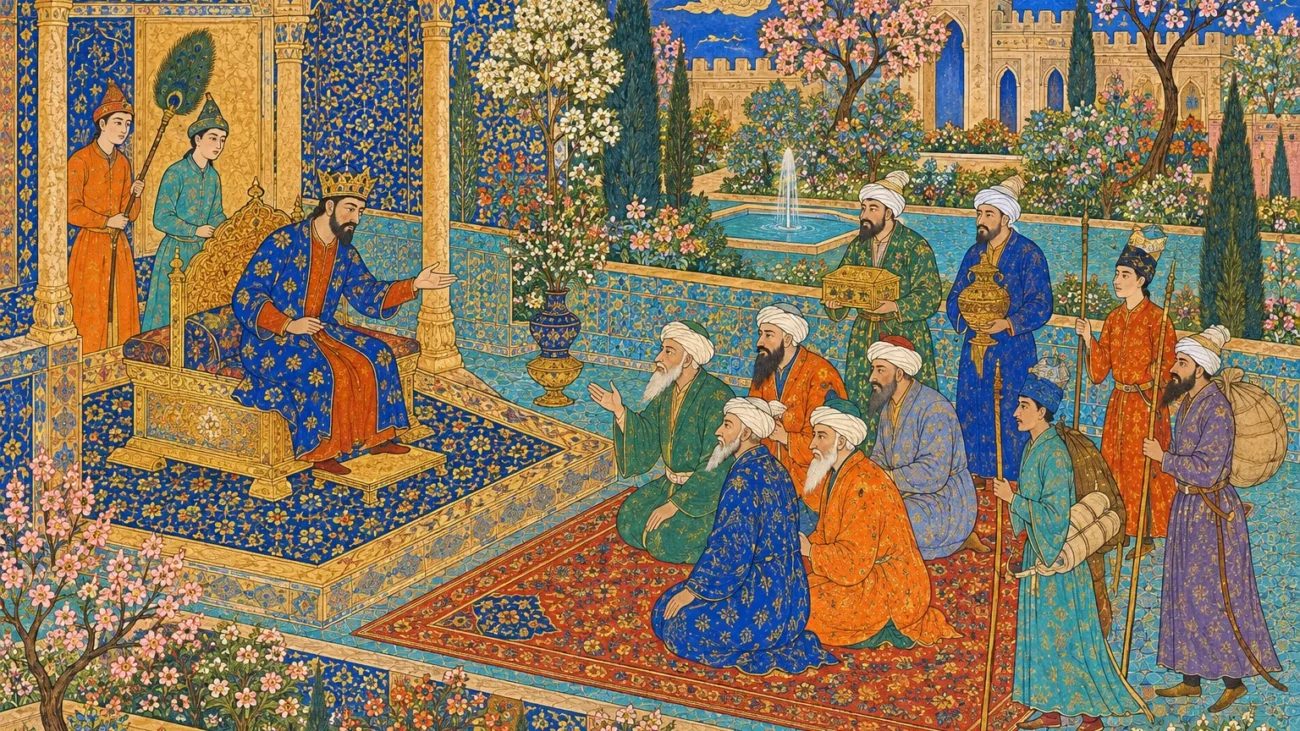
The story of Balaam and his donkey is one of the most surprising scenes in the Old Testament. In Numbers 22–24, a foreign seer sets out to curse Israel. Yet God stops him on the road, opens his eyes and turns his words into blessings. In fact, this same Balaam son of Beor also appears in an ancient inscription found outside the Bible. So his story invites us to look closely at a man who heard God but struggled to follow Him.
Who Was Balaam Son of Beor?
The Bible presents Balaam son of Beor as a gentile prophet and diviner. He lived in Pethor, a town that many identify with the ancient city of Pitru. Today that area lies in northern Syria and southeastern Turkey. In his first oracle, Balaam says that Balak brought him from Aram (Numbers 23:7). For this reason, many readers see him as an Aramean, a foreigner with no stake in the quarrel between Moab and Israel.
Balaam’s role was also unusual. Some of his messages came unasked, at night or on the road, much like the messages of the Hebrew prophets. However, he also offered sacrifices before speaking and wanted the Israelite camp in view, as diviners of the ancient Near East did. As a result, traditions remember him very differently. Some see a forerunner of the magi, while others see little more than a charlatan. The story of Balaam and his donkey shows both sides of this puzzling man.
King Balak Sends for a Prophet
The main story takes place at the end of Israel’s forty years of wandering. The people camp on the plains of Moab, east of the Jordan River, shortly before the death of Moses. They have already defeated Sihon, king of the Amorites, and Og, king of Bashan. Therefore Balak, king of Moab, grows alarmed. He sends elders of Midian and his own messengers to Balaam with one request: come and curse Israel.
At first, Balaam replies that he can only do what the Lord commands. In fact, God speaks to him in a dream by night and tells him not to go. Balak then sends higher-ranking priests and offers honours. Balaam keeps pressing God, and finally God allows him to go. Still, God sets a clear limit: Balaam must say only what God tells him.
Balaam and His Donkey Meet the Angel
Balaam rises in the morning, saddles his donkey and leaves with the princes of Moab. However, God is angry that he goes. So the angel of the Lord stands in the road as an adversary, with a drawn sword in his hand. Balaam does not see him, but his donkey does. First, she turns off the road into a field, and Balaam strikes her.
Next, the angel stands in a narrow path between the walls of the vineyards. The donkey presses against a wall and crushes Balaam’s foot, so he strikes her again. Finally, the angel blocks a place so narrow that no one can turn right or left. The donkey simply lies down under her rider. Balaam’s anger flares, and he beats her with his staff. Then something astonishing happens:
“And the LORD opened the mouth of the ass, and she said unto Balaam, What have I done unto thee, that thou hast smitten me these three times?” (Numbers 22:28)
Balaam answers that she has mocked him, and he wishes he had a sword to kill her. Yet the donkey reminds him that she has been his ass, the one he has ridden ever since she was his until this day. Has she ever acted like this before? Balaam has to admit that she has not.
Balaam and His Donkey: Eyes Opened and a Confession
At this moment the scene turns. The Lord opens Balaam’s eyes, and he finally sees what his donkey saw all along:
“Then the LORD opened the eyes of Balaam, and he saw the angel of the LORD standing in the way, and his sword drawn in his hand: and he bowed down his head, and fell flat on his face.” (Numbers 22:31)
The angel asks why Balaam struck his donkey three times. He explains that he came out to oppose Balaam because his way is perverse. The donkey had turned from him three times, and had she not, the angel says, he would have slain Balaam and saved her alive.
Balaam responds at once. He confesses, “I have sinned,” and offers to go back home (Numbers 22:34). Instead, the angel sends him on with the same limit God set before: “Go with the men: but only the word that I shall speak unto thee, that thou shalt speak” (Numbers 22:35).
Blessings Instead of Curses over Israel
Balak meets Balaam at Kirjat Huzoth and takes him to Bamoth-Baal, the high places of Baal. There they build seven altars and offer sacrifices. However, when Balaam speaks, he blesses Israel. Indeed, he asks how he can curse those whom God has not cursed (Numbers 23:8). Balak protests, so he moves Balaam to Pisgah, builds seven more altars and tries again. Once again, Balaam blesses Israel.
Finally, a frustrated Balak brings him to Peor. This time Balaam does not seek enchantments. Instead, he looks out upon the Israelites, and the Spirit of God comes upon him. He delivers a third blessing, and later he speaks of a coming king:
“I shall see him, but not now: I shall behold him, but not nigh: there shall come a Star out of Jacob, and a Sceptre shall rise out of Israel” (Numbers 24:17)
In all, Balaam’s prophecies form seven Hebrew poems. They praise Israel’s countless numbers, its virtue and its kings. Then they speak of the fates of Amalek, the Kenites and others. Twice Balaam calls himself “the man whose eyes are open” (Numbers 24:15).
Sadly, the story does not end there. Numbers 31:16 links Balaam to the sin at Peor, when Israel turned to idolatry. Also, Numbers 31:8 records his death in battle against Midian. Later, the New Testament portrays him as a symbol of greed (Revelation 2:14).
Balaam and His Donkey Outside the Bible: The Deir Alla Inscription
Remarkably, the name of Balaam son of Beor also appears outside Scripture. In 1967, excavators at Deir Alla in Jordan uncovered a building with several rooms. An earthquake had destroyed it, and the complex probably served a religious purpose. On one plastered wall, someone had written a text in black and red ink. Today it rests in the Jordan Archaeological Museum in Amman.
The wall had fallen, and 119 pieces of ink-inscribed plaster were recovered, so scholars had to piece the text together. The first complete reconstruction appeared in 1981. The inscription tells of visions of “Balaam, son of Beor,” whom it calls “a seer of the gods.” Scholars offer dates such as 840–760 BC or 880–770 BC. As a result, it may be the earliest reference outside the Bible to a biblical figure.
However, this Balaam differs from the one in Numbers. In the inscription, gods come to him at night, and he receives messages from several deities rather than from the Lord.
What Balaam and His Donkey Teach Believers Today
The story of Balaam and his donkey gently invites us to examine our own sight. A gifted seer missed what a simple animal saw. Yet God opened his eyes, and Balaam bowed low and confessed his sin. Likewise, we can ask the Lord to open our eyes when our own plans rush ahead of His will.
Above all, this passage reminds us that God’s word stands firm. Balak built altars and changed places, but he could not turn a blessing into a curse. May we, like Balaam on the road, speak only the word that God gives us.
