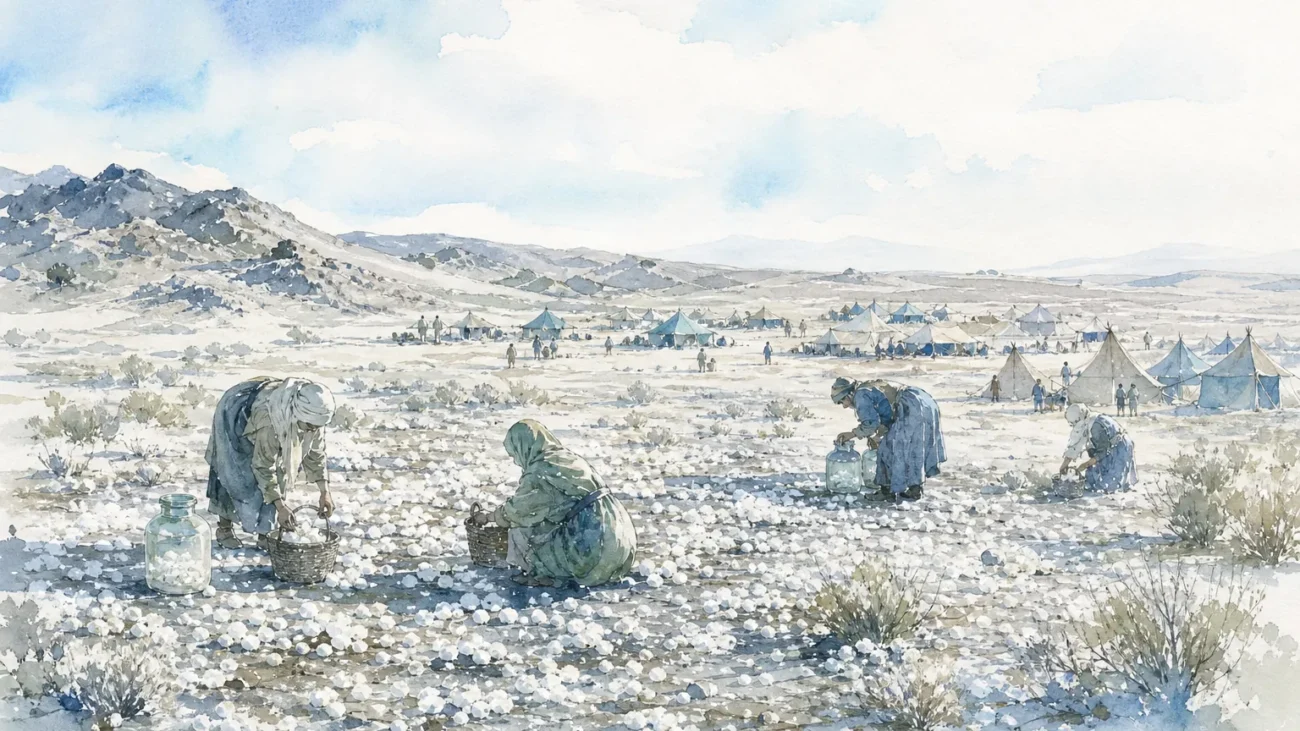
The story of manna in the wilderness tells how God fed his people day after day as they wandered the desert. For about 40 years after the Exodus, the Israelites lived in a barren land before they entered Canaan. Yet God gave them food each morning. Exodus 16 tells the story in detail, and it is full of lessons about trust. Later, in John 6, Jesus pointed back to that same bread and called himself the bread of life. So this ancient meal still speaks to believers today.
God Hears the Cries of His People
Exodus 16 opens with a hungry, complaining people. The Israelites murmured in the desert, and God heard them. Instead of turning away, the LORD spoke to Moses and gave him a promise to pass on.
“I have heard the murmurings of the children of Israel: speak unto them, saying, At even ye shall eat flesh, and in the morning ye shall be filled with bread; and ye shall know that I am the LORD your God.” (Exodus 16:12)
Notice the purpose behind the gift. God did not only want to fill empty stomachs. He also said that his people would know him as their God. So that evening quails came up and covered the camp. Then, in the morning, dew lay all around the camp. When the dew lifted, the first manna in the wilderness appeared on the ground.
Describing Manna in the Wilderness
The people saw a small round thing, as fine as frost on the ground. They did not know what it was. The biblical account links the name manna to the question “man hu?”, which seems to mean “What is it?” Moses gave them the answer: “This is the bread which the LORD hath given you to eat” (Exodus 16:15).
The Bible describes this food in two places, Exodus 16 and Numbers 11. Exodus compares it to coriander seed in size, though white in color. Raw, it tasted like wafers made with honey. Numbers adds that it came with the dew during the night. The people ground it, pounded it into cakes and baked them. As a result, the cakes tasted like something baked with oil.
Over the centuries, readers have tried to explain manna in the wilderness in natural terms. Some suggest the sweet honeydew of a scale insect that feeds on tamarisk trees in the Sinai. Others have proposed a kind of lichen. However, according to the Hebrew Bible and to Jesus in the New Testament, manna is from heaven.
Enough for Every Household
God gave clear instructions with the gift. Each person needed one omer, which equals about 3.64 litres. In addition, each man gathered for those who were in his tents. The Israelites obeyed, yet some gathered more and others gathered less.
“He that gathered much had nothing over, and he that gathered little had no lack.” (Exodus 16:18)
This detail is quietly remarkable. When the people measured their portions, everyone had enough. Nobody ended up with a surplus, and nobody lacked. They gathered every man according to his eating.
Manna in the Wilderness and Daily Trust
Next, Moses gave a harder command: “Let no man leave of it till the morning” (Exodus 16:19). Some people did not listen and saved part of their portion until the morning. Their stored manna bred worms and stank, and Moses grew angry with them.
So the people followed a daily rhythm. Every morning they went out and gathered according to each person’s eating. Then, when the sun grew hot, it melted. Each day began with a fresh dependence on God’s provision.
There was one exception. On the day before the Sabbath, the Israelites gathered twice the usual amount. Moses told them to bake and boil what they wanted and keep the rest until morning, for the next day was a day of rest. This time the stored manna did not stink or get maggots in it.
Jesus and the True Bread From Heaven
In John 6, a crowd asked Jesus for a sign. They pointed back to the desert: “Our fathers did eat manna in the desert; as it is written, He gave them bread from heaven to eat” (John 6:31). They remembered manna in the wilderness as bread from heaven.
Jesus answered by turning their eyes from Moses to the Father. Moses, he said, did not give them that bread. Instead, his Father gives the true bread from heaven. He explained that the bread of God is he which comes down from heaven and gives life to the world. The crowd then asked him to give them this bread evermore.
“I am the bread of life: he that cometh to me shall never hunger; and he that believeth on me shall never thirst.” (John 6:35)
Here Jesus connects the ancient story with himself. The manna fed Israel one day at a time. Jesus says that he that comes to him shall never hunger. Just as the Israelites went out each morning to gather, believers come to him and believe on him.
Receiving Manna in the Wilderness Today
The story of manna in the wilderness invites us to live one day at a time with God. Instead of storing up for tomorrow, we come to the Lord each morning and receive what he gives.
These passages also encourage contentment. Those who gathered much had nothing over, and those who gathered little had no lack. Finally, the gift points us to Jesus, the true bread from heaven. Whoever comes to him, he said, shall never hunger. So as you begin each day, remember manna in the wilderness, and come to the One who gives life to the world.
