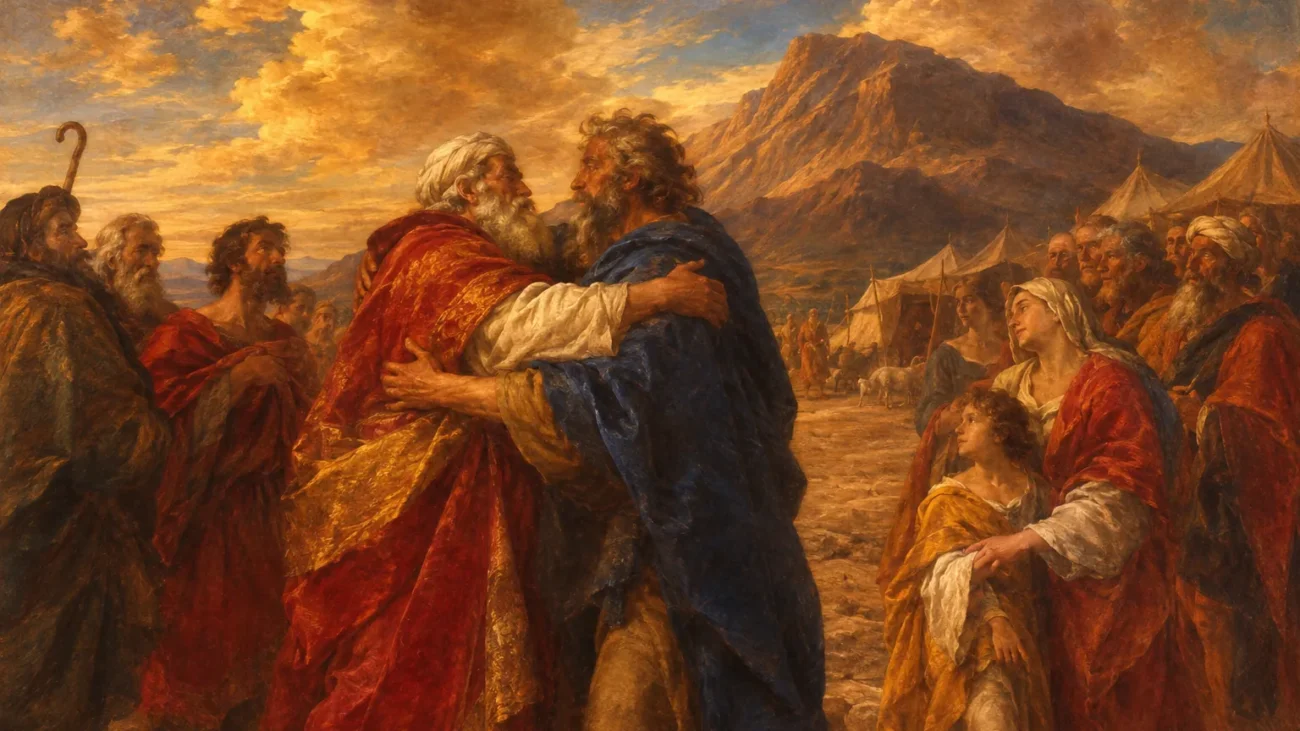
The story of Jethro and Moses is one of the warmest friendships in the Book of Exodus. Jethro, a priest of Midian, welcomed a fugitive into his home. Years later, he gave that same man advice that changed how Israel lived together. In fact, his counsel still speaks to anyone who tries to carry too much alone. In this article, we look at who Jethro was and how the two men met. We also consider what his wise words teach us about humility, rest and serving side by side.
Who Was Jethro, Priest of Midian?
The Bible presents Jethro as a non-Israelite, a shepherd and a priest of Midian. Exodus first calls him Reuel (Exodus 2:18), but it later uses the name Jethro (Exodus 3:1). In Exodus 4:18 he appears as both Jether and Jethro. Some modern scholars suggest that “Jethro” was a title meaning “His Excellency,” while Reuel was his personal name. Jewish tradition, for its part, explained the different names by saying that he had seven of them.
Midian lay along the eastern edge of the Gulf of Aqaba, in northwestern Arabia. However, some believe it sat within the Sinai Peninsula, and ancient maps show it in both places. Interestingly, the Bible traces the Midianites back to Midian, a son of Abraham and Keturah. So Jethro and Moses may have shared a common ancestor, since Moses came from the line of Abraham and Sarah.
How Jethro and Moses First Met in Midian
Moses fled Egypt after killing an Egyptian who was beating an enslaved Hebrew. He came to Midian, where the seven daughters of the priest drew water for their father’s flock. Then local shepherds arrived and drove them away. Scripture describes what happened next:
“And the shepherds came and drove them away: but Moses stood up and helped them, and watered their flock.” (Exodus 2:17)
When the daughters returned home early, their father asked why. They told him that an Egyptian had rescued them and even watered the flock. Immediately, Reuel asked where the man was and told them to invite him to eat bread. As a result, Moses agreed to live with him, and Jethro gave him his daughter Zipporah (Exodus 2:21). In addition, Moses worked as a shepherd for Jethro for 40 years.
Even so, Moses never forgot that he was a stranger in exile. He named his first son Gershom, a name that means “stranger there.” Still, Jethro’s kindness gave a hunted man shelter, a family and a new beginning.
A Joyful Reunion at the Mountain of God
Decades later, God called Moses to lead His people out of Egypt. After Israel’s victory over the Amalekites at Rephidim, news reached Jethro of all that the Lord had done. So he set out to visit, bringing members of Moses’s family with him. The reunion of Jethro and Moses took place in the wilderness near “the mountain of God.” Moses went out to greet him, bowed before his elder, and the two embraced.
Inside the tent, Moses told Jethro everything the Lord had done for Israel. Notably, Moses spoke about the Lord rather than about himself. Jethro, in turn, listened and rejoiced. He blessed the Lord for rescuing the people from Pharaoh and the Egyptians. He also confessed that the Lord is greater than all the gods. Then Jethro brought a burnt offering and other sacrifices to God. Afterward, Aaron and the 70 elders of Israel ate with him in God’s presence. For this reason, some see Jethro as possibly the Bible’s first convert.
What Jethro Saw: A Leader Wearing Himself Out
The next day, Jethro watched the daily life of the camp. Moses sat to judge the people, and they stood by him “from the morning unto the evening” (Exodus 18:13). Soon Jethro grew concerned. He asked Moses why he sat alone while everyone waited on him. Moses explained that the people came to him to enquire of God. He judged their disputes and taught them God’s statutes and laws.
This honest talk between Jethro and Moses then reached its turning point. Jethro spoke plainly, yet with care:
“The thing that thou doest is not good. Thou wilt surely wear away, both thou, and this people that is with thee: for this thing is too heavy for thee; thou art not able to perform it thyself alone.” (Exodus 18:17-18)
Jethro did not scold Moses for his devotion. Instead, he named the problem: the work was too heavy for one man. Above all, he saw that the strain harmed not only Moses but also the people around him.
Jethro and Moses Build a Plan to Share the Load
Next, Jethro outlined a better way. First, Moses would keep his central calling. He would stand before God for the people, bring their causes to God, and teach them the way they must walk (Exodus 18:19-20). Then he would choose others to help. Jethro listed clear qualities for these helpers:
“Moreover thou shalt provide out of all the people able men, such as fear God, men of truth, hating covetousness; and place such over them, to be rulers of thousands, and rulers of hundreds, rulers of fifties, and rulers of tens.” (Exodus 18:21)
These leaders would judge the small matters and bring the great ones to Moses. In this way, the work would become easier, and “they shall bear the burden with thee” (Exodus 18:22). Furthermore, Jethro named two results. Moses would be able to endure, and the people would go to their place in peace (Exodus 18:23). Yet Jethro framed his advice humbly, telling Moses to act if God commanded him so.
Remarkably, Moses did not argue. Instead, Scripture says that he “hearkened to the voice of his father in law, and did all that he had said” (Exodus 18:24). He chose capable men from across Israel to judge units of thousands, hundreds, fifties and tens. Because Jethro and Moses worked together, Israel gained a shared system of justice just before the journey to Mount Sinai.
Lessons from Jethro and Moses for Our Lives
The friendship of Jethro and Moses offers gentle lessons for every believer. First, it shows humility on both sides. Jethro, an older priest, rejoiced in what God had done for others. Moses, a great leader, listened to his father-in-law and changed course. Similarly, we grow when we welcome wise counsel instead of defending our habits.
Second, the story honors rest. Jethro saw that Moses would “wear away” if nothing changed. Therefore, sharing the load was not weakness but wisdom, so that Moses could endure. Finally, the passage celebrates serving together, with many able and faithful hands bearing the burden. May the example of Jethro and Moses encourage us to work side by side, so that all may go to their place in peace.
