Codex Sinaiticus is a fourth-century Christian manuscript of the Greek Bible, and it holds the oldest complete copy of the New Testament. It came to the attention of scholars in the nineteenth century at Saint Catherine’s Monastery in the Sinai Peninsula. Today, most of Codex Sinaiticus sits in the British Library in London, where visitors can see it on public display. In fact, its story invites believers to marvel at how the words of Scripture have traveled through the ages. It also reveals the patient work of scribes who copied the text letter by letter.
Codex Sinaiticus Among the Great Bible Manuscripts
Scholars count this manuscript among the four great uncial codices. These were books that originally contained both the Old and New Testaments. Together with Codex Alexandrinus and Codex Vaticanus, it ranks among the earliest and most complete Bibles. Through the study of handwriting styles, known as palaeography, experts date it to the mid-fourth century.
Its contents are rich. Besides the New Testament, Codex Sinaiticus preserves much of the Greek Old Testament, including the deuterocanonical books. In addition, it includes two other early Christian writings, the Epistle of Barnabas and part of the Shepherd of Hermas. Large portions of the Old Testament are missing today. However, scholars assume the codex once contained both Testaments in full. The New Testament, by contrast, survives complete.
The order of the books may surprise modern readers. First come the four Gospels, then the letters of Paul, with Hebrews placed after 2 Thessalonians. Next follow the Acts of the Apostles and the General Epistles. Finally, the Book of Revelation closes the collection.
A Monastery at the Foot of Mount Sinai
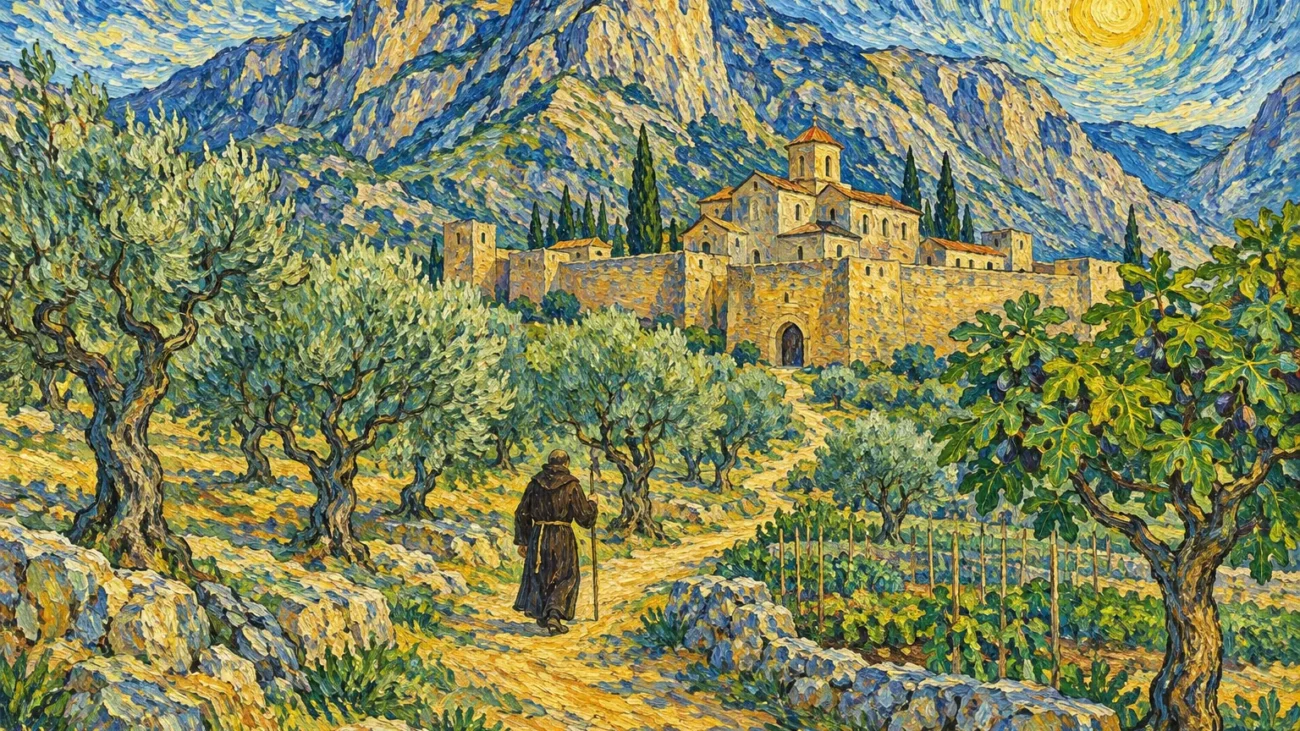
Saint Catherine’s Monastery stands at the foot of Mount Sinai in Egypt. Builders raised it between 548 and 565 by order of the Byzantine emperor Justinian I. Today it is the world’s oldest continuously inhabited Christian monastery. Moreover, it encloses what tradition claims is the burning bush that Moses saw. It also guards the “Well of Moses,” where, by tradition, Moses met his future wife, Zipporah.
Massive fortifications surround the monastery, and they have preserved it through many centuries. Until the twentieth century, people entered only through a door high in the outer walls. Within those walls, the library counts among its rare works both Codex Sinaiticus and the Syriac Sinaiticus. Scholars learned of the codex there in the nineteenth century. In 1844, the German biblical scholar Constantin von Tischendorf made his famous discovery. Later, researchers found further material in the twentieth and twenty-first centuries.
Today, parts of the codex lie scattered across four libraries around the world. Some leaves remain in good condition, while others are in very poor shape. This contrast suggests that people separated the parts and stored them in several places.
How the Scribes Crafted Codex Sinaiticus
Making this Bible required enormous effort. Craftsmen prepared vellum parchment, mainly from calf skins and partly from sheep skins. Tischendorf thought the parchment came from antelope skins. However, modern microscopic examination has shown otherwise. In fact, experts estimate that the hides of about 360 animals went into the folios.
The pages of Codex Sinaiticus carry four columns of text, with 48 lines per column. Every line holds some twelve to fourteen Greek uncial letters. When a reader opens the book, eight columns appear, much like the columns of a papyrus roll. The poetical books of the Old Testament, however, use only two columns. There the scribes placed each new poetic phrase on a new line. Altogether, the codex contains almost 4,000,000 letters.
The cost was immense. Experts estimate that the materials, the copying time and the binding equalled the lifetime wages of one person at the time. Fittingly, typographer Robert Bringhurst called the codex a “subtle piece of craftsmanship.”
Careful Copying Letter by Letter
The scribes worked with great discipline. First, they ruled the parchment with a sharp point to prepare straight writing lines. Then they wrote the words along those lines without spaces between them, a style called scriptio continua. They used the handwriting style later known as biblical uncial, or biblical majuscule. They also added punctuation such as high and middle points and colons.
In addition, the scribes gave sacred names a special form. They shortened words such as God, Lord, Jesus, Christ and Spirit, and drew a line over them. These short forms, called nomina sacra, appear throughout the manuscript. Similarly, they wrote names like David, Jerusalem and Israel in abbreviated forms.
Careful work still left room for review. For example, the section from John 1:1 to John 8:38 contains a large number of corrections. In that same portion, Codex Sinaiticus sides with Codex Bezae rather than with Vaticanus and the other Alexandrian manuscripts.
Why Codex Sinaiticus Matters for Bible Study Today
Biblical scholars consider Codex Sinaiticus one of the most important Greek texts of the New Testament. Before 1844, the Greek text of Codex Vaticanus stood without rival. Since then, scholars have found Sinaiticus useful for critical studies of the biblical text.
For most of the New Testament, the codex agrees with Codex Vaticanus and Codex Ephraemi Rescriptus. Together, they witness to what scholars call the Alexandrian text-type. For example, both Sinaiticus and Vaticanus leave out the words “without a cause” in Matthew 5:22. Similarly, in John 1:4, only Sinaiticus and Codex Bezae among Greek manuscripts read “in him is life” rather than “in him was life.”
Still, the two great codices do not match in every detail. Textual critic Herman C. Hoskier counted 3036 differences between Sinaiticus and Vaticanus in the Gospels. He found 656 in Matthew, 567 in Mark, 791 in Luke and 1022 in John.
Certainty in What We Have Been Taught
Luke opened his Gospel by explaining why he wrote with such care:
“It seemed good to me also, having had perfect understanding of all things from the very first, to write unto thee in order, most excellent Theophilus, That thou mightest know the certainty of those things, wherein thou hast been instructed.” (Luke 1:3-4)
Luke wanted Theophilus to know the certainty of what he had learned. In a similar spirit, Codex Sinaiticus reminds believers of the many hands that copied the Gospel story with patience. So, when we open our Bibles, we can give thanks for that faithful labor. Above all, we can read with the same desire Luke voiced: to know the certainty of the things we have been taught.
