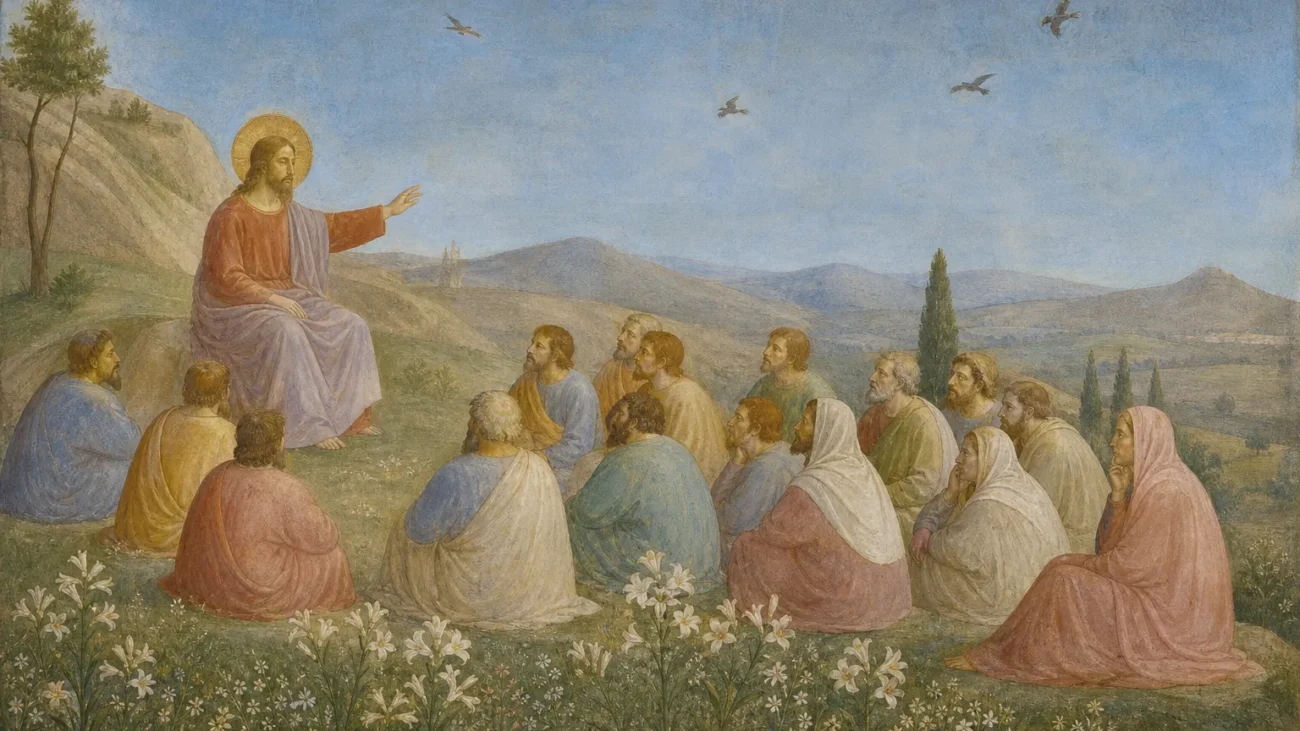
The words of Jesus on worry are some of the most comforting lines in the Gospel of Matthew. For example, in chapter 6, Jesus points to the birds of the air and the lilies of the field. Then he asks a simple question: if God clothes the grass of the field, shall he not much more clothe you? So for anxious hearts today, this passage still offers a steady place to rest. Therefore, in this article, we walk through Matthew 6:25-34 one step at a time. Along the way, we also listen to what Jesus says about the heavenly Father and the fears that crowd our minds.
Where Jesus Spoke These Words
To begin with, Jesus gave this teaching as part of the Sermon on the Mount. The sermon fills chapters 5, 6, and 7 of Matthew. In fact, it is the first of five discourses in that Gospel. Moreover, it comes relatively early in Matthew’s portrayal of his ministry, after his baptism by John, his temptation in the desert, his call of four disciples, and his early preaching in Galilee.
First, Matthew 5:1-2 sets the scene. Then Jesus sees the crowds, goes up the mountain with his disciples, sits down, and begins his speech. Traditionally, Christians have commemorated the Mount of Beatitudes as the place. However, some have also suggested other locations, such as Mount Arbel and the Horns of Hattin. In addition, several traditions also regard the sermon as the New Testament counterpart to the giving of the Ten Commandments on Mount Sinai.
Within chapter 6, Jesus first condemns doing good works simply for recognition and not from the heart. For example, he speaks about alms, prayer, and fasting. He also gives the Lord’s Prayer in Matthew 6:9-13. After that, the discourse condemns the superficiality of materialism. Then he calls his disciples not to worry about material needs or fret about the future. Instead, they should seek God’s kingdom first. So this is where we find the teaching of Jesus on worry.
The Birds of the Air and Jesus on Worry
Jesus opens this part of the sermon with a clear command:
“Therefore I say unto you, Take no thought for your life, what ye shall eat, or what ye shall drink; nor yet for your body, what ye shall put on. Is not the life more than meat, and the body than raiment?” (Matthew 6:25)
First, notice how practical his concerns are. In fact, food, drink and clothing are the things he names. Yet Jesus asks whether life is not more than meat, and the body than raiment.
Next, Jesus points to the sky. “Behold the fowls of the air: for they sow not, neither do they reap, nor gather into barns; yet your heavenly Father feedeth them. Are ye not much better than they?” (Matthew 6:26). In other words, the birds do not sow, reap or gather into barns. Still, the verse says, the heavenly Father feeds them. And then Jesus asks his listeners: are ye not much better than they?
Then comes another question: “Which of you by taking thought can add one cubit unto his stature?” (Matthew 6:27). In this way, Jesus asks what taking thought can really add.
Lilies of the Field: How God Clothes His Own
After the birds, Jesus also turns to the flowers. “And why take ye thought for raiment? Consider the lilies of the field, how they grow; they toil not, neither do they spin” (Matthew 6:28). Similarly, the lilies do not toil or spin.
Indeed, Jesus compares them with Solomon. “And yet I say unto you, That even Solomon in all his glory was not arrayed like one of these” (Matthew 6:29). In other words, he says, even Solomon in all his glory did not have clothing like one of these.
“Wherefore, if God so clothe the grass of the field, which to day is, and to morrow is cast into the oven, shall he not much more clothe you, O ye of little faith?” (Matthew 6:30)
Here the words of Jesus on worry then move from the grass to his listeners. The grass of the field is here today, and tomorrow someone casts it into the oven. Yet God clothes it. Shall he not much more clothe you? Jesus asks. He also addresses his hearers as “O ye of little faith.”
Jesus on Worry and Seeking the Kingdom First
Therefore, Jesus now draws his conclusion. “Therefore take no thought, saying, What shall we eat? or, What shall we drink? or, Wherewithal shall we be clothed?” (Matthew 6:31). He then explains why: “(For after all these things do the Gentiles seek:) for your heavenly Father knoweth that ye have need of all these things” (Matthew 6:32).
Indeed, this verse holds a quiet comfort. After all, the heavenly Father knows that we have need of all these things. So in this passage, the teaching of Jesus on worry points to what the Father knows.
Finally, Jesus gives the heart of the passage:
“But seek ye first the kingdom of God, and his righteousness; and all these things shall be added unto you.” (Matthew 6:33)
Instead of taking thought for what to eat, drink or wear, Jesus calls the disciple to seek first the kingdom of God and his righteousness. And then Jesus also promises that all these things shall be added.
Sufficient Unto the Day
In the end, the passage closes with a word about time. “Take therefore no thought for the morrow: for the morrow shall take thought for the things of itself. Sufficient unto the day is the evil thereof” (Matthew 6:34).
Here Jesus also speaks about the morrow. Specifically, he says the morrow shall take thought for the things of itself, and that each day has enough evil of its own. Thus this word of Jesus on worry calls his hearers to take no thought for the morrow.
Casting Our Care: Living Out Jesus on Worry
Likewise, the first letter of Peter speaks a similar word: “Casting all your care upon him; for he careth for you” (1 Peter 5:7). In fact, the verse gives its own reason: he cares for you.
So what can we take from the teaching of Jesus on worry? First, we can behold the birds of the air and remember that the heavenly Father feeds them. Then, we can consider the lilies of the field and remember that God clothes the grass. Finally, we can seek first his kingdom and cast all our care upon him. Above all, our heavenly Father knows that we have need of these things, and he cares for us.
