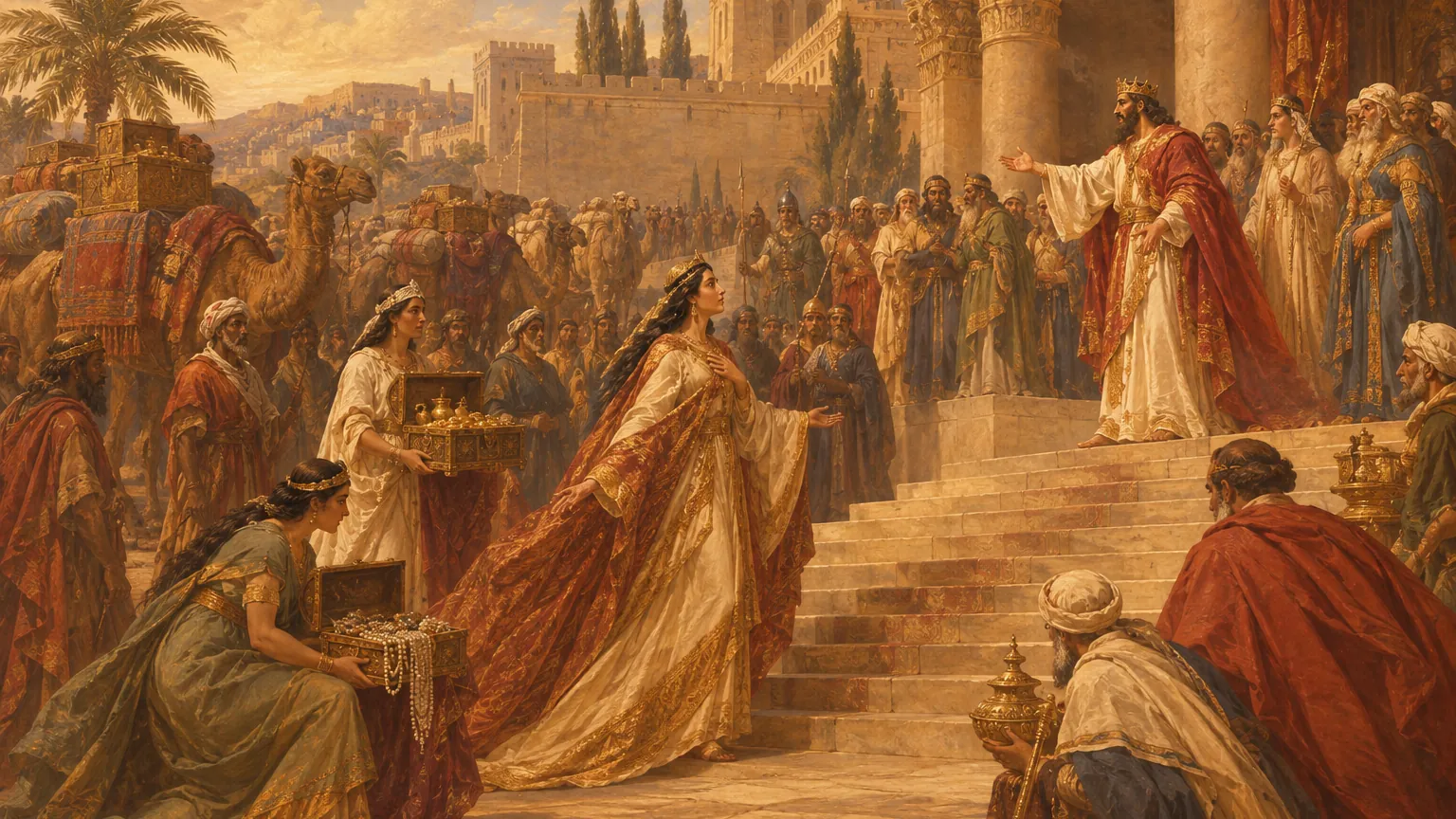
The story of the queen of Sheba visiting King Solomon is one of the most memorable royal encounters in the Old Testament. A foreign ruler hears about the king’s fame, sets out on a long road and arrives in Jerusalem with camels, gold and spices. Yet she comes above all for one thing: wisdom. In this article we follow her journey, listen to her praise of Israel’s God, look at what history tells us about ancient Sheba, and see why Jesus himself remembers her.
Why the Queen of Sheba Traveled to Jerusalem
The account opens in 1 Kings 10, and a parallel version appears in 2 Chronicles 9. First, the queen of Sheba hears a report. However, the report is not only about riches. The writer links Solomon’s fame to the name of the Lord:
“And when the queen of Sheba heard of the fame of Solomon concerning the name of the LORD, she came to prove him with hard questions.” (1 Kings 10:1)
So her motive went beyond curiosity. She wanted to test the king, and she came ready to do it in person. In addition, she did not travel lightly. She arrived “with a very great train, with camels that bare spices, and very much gold, and precious stones” (1 Kings 10:2). The Bible never gives her name. In fact, later traditions supplied names: Ethiopian Christians call her Makeda, while Arabic tradition calls her Bilqis.
Hard Questions and Honest Answers
Once she reached Solomon, the queen “communed with him of all that was in her heart” (1 Kings 10:2). In other words, she held nothing back. She brought her deepest questions to the king. The Hebrew word behind “hard questions” means riddles, and some scholars think this term points to a late origin for the text.
Then Solomon answered every one of them. The narrator stresses that nothing stayed hidden from him: “there was not any thing hid from the king, which he told her not” (1 Kings 10:3). Later Jewish writers loved this scene. For example, one Yemenite manuscript collects nineteen riddles and credits them to the queen of Sheba. One riddle describes something that does not move while living but moves once someone cuts off its head. The answer is a tree that becomes a ship.
What She Saw at Solomon’s Court
The queen did not judge only by words. She also looked closely at the life of the court. She saw the house Solomon had built, the food on his table and the seating of his servants. Then she noticed the ministers, their clothing, his cupbearers and the ascent he used to go up to the house of the Lord. The text puts it simply: “there was no more spirit in her” (1 Kings 10:5).
Her response is honest and humble. She admits that she had not believed the reports until she came and saw for herself:
“Howbeit I believed not the words, until I came, and mine eyes had seen it: and, behold, the half was not told me: thy wisdom and prosperity exceedeth the fame which I heard.” (1 Kings 10:7)
The Queen of Sheba Blesses the Lord
Next, her admiration turns into praise. First, she calls Solomon’s servants happy because they stand before him and hear his wisdom. Then she lifts her eyes beyond the king to his God:
“Blessed be the LORD thy God, which delighted in thee, to set thee on the throne of Israel: because the LORD loved Israel for ever, therefore made he thee king, to do judgment and justice.” (1 Kings 10:9)
This blessing is the heart of the story. A ruler from a distant land says that the Lord delighted in Solomon and set him on the throne of Israel. She also names the purpose of his kingship: to do judgment and justice. In addition, she declares that the Lord loved Israel for ever.
Gifts Fit for Kings
Afterward the queen of Sheba gave Solomon a hundred and twenty talents of gold, a great store of spices and precious stones. In fact, no such abundance of spices ever came again (1 Kings 10:10). At the same time, Hiram’s ships brought gold, almug trees and precious stones from Ophir. Solomon used the almug wood for pillars in the house of the Lord and in his own house. He also made harps and psalteries for the singers.
Solomon showed generosity in return. He gave the queen all her desire, whatever she asked, besides the gifts from his royal bounty. Finally, she turned and went back to her own country with her servants (1 Kings 10:13). One source suggests that her visit could have been a trade mission. Similarly, a recent theory reads the Ophel inscription in Jerusalem as Sabaic, pointing to trade between South Arabia and Judah in the 10th century BC.
What We Know of Ancient Sheba
Modern historians and archaeologists place Sheba, also called Saba, in South Arabia, in what is now Yemen. The kingdom likely began between about 1000 BCE and 800 BCE and lasted until around 275 CE. Its heartland lay around Marib, its capital, and Sirwah. Its people, the Sabaeans, spoke Sabaic and left many inscriptions. In addition, they took part in the spice trade, especially frankincense and myrrh.
However, scholars remain cautious about the queen of Sheba herself. Because no trace of her has been found, historians dispute her existence, and the account is considered legendary. Early inscriptions show no evidence of diplomatic missions or women rulers. Still, South Arabian inscriptions do mention a queen, and Assyrian inscriptions repeatedly mention Arab queens. Ethiopian tradition tells a fuller story. The Kebra Nagast names her Makeda, identifies Sheba as ancient Ethiopia and makes her the mother of Menelik, Solomon’s son.
Why Jesus Remembers the Queen of Sheba
The New Testament also mentions this visit. It speaks of a “queen of the south.” The same saying also appears in Luke 11:31.
“The queen of the south shall rise up in the judgment with this generation, and shall condemn it: for she came from the uttermost parts of the earth to hear the wisdom of Solomon; and, behold, a greater than Solomon is here.” (Matthew 12:42)
She came from the uttermost parts of the earth to hear Solomon’s wisdom. Yet the passage says that a greater than Solomon is here.
Seeking Wisdom Like the Queen of Sheba
The queen of Sheba invites us to bring our hard questions honestly, to come and see for ourselves, and to turn our wonder into praise. She began with a report, moved through disbelief and ended by blessing the Lord.
