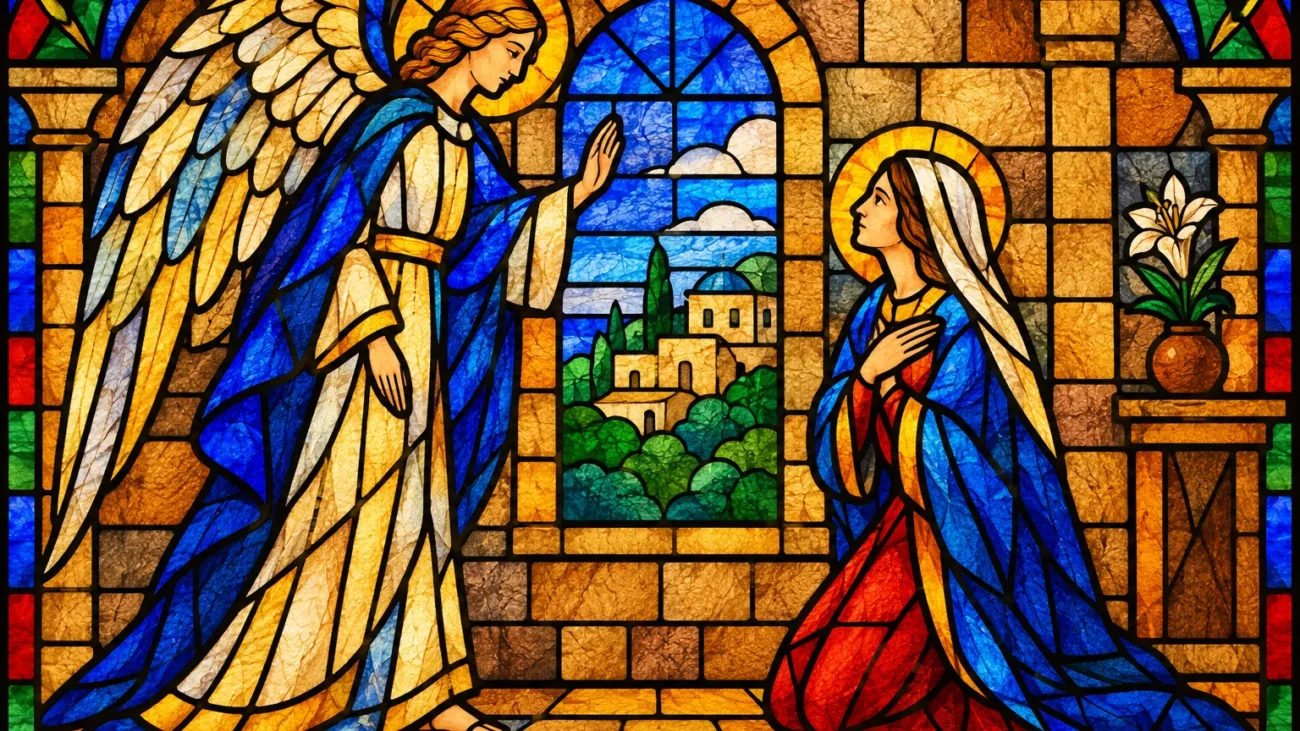
The annunciation to mary is one of the most tender moments in the Gospel of Luke. In it, the angel Gabriel brings astonishing news to a young woman in Nazareth. Mary listens, wonders, asks a question, and then gives her quiet yes. Her answer still speaks to believers today. In fact, her words have found a lasting place in Christian prayer. So let us walk slowly through this story and see what her trust teaches us about faith and surrender.
The Annunciation to Mary Begins in Nazareth
Luke sets the scene with care. God sends the angel Gabriel to a city of Galilee named Nazareth (Luke 1:26). Luke also notes the timing. Gabriel comes in the sixth month of Elizabeth’s pregnancy with John the Baptist. Therefore the annunciation to mary connects from the start with another miracle already underway.
Next, Luke introduces Mary herself. She is a virgin, engaged to a man named Joseph, of the house of David (Luke 1:27). Yet Luke offers no list of her achievements. Instead, he simply tells us her name: Mary. The story invites us to notice how God reaches out to a person, not to a title.
Christians have long remembered where this happened. Both Roman Catholic and Eastern Orthodox churches hold that the event took place at Nazareth. However, they differ on the exact spot. Catholic tradition places it in Mary’s home, while Orthodox tradition places it at the town well, known as Mary’s Well. Today the Basilica of the Annunciation marks the first site. Similarly, the Greek Orthodox Church of the Annunciation, around half a mile away, marks the second.
A Greeting That Troubled Her Heart
Gabriel comes in to Mary and greets her with words of honor:
“Hail, thou that art highly favoured, the Lord is with thee: blessed art thou among women.” (Luke 1:28)
Mary does not respond with pride. Instead, the greeting troubles her. She turns the words over in her mind and wonders what kind of salutation this could be (Luke 1:29). Her reaction feels deeply human. After all, nothing in her day had prepared her for a visit from heaven.
Gabriel answers her unease at once. “Fear not, Mary: for thou hast found favour with God” (Luke 1:30). In other words, God speaks comfort before he reveals the plan. This moment in the annunciation to mary reminds us that God sees our fear. He does not ignore it, and he does not shame it. Rather, he meets it with a word of peace.
The Annunciation to Mary and Her Honest Question
Then Gabriel unfolds the message. Mary will conceive and bear a son, and she will call his name Jesus (Luke 1:31). He will be great, and people will call him the Son of the Highest. Also, the Lord God will give him the throne of his father David. He will reign over the house of Jacob for ever (Luke 1:32-33). Finally, Gabriel adds a breathtaking promise: “and of his kingdom there shall be no end” (Luke 1:33).
Mary responds with an honest question. “How shall this be, seeing I know not a man?” (Luke 1:34). Notice that Gabriel does not scold her for asking. Instead, he explains. The Holy Ghost will come upon her, and the power of the Highest will overshadow her (Luke 1:35). For this reason, the holy child she bears will carry the name Son of God.
Here the annunciation to mary gives us permission to bring our questions to God. Mary asks how, yet she never asks whether God can be trusted. Her question opens the way for a deeper answer, and that answer points her to God’s own power.
With God Nothing Shall Be Impossible
Gabriel then offers Mary a sign close to home. Her cousin Elisabeth has conceived a son in her old age. People once spoke of Elisabeth as barren, yet she is now in her sixth month (Luke 1:36). Then Gabriel sums up everything in one short line:
“For with God nothing shall be impossible.” (Luke 1:37)
This verse stands at the heart of the annunciation to mary. Mary faces something no human strength could accomplish. Yet God does not ask her to make it happen. He asks her to trust that he will. As a result, her faith rests not on her own ability but on the God who keeps his word.
God’s care also extends beyond Mary. In the Gospel of Matthew, an angel of the Lord appears to Joseph in a dream. The angel tells him not to fear taking Mary as his wife. He explains that the child comes from the Holy Ghost. Moreover, he tells Joseph to name the boy Jesus, because he will save his people from their sins. So God speaks to both of them as the story unfolds.
Behold the Handmaid of the Lord
At last Mary gives her answer. It is short, simple and complete:
“Behold the handmaid of the Lord; be it unto me according to thy word.” (Luke 1:38)
Then the angel departs from her. Mary has no further explanation, no map of the years ahead. Still, she places herself in God’s hands. The English word fiat, meaning permission, comes from the Latin for “let it be done,” taken from her acceptance. Her yes became so treasured that it now forms the second versicle and response of the Angelus prayer.
The church remembers this moment in other ways too. Some translations render Gabriel’s greeting as “Hail, full of grace” (Luke 1:28, DRV). In fact, this greeting forms the first part of the prayer Hail Mary. Many Christians also keep the Feast of the Annunciation on 25 March, nine months before Christmas. In England, people came to call this feast Lady Day. Meanwhile, Eastern churches count it among their twelve Great Feasts.
Learning to Say Yes From the Annunciation to Mary
The annunciation to mary invites every believer into the same posture of trust. Mary did not feel ready, and she did not understand every detail. Yet she heard God’s word and answered, “be it unto me according to thy word.” Her surrender was not passive resignation. Instead, it was a willing choice to let God work through her life.
We often stall when God places something on our hearts. Fear whispers about what might go wrong, and we keep looking down instead of up. However, when fear wins, we never get to see what God would have done through our yes. Mary shows another way. She looked at God’s promise rather than the obstacle. So today, as you reflect on the annunciation to mary, remember Gabriel’s words: with God nothing shall be impossible. Then, like Mary, offer him your own willing yes.
