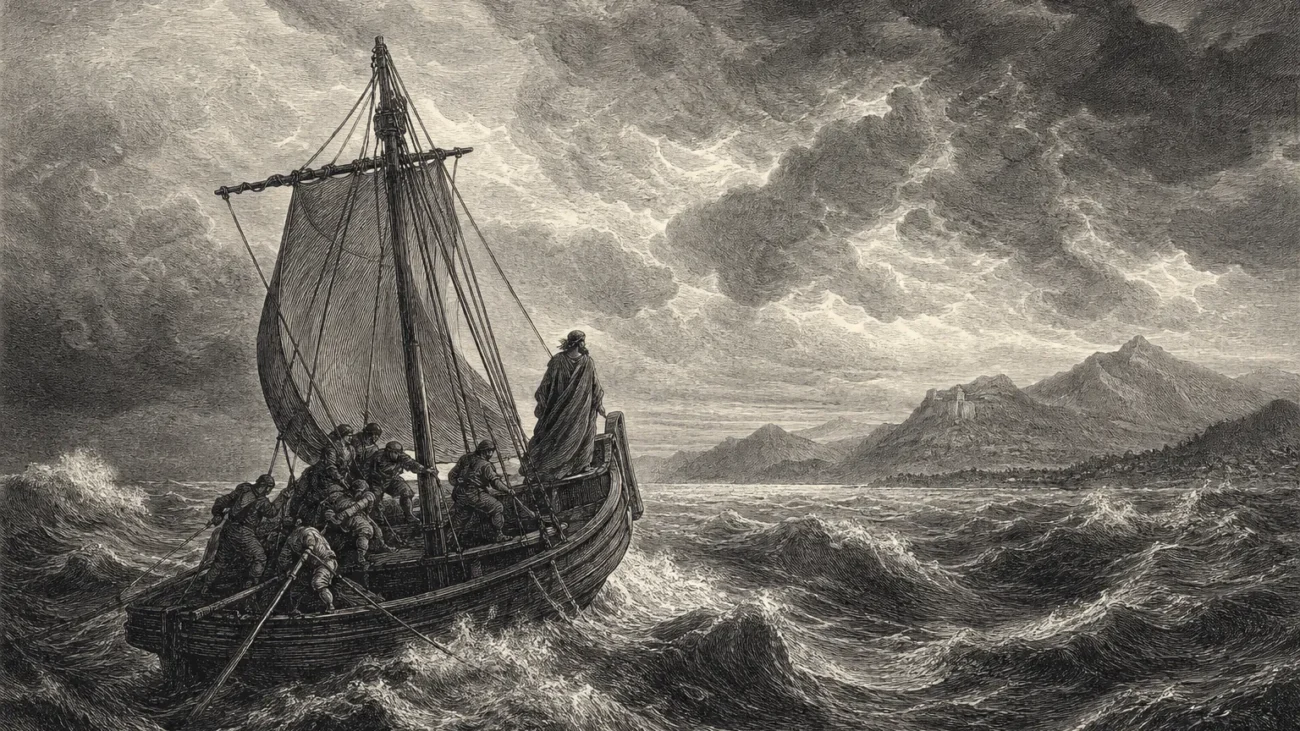
The Book of Jonah tells one of the most beloved stories in the Bible, yet its message reaches far beyond a man and a great fish. In just four chapters, it follows a prophet who runs from God, a pagan city that turns in repentance, and a Lord whose compassion surprises everyone. For believers today, this short book still speaks with fresh power. Above all, it invites us to see how wide God’s mercy really is.
Where the Book of Jonah Sits in Scripture
In the Jewish Hebrew Bible, the Book of Jonah belongs to the twelve minor prophets within the Nevi’im, or Prophets. In the Christian Old Testament, it stands as its own book of four chapters. Its hero is Jonah, son of Amittai, a Hebrew prophet whom God sends to announce the destruction of Nineveh. However, this book differs from the other minor prophets. It is almost entirely a story, broken only by the psalm in the second chapter. In fact, the actual prophetic word against Nineveh appears only in passing.
Readers have long noticed its careful craft. It has a setting, characters, a plot and themes, and it uses irony with great skill. Many people first meet it through children’s stories. Jewish communities also read it as the Haftarah portion on the afternoon of Yom Kippur, so that worshipers reflect on God’s willingness to forgive those who repent. The Quran retells the story as well.
The prophet himself appears in 2 Kings 14:25, which places his life in the reign of Jeroboam II, King of Israel (786–746 BCE). Yet the book names no king and gives no firm date. For this reason, scholars hold different views. Most date its composition long after the events, pointing to words and motifs found in postexilic Aramaic sources. Mainstream scholars generally read it as fictional and partly satirical, and Katherine Dell argues for the Hellenistic period (332–167 BCE). On the other hand, the evangelical Assyriologist Donald Wiseman questions the idea that the story is late or a parable.
Flight to Tarshish and the Great Fish
The story opens with a clear command and a surprising response:
Now the word of the LORD came unto Jonah the son of Amittai, saying, Arise, go to Nineveh, that great city, and cry against it; for their wickedness is come up before me. But Jonah rose up to flee unto Tarshish from the presence of the LORD, and went down to Joppa; and he found a ship going to Tarshish: so he paid the fare thereof, and went down into it, to go with them unto Tarshish from the presence of the LORD. (Jonah 1:1-3)
Instead of heading toward Nineveh, Jonah goes down to Joppa and boards a ship for Tarshish. Notice how the passage repeats that he went down, first to Joppa and then into the ship. Twice the verse says he fled “from the presence of the LORD.”
Soon a huge storm breaks over the sea. The sailors sense that this is no ordinary storm, so they cast lots, and the lot points to Jonah. He admits his guilt and tells them the storm will stop if they throw him overboard. At first the sailors refuse and keep rowing. Finally, when every effort fails, they cast him into the sea. As a result, the storm calms, and the sailors offer sacrifices to God.
Yet God has not let Jonah go. A great fish swallows the prophet, and he spends three days and three nights in its belly. There Jonah prays in thanksgiving and promises to pay what he has vowed. Readers have compared his prayer with several Psalms and with the Song of Hannah in 1 Samuel 2:1-10. Then God commands the fish, and it vomits Jonah out. This is one of many moments in the Book of Jonah where God works through creation to reach his servant.
Nineveh, That Great City, Turns to God
Nineveh was no small town. It stood on the eastern bank of the Tigris River, in what is now the city of Mosul in northern Iraq. It served as the capital and largest city of the Neo-Assyrian Empire, and it may have been the wealthiest city of the ancient world. Today one of its two main mounds, Tell Nabī Yūnus, holds a shrine to Jonah. In Arabic, Nabī Yūnus means “Prophet Jonah.”
In chapter 3, God speaks to Jonah a second time, and this time the prophet obeys. He walks into the city and announces that in forty days Nineveh will be overthrown. After he crosses the city, the people begin to believe his word and declare a fast. Even the king puts on sackcloth and sits in ashes. He then issues a decree calling for fasting, sackcloth, prayer and repentance.
The whole city humbles itself, and even the animals wear sackcloth. God sees their repentant hearts and spares Nineveh at that time. So in the Book of Jonah, a message of judgment becomes an open door to mercy.
The Gourd, the Worm and God’s Final Question
We might expect Jonah to rejoice. Instead, chapter 4 opens with anger, and Jonah explains why he ran away in the first place:
I pray thee, O LORD, was not this my saying, when I was yet in my country? Therefore I fled before unto Tarshish: for I knew that thou art a gracious God, and merciful, slow to anger, and of great kindness, and repentest thee of the evil. (Jonah 4:2)
Strikingly, Jonah’s complaint is a confession of who God is. He knows that the Lord is gracious, merciful, slow to anger and full of kindness. Yet that very truth troubles him. He asks God to take his life, and the Lord answers with a gentle question: “Doest thou well to be angry?” (Jonah 4:4).
Jonah then leaves the city, sits on its east side and builds a booth to watch what will happen. God prepares a gourd to shade his head, and Jonah is exceedingly glad. The next morning, however, God prepares a worm that strikes the plant, and it withers. A vehement east wind follows, the sun beats on Jonah’s head, and he faints and wishes to die. The Hebrew word for the plant is kikayon, while the King James Version calls it a gourd.
At last God draws the lesson:
Thou hast had pity on the gourd, for the which thou hast not laboured, neither madest it grow; which came up in a night, and perished in a night: And should not I spare Nineveh, that great city, wherein are more than sixscore thousand persons that cannot discern between their right hand and their left hand; and also much cattle? (Jonah 4:10-11)
The Book of Jonah ends abruptly with this question. We hear no reply from Jonah, and so the question lingers for every reader.
The Book of Jonah in the Words of Jesus
The earliest Christian readings of Jonah appear in the Gospels of Matthew and Luke. In fact, Matthew records two very similar traditions, in chapters 12 and 16. When scribes and Pharisees ask Jesus for a sign, he replies:
An evil and adulterous generation seeketh after a sign; and there shall no sign be given to it, but the sign of the prophet Jonas: For as Jonas was three days and three nights in the whale’s belly; so shall the Son of man be three days and three nights in the heart of the earth. The men of Nineveh shall rise in judgment with this generation, and shall condemn it: because they repented at the preaching of Jonas; and, behold, a greater than Jonas is here. (Matthew 12:39-41)
Here Jonah becomes a “type” of Jesus. Just as Jonah spent three days in the fish, Jesus would spend three days in the tomb. In addition, Jesus compares his own generation with the people of Nineveh. Nineveh repented at Jonah’s preaching, but many who heard one greater than Jonah did not. In this way, the Book of Jonah becomes a call to respond to Christ with an open heart.
Living the Message of the Book of Jonah
The Book of Jonah holds up a mirror to every believer. Like Jonah, we may run from what God asks, or feel uneasy when his mercy reaches people we would rather see judged. Yet the Lord who pursued his prophet across the sea also cared for more than sixscore thousand people in Nineveh, and even for its cattle.
Therefore this short book invites us to rejoice in the God whom Jonah himself called gracious, merciful and slow to anger. It also invites us to answer his final question with our lives, sharing his compassion with all peoples.
