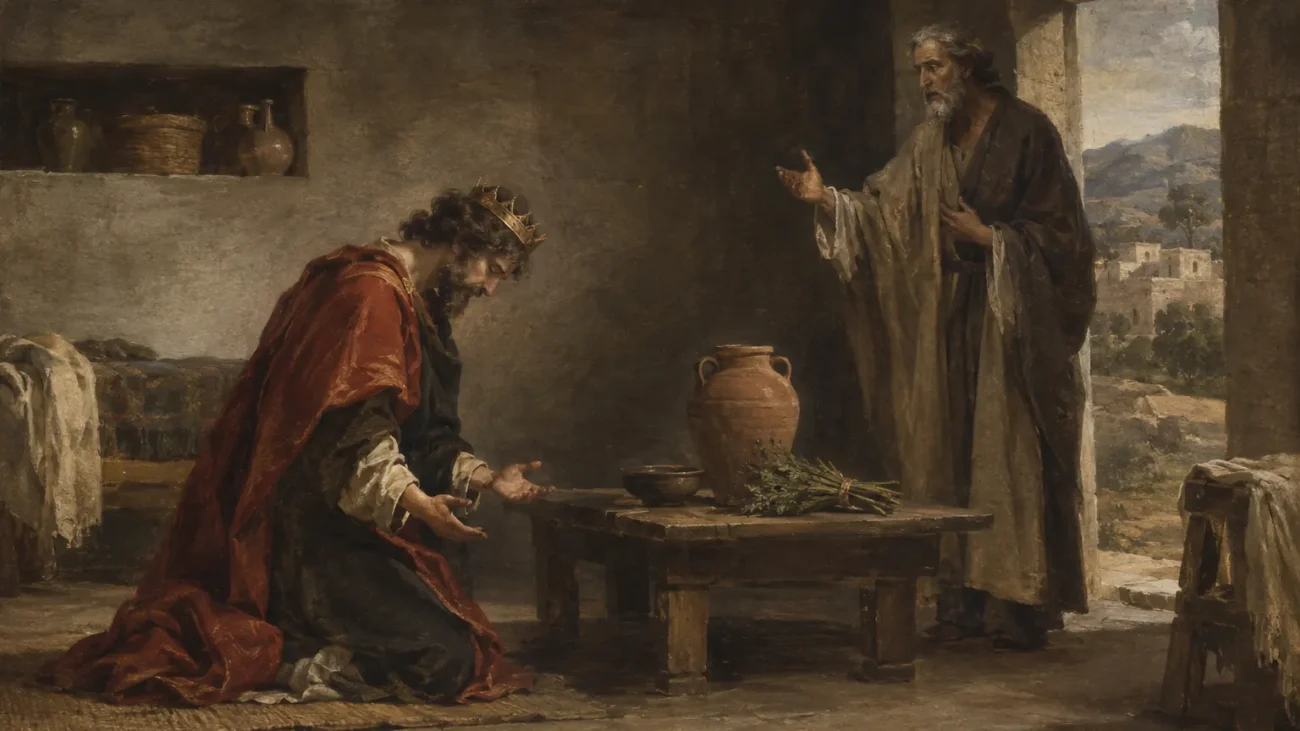
The psalm 51 meaning begins with a broken king who chose honesty over hiding. Psalm 51 is one of the penitential psalms, and its first words in the King James Version form a plea: “Have mercy upon me, O God.” The introduction to the psalm links it to David, who wrote it as a confession after he sinned with Bathsheba. For this reason, Jews and Christians alike treat his words as a model of repentance. In this article we walk through the story behind the psalm, listen to its key verses, and consider how it can shape our own prayers.
Psalm 51 Meaning Starts with Nathan’s Visit
The psalm grows out of the events in 2 Samuel 11–12. In chapter 12, the LORD sends the prophet Nathan to David. Nathan does not begin with an accusation. Instead, he tells a story about two men in one city, one rich and one poor. The rich man owned many flocks and herds. However, the poor man had only one little ewe lamb. It grew up with his children, and it was like a daughter to him.
Then a traveller came to the rich man. Yet the rich man spared his own animals and took the poor man’s lamb to feed his guest. David burned with anger. He declared that the man deserved to die and must restore the lamb fourfold, because he had no pity. Then Nathan spoke words that changed everything:
“Thou art the man.” (2 Samuel 12:7)
Nathan went on to name the sin plainly. David had killed Uriah the Hittite with the sword of the children of Ammon and had taken Uriah’s wife. The LORD had anointed him king and given him so much, and still David despised His commandment. In addition, Nathan announced that the sword would never depart from David’s house. So the psalm 51 meaning rests on a real story of real failure.
From Hidden Sin to Honest Confession
David’s response is short and striking. He did not argue, blame or explain. Instead, he said, “I have sinned against the LORD.” Nathan answered at once: “The LORD also hath put away thy sin; thou shalt not die.” (2 Samuel 12:13)
This exchange helps unlock the psalm 51 meaning. The same honesty that David showed before Nathan fills the psalm itself. David writes, “For I acknowledge my transgressions: and my sin is ever before me” (Psalm 51:3). In other words, he stops hiding. The LORD had pointed out that David acted secretly. Confession, then, brings into the open what David once tried to conceal.
Jewish tradition also draws a lesson from this. Midrash Tehillim teaches that a person who admits sin, fears, and prays to God as David did will find forgiveness. However, anyone who ignores sin faces God’s punishment. The Talmud, in Yoma 86b, uses verse 3 to remind the penitent to stay watchful in the very area where they fell, even after forgiveness.
Psalm 51 Meaning in David’s Cry for Mercy
The psalm opens not with David’s merit but with God’s character. David appeals to God’s lovingkindness and to “the multitude of thy tender mercies” (Psalm 51:1). He asks God to blot out his transgressions, to wash him thoroughly, and to cleanse him from sin. So the first word of the prayer is mercy, and the ground of hope is God’s own heart.
Next, David names the true direction of his sin: “Against thee, thee only, have I sinned, and done this evil in thy sight” (Psalm 51:4). He admits that God is just when He speaks and clear when He judges. In fact, the New Testament takes up this verse, since Romans 3:4 quotes it. David even looks back to his beginnings and confesses that he was “shapen in iniquity” (Psalm 51:5). Yet he also knows that God desires truth in the inward parts (Psalm 51:6). For this reason, the psalm 51 meaning always pairs honest confession with trust in God’s mercy.
A Clean Heart and a Right Spirit
At the center of the psalm stands a famous request:
“Create in me a clean heart, O God; and renew a right spirit within me.” (Psalm 51:10)
Here the psalm 51 meaning deepens. David asks for more than a clean record. Above all, he asks God to create something new inside him. Earlier he prays, “Purge me with hyssop, and I shall be clean: wash me, and I shall be whiter than snow” (Psalm 51:7). At the first Passover, God’s people used hyssop to smear blood on the lintels, so the image carries rich meaning.
David also longs for joy again. He asks God to let him hear joy and gladness, so that the bones God has broken may rejoice (Psalm 51:8). Then he pleads with God not to cast him away from His presence or take His holy spirit from him (Psalm 51:11). Finally, he asks God to restore the joy of salvation and uphold him with a free spirit (Psalm 51:12). As a result, repentance in David’s prayer ends not in gloom but in restored gladness.
How Believers Have Prayed Psalm 51 Through the Ages
Because the psalm 51 meaning is so clear about returning to God, believers have prayed it for centuries. Charles Spurgeon wrote that people call it “The Sinner’s Guide”, since it shows a sinner the way back to God’s grace. Athanasius of Alexandria advised some of his disciples to recite it each night. According to James Montgomery Boice, Thomas More and Lady Jane Grey both recited it at their executions.
The psalm also lives on in worship. In the Greek Septuagint and Latin Vulgate it is Psalm 50, and Latin speakers call it the Miserere. Jewish liturgy uses several of its verses, and the line “O Lord, open my lips” introduces the Amidah in every prayer service. Similarly, the Eastern Orthodox Church reads it several times every day. The Coptic Church prays it at every office of the Agpeya. Many churches also read parts of it on Ash Wednesday.
Living the Psalm 51 Meaning Today
The psalm 51 meaning is good news for anyone who has failed. David did not wait until he felt worthy. Instead, he came to God with the truth and asked for mercy. Nathan’s words show that God was ready to put away his sin.
So this psalm invites us to stop hiding and to name our sins honestly before the Lord. It also encourages us to ask for more than relief. Like David, we can pray for a clean heart, a right spirit and the return of joy. The psalm reminds us that God desires truth in the inward parts, and it teaches us to answer that desire with honest, hopeful prayer.
