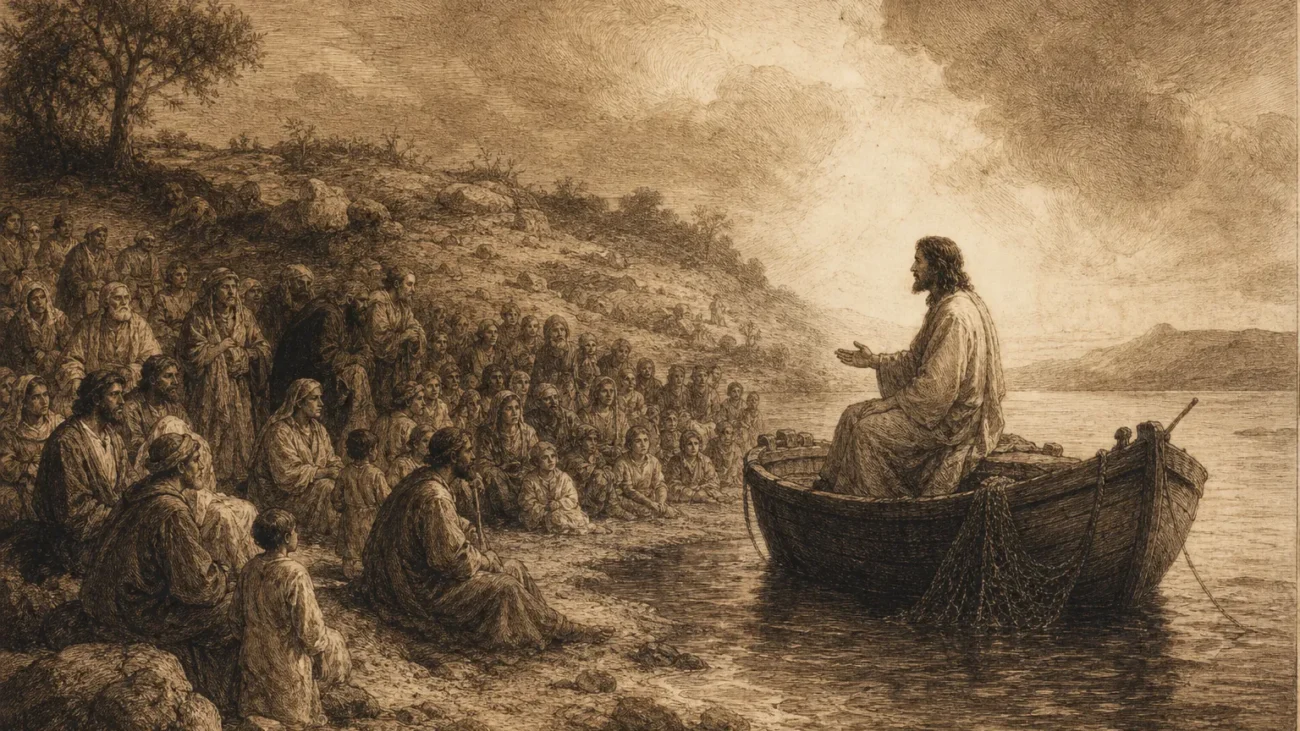
The parable of the sower is a story Jesus told, and Mark 4:1-20 keeps both the story and Jesus’ own explanation of it. In a few lines, Jesus describes a farmer, scattered seed and four kinds of ground. Then, alone with his followers, he opens up its meaning. Above all, the story asks each listener about the condition of the heart. So let us walk through the passage slowly, listening as the first disciples did.
A Teacher by the Sea
Mark sets the scene beside the water. Jesus began to teach by the sea side, and a great multitude gathered around him. In fact, the crowd grew so large that he stepped into a ship and sat in it on the sea. Meanwhile, the whole multitude stood on the land by the shore. From this floating pulpit, he taught them many things by parables (Mark 4:1-2).
Jesus begins with a call to attention: “Hearken; Behold, there went out a sower to sow” (Mark 4:3). Before any detail of the story, he asks people to listen. This story is about hearing, and about what happens after we hear.
Four Soils in the Parable of the Sower
In the parable of the sower, the farmer scatters his seed, and it lands in four places. First, some falls by the way side, and the birds come and devour it. Next, some lands on stony ground with little earth. It springs up quickly because the soil has no depth. However, when the sun rises, the heat scorches it, and it withers because it has no root.
Then some seed falls among thorns. The thorns grow up and choke it, so it yields no fruit. Finally, other seed falls on good ground. There it springs up, increases and brings forth fruit, some thirty, some sixty and some a hundred (Mark 4:4-8). Jesus then closes with a solemn invitation: “He that hath ears to hear, let him hear” (Mark 4:9).
Why Jesus Spoke in Parables
Later, when Jesus was alone, the people around him, together with the twelve, asked him about the parable. His answer is striking. He tells them that it is given to them to know the mystery of the kingdom of God. Yet for those outside, everything comes in parables (Mark 4:10-11).
Jesus also describes outsiders who see but do not perceive, and who hear but do not understand (Mark 4:12). Then he asks his disciples a pointed question: “Know ye not this parable? and how then will ye know all parables?” (Mark 4:13). With that question, Jesus ties this parable to all the others.
Jesus Explains the Parable of the Sower
Jesus gives the interpretation himself, beginning with a short sentence: “The sower soweth the word” (Mark 4:14). The seed is the word, and the soils are the people who hear it. First, the way side pictures those who hear, but Satan comes immediately and takes away the word sown in their hearts (Mark 4:15).
Next, the stony ground stands for people who receive the word at once with gladness. Yet they have no root in themselves, so they endure only for a time. Then, when affliction or persecution arises because of the word, they immediately are offended (Mark 4:16-17).
Similarly, the thorny ground describes those who hear the word, but other things crowd it out. The cares of this world, the deceitfulness of riches and the lusts of other things entering in choke the word, and it becomes unfruitful (Mark 4:18-19). Finally, the good ground pictures those who hear the word, receive it and bring forth fruit, some thirtyfold, some sixty and some a hundred (Mark 4:20).
Cultivating Good Soil Today
The parable of the sower does not leave us as mere observers. Instead, it holds up a mirror. Notice that every soil hears the word. The difference lies in what happens next. So the passage gently invites us to ask which ground best describes our own hearts this week.
The story also names real dangers. For example, the shallow heart welcomes the word with gladness but has no root for hard days. In addition, the crowded heart lets the cares of this world and the deceitfulness of riches choke the word. Jesus’ words encourage us to let the word sink deep and to clear away the thorns that compete for our attention.
Above all, Jesus describes the good soil with three simple verbs: they hear, they receive and they bring forth fruit. That pattern offers a humble path for daily faith. We can open Scripture with attentive ears and welcome what it says.
A Fruitful Heart and the Parable of the Sower
Scripture makes clear that God still plants a garden for himself, a kingdom of priests who display his rule in the world. In that light, the parable of the sower becomes an invitation. The sower keeps scattering the word.
So take heart. The harvest Jesus describes is thirtyfold, sixtyfold and a hundredfold. May we hear his call, “He that hath ears to hear, let him hear” (Mark 4:9), and may our hearts become good ground for his word.
