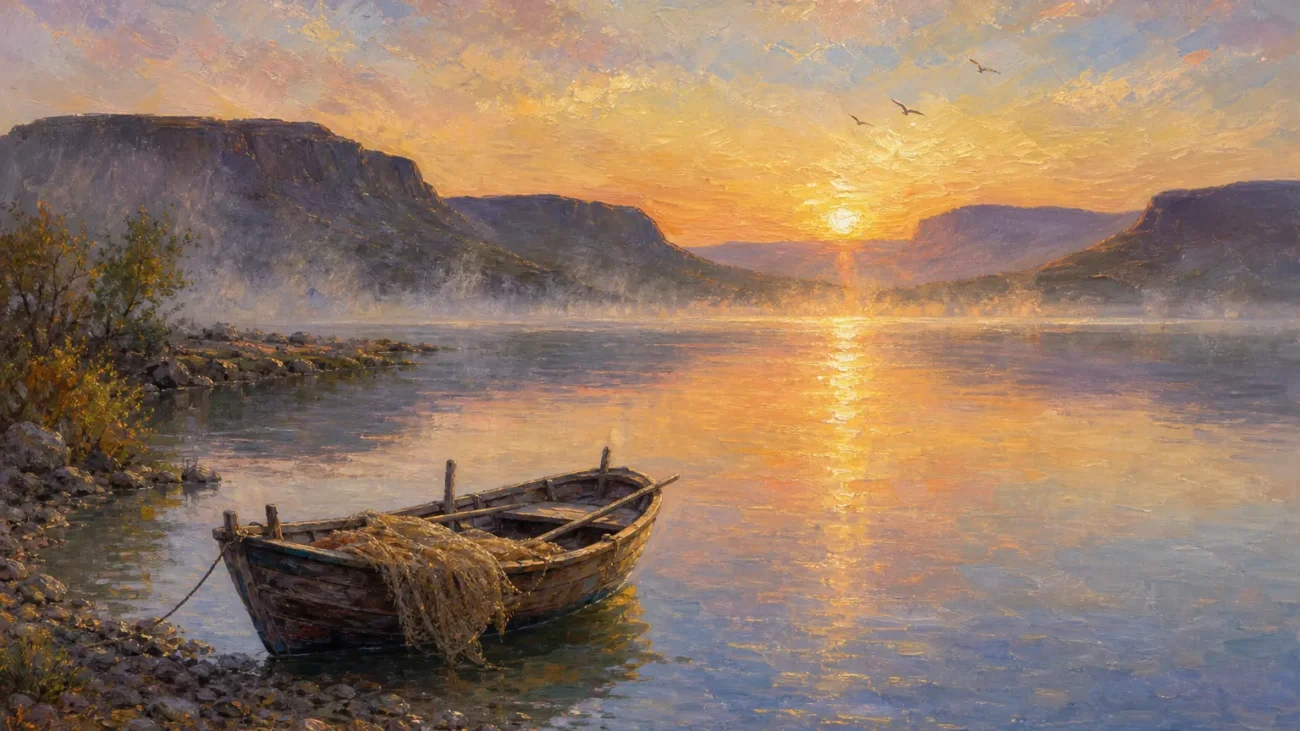
The Sea of Galilee holds a cherished place in the Gospel story. On its shores, Jesus met ordinary fishermen and invited them to follow him. In another passage of Mark, he spoke to a raging storm at sea, and the wind ceased. Yet this lake is also a real place, with real hills, real boats and a long history. In this article, we explore the geography of the lake and the fishing life described there. We also look at two moments from the Gospel of Mark that still speak to believers today.
Where the Sea of Galilee Lies
The Sea of Galilee is a freshwater lake in northeast Israel. It sits between the Golan Heights and the Galilee region, inside the Jordan Rift Valley. The relative motion of the African and Arabian plates formed this valley. As a result, the area is subject to earthquakes and, in the past, volcanic activity. Abundant basalt and other igneous rocks define the geology of Galilee.
The lake is remarkable for how far below sea level it lies. In fact, it is the lowest freshwater lake on Earth. Only the Dead Sea, a salt lake, lies lower. Depending on rainfall, its elevation fluctuates between 215 and 209 metres below sea level. The lake measures about 21 km long and 13 km wide, with a circumference of roughly 53 km. At its fullest it covers 166.7 square kilometres, and its maximum depth is approximately 43 metres.
Water comes partly from underground springs. However, the main source is the Jordan River, which flows through the lake from north to south. The Degania Dam controls the outflow.
Many Names for One Lake
Readers of Scripture may notice that the lake goes by several names. The Hebrew Bible calls it the “sea of Kineret” in Numbers 34:11 and Joshua 13:27. A persistent, though likely erroneous, popular etymology links this name to the Hebrew word kinnor, “harp” or “lyre,” because of the lake’s shape. The scholarly consensus, however, derives it from the ancient city of Kinneret, excavated at Tell el-‘Oreimeh. That city may itself have been named after the body of water.
In the New Testament, the writers use the term “sea,” with one exception. Matthew 4:18 and Mark 1:16 both speak of the sea of Galilee. Luke, by contrast, calls it “the Lake of Gennesaret” (Luke 5:1). The word Galilee itself comes from the Hebrew Haggalil, which literally means “The District,” a compressed form of “The District of Nations” (Isaiah 8:23).
Another name arose later. In 16 CE, the city of Tiberias was founded on the western shore in honour of the Roman emperor Tiberius. Some time after that, the lake started to be called the Sea of Tiberias. John 6:1 describes it as “the sea of Galilee, which is [the sea] of Tiberias.” In English, Lake Genezareth serves as an alternative name, and the lake is also called Lake Tiberias.
Fishing Life on the Sea of Galilee
In the Hellenistic and Roman periods, the Sea of Galilee lay on the ancient Via Maris, a route that linked Egypt with the northern empires. Greeks, Hasmoneans and Romans founded flourishing towns and settlements on the lake, including Hippos and Tiberias.
Fishing was a thriving industry here. The contemporary Roman–Jewish historian Flavius Josephus reported a thriving fishing industry, with 230 boats regularly working in the lake. He was so impressed by the area that he wrote, “One may call this place the ambition of Nature.” In addition, archaeologists discovered one such boat in 1986. It is nicknamed the Jesus Boat.
These details help us picture the world of the Gospels. In Mark’s account, nets, boats, a father and hired servants appear by the shore. When Jesus walked along the shore, he met fishermen at work.
Jesus Calls Fishermen by the Shore
Mark describes the moment Jesus called his first disciples beside the Sea of Galilee with striking simplicity:
“Now as he walked by the sea of Galilee, he saw Simon and Andrew his brother casting a net into the sea: for they were fishers. And Jesus said unto them, Come ye after me, and I will make you to become fishers of men. And straightway they forsook their nets, and followed him.” (Mark 1:16-18)
Simon and Andrew were casting a net into the sea. Then Jesus spoke an invitation that drew on their own trade: he would make them “fishers of men.” Their response came straightway, and they forsook their nets.
A little farther along, Jesus saw two more brothers:
“And when he had gone a little farther thence, he saw James the son of Zebedee, and John his brother, who also were in the ship mending their nets. And straightway he called them: and they left their father Zebedee in the ship with the hired servants, and went after him.” (Mark 1:19-20)
James and John were in the ship mending their nets, and their father Zebedee was there with the hired servants. When Jesus called, they too left and went after him. Their example invites us to listen for his voice in the middle of our own daily tasks.
A Storm at Sea in Mark’s Gospel
Later in Mark’s Gospel, a dramatic evening unfolds at sea. Jesus told his disciples, “Let us pass over unto the other side” (Mark 4:35). They sent away the multitude and took him in the ship, with other little ships with him. Then a great storm of wind arose, and the waves beat into the ship, so that it was now full.
“And he was in the hinder part of the ship, asleep on a pillow: and they awake him, and say unto him, Master, carest thou not that we perish? And he arose, and rebuked the wind, and said unto the sea, Peace, be still. And the wind ceased, and there was a great calm.” (Mark 4:38-39)
While the storm raged, Jesus was asleep on a pillow in the hinder part of the ship. The disciples woke him and asked whether he cared that they were perishing. Then, with a few words, he brought a great calm to the sea.
Jesus then asked them, “Why are ye so fearful? how is it that ye have no faith?” (Mark 4:40). The disciples feared exceedingly and said one to another, “What manner of man is this, that even the wind and the sea obey him?” (Mark 4:41).
Peace on Troubled Waters
The Sea of Galilee is a real lake, set in the Jordan Rift Valley, where Josephus reported 230 boats regularly working. On its shore, Jesus invited working fishermen to follow him, and they left their nets straightway. In another passage, on a storm-tossed sea, he said, “Peace, be still,” and the wind ceased.
These passages encourage us to answer his call with the same readiness. They also invite us to bring our fears to him when the storms of life rise. Above all, they lead us to the disciples’ own question, and to trust the One whom even the wind and the sea obey.
