The Lord’s Prayer is the prayer Jesus gave his followers, and believers still pray it in homes and churches around the world. Many know it by its opening words, the Our Father. In Greek it begins Páter hēmôn, and in Latin Pater Noster. Its petitions turn first to God’s holiness, will and kingdom. Then they turn to our own needs. In this article we walk through the prayer line by line. We also compare the versions in Matthew and Luke, and we close with ways to pray it devotionally today.
Where Jesus Taught the Lord’s Prayer
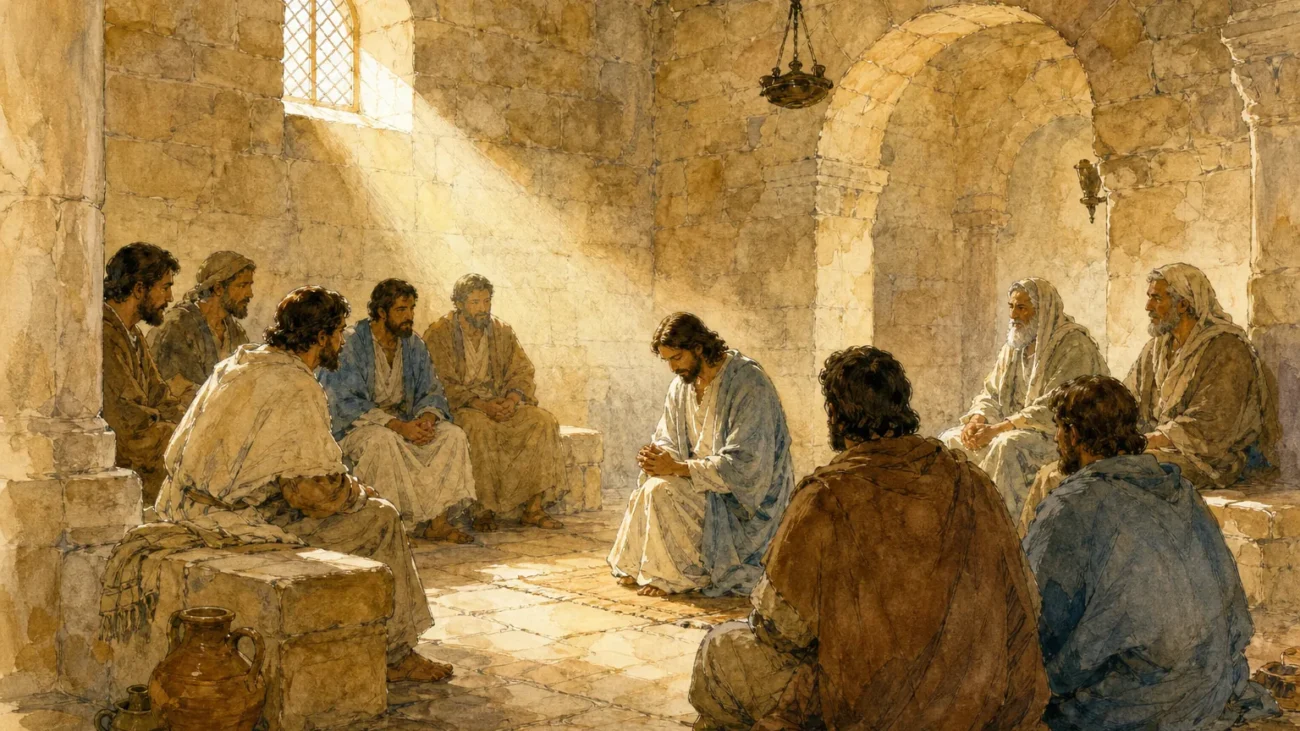
Two Gospels record the prayer, and each frames it a little differently. Luke sets it in a moment after Jesus himself had been praying. When he ceased, one of the disciples asked for help:
“And it came to pass, that, as he was praying in a certain place, when he ceased, one of his disciples said unto him, Lord, teach us to pray, as John also taught his disciples.” (Luke 11:1)
Matthew, by contrast, introduces the prayer with the words “After this manner therefore pray ye” (Matthew 6:9). Theologians broadly view the Lord’s Prayer as a model as well as a prayer. Most scholars regard it as coming authentically from the historical Jesus. For example, Dale Allison and John P. Meier are both confident that Jesus composed it.
Our Father, His Name, His Kingdom and His Will
The prayer opens not with a request but with God himself. Matthew records these first lines:
“Our Father which art in heaven, Hallowed be thy name. Thy kingdom come. Thy will be done in earth, as it is in heaven.” (Matthew 6:9-10)
In Matthew, the first three of the seven petitions address God. The other four are related to human needs and concerns. Most of the Greek verbs are aorist imperatives. In the first part of the prayer, they are third person passive imperatives.
Theologians broadly see the Lord’s Prayer as a model that aligns the soul with God’s will. It emphasizes praise, trust and ethical living. When we pray “Thy will be done,” we can let these words shape our own hearts. Like the prayer itself, we can begin by honoring the Father before we ask for anything.
Daily Bread and Forgiveness in the Lord’s Prayer
Next, the prayer turns to our most basic needs. Matthew writes, “Give us this day our daily bread” (Matthew 6:11). Luke words it slightly differently: “Give us day by day our daily bread” (Luke 11:3). Both original Greek texts use the adjective epiousion here. Its translation is controversial, yet “daily” has been the most common English translation. Interestingly, the Latin Vulgate text reads supersubstantialem.
Then comes the petition for forgiveness. Matthew records, “And forgive us our debts, as we forgive our debtors” (Matthew 6:12). Luke instead says, “And forgive us our sins; for we also forgive every one that is indebted to us” (Luke 11:4). In both versions, the request for forgiveness is joined to our own forgiving of others. This line of the Lord’s Prayer can gently lead us to look at our own hearts. Is there someone we still need to forgive?
Temptation, Deliverance and the Closing Doxology
The prayer then asks for protection: “And lead us not into temptation, but deliver us from evil” (Matthew 6:13). Here the grammar shifts. In the last part of the prayer, the verbs are second person active imperatives. In addition, the line “Lead us not into temptation” carries its own theological nuance. It has no direct counterpart in the Old Testament.
Many Christians finish the Lord’s Prayer with words of praise. The King James text of Matthew ends, “For thine is the kingdom, and the power, and the glory, for ever. Amen” (Matthew 6:13). However, this doxology is a later addition found in some manuscripts of Matthew. Protestants usually conclude with it. The Eastern Orthodox version adds a Trinitarian ending: “of the Father, and of the Son, and of the Holy Spirit, now and ever, and unto the ages of ages. Amen.” Similarly, the first-century text Didache, in chapter VIII, gives a version closely resembling Matthew’s that ends with the Minor Doxology. The Vulgate, on the other hand, does not include the doxology.
Comparing Matthew and Luke
The two Gospel versions share the same heart, yet they differ in length and wording. Matthew’s prayer is fuller, with seven petitions and, in the King James text, the closing doxology. Luke’s version opens with the disciple’s request and, in the King James text, has no doxology. Also, Luke speaks of “sins” where Matthew speaks of “debts.” In the King James wording, both Gospels include “Thy will be done” and “deliver us from evil.” Yet in modern translations such as the NIV, only Matthew’s account includes these two petitions.
Scholars still debate how the two forms relate. Some suggest Jesus spoke more than one version. Supporters of the two-source hypothesis trace both to Q. Martin Dibelius and Joachim Jeremias gave priority to Luke, on the grounds that in the early period liturgical texts were elaborated, expanded and enriched. Instead, Michael Goulder, Thomas J. Mosbo and Ken Olson see Luke’s shorter form as a reworking of Matthew. Whatever the answer, with few exceptions the liturgical form used in worship is Matthew’s version.
Praying the Lord’s Prayer Today
How can we pray the Lord’s Prayer with fresh hearts? First, try praying it slowly, one line at a time. Pause after each petition and let it shape your own words. For example, after “Hallowed be thy name,” spend a moment simply praising God. After “our daily bread,” name the needs of this day.
Then, use the prayer as a pattern, following the words “After this manner therefore pray ye.” Begin with God’s name, kingdom and will, and only then bring your requests. Finally, remember that you never pray it alone. Most Christian denominations use it in worship. It has also been set to music, from 9th-century Gregorian chant to modern works by Christopher Tin. In fact, English translations go back to around AD 650. The Catechism of the Catholic Church calls it “truly the summary of the whole gospel.”
The disciple in Luke asked simply, “Lord, teach us to pray.” Jesus answered with words we can still carry into every day. The Lord’s Prayer leads us to ask the Father for daily bread, forgiveness and deliverance from evil, and to pray that his will be done.
