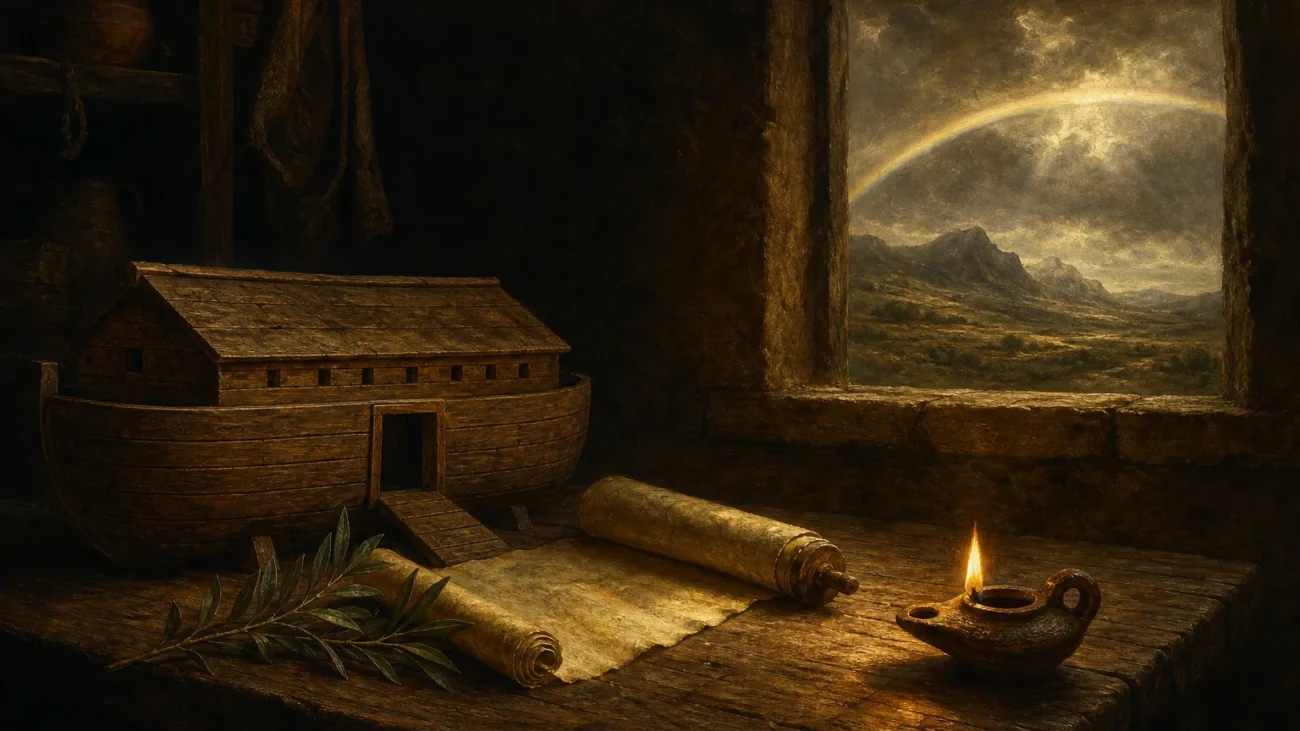
The story of Noah and the rainbow is one of the best-loved accounts in the whole Bible. It fills chapters 6 to 9 of Genesis, the first book of Scripture. In these chapters, God judges a violent world. Yet he also saves Noah, his family and pairs of every land animal in an ark. Then, when the waters are gone, God makes a covenant and sets his bow in the cloud as its sign. In this article we walk through the story step by step. We also look at the ancient world behind the account, because that setting helps us hear its message more clearly.
Why Noah and the rainbow begin with a corrupt world
The story opens ten generations after the creation of Adam. God saw that the earth was corrupt and full of violence. Indeed, every intention of the human heart was only evil, all the time. So God decided to destroy what he had made. Yet he found one righteous man, Noah, and he shared his plan with him.
“And God said unto Noah, The end of all flesh is come before me; for the earth is filled with violence through them; and, behold, I will destroy them with the earth.” (Genesis 6:13)
Notice that the reason for the flood is moral. In the Hebrew account, the flood brings God’s judgment on wicked humanity. However, the same chapter already hints at grace. Before a single drop of rain falls, God speaks of a covenant: “But with thee will I establish my covenant” (Genesis 6:18). In other words, the story of Noah and the rainbow carries hope from its very first scene.
Building the ark with wood, pitch and three stories
God gives Noah precise instructions. First, Noah must use gopher wood, make rooms inside, and cover the ark with pitch inside and out. Next, God sets the size: three hundred cubits long, fifty wide and thirty high. That comes to roughly 134 by 22 by 13 meters. The ark also needs a window, a door in the side, and lower, second and third stories (Genesis 6:14–16).
Some of the Hebrew words are rare. For example, the word for gopher wood appears nowhere else in the Bible, and it may come from the Akkadian gupru. Similarly, the word for pitch likely comes from the Akkadian kupru, meaning bitumen. The Hebrew word for the ark, tevah, has only one other use in the Bible. It describes the rush basket of Moses. So the same word belongs to two stories of rescue on the water.
Noah then gathers his family: his wife, his sons and his sons’ wives. He also brings two of every kind of living creature, male and female, along with food for all of them. The chapter closes with a simple verdict on his obedience:
“Thus did Noah; according to all that God commanded him, so did he.” (Genesis 6:22)
For anyone reading Noah and the rainbow, this quiet obedience prepares the way for the promise that follows.
The flood rises and the waters go down
Noah enters the ark in his six hundredth year. On the 17th day of the second month, the fountains of the great deep burst open and the floodgates of heaven break. Rain then falls for forty days and forty nights. In the end, the waters cover the highest mountains to a depth of 15 cubits. All life perishes except Noah and those with him.
Then the turning point comes. After 150 days, God remembers Noah, and the waters begin to fall. The ark comes to rest on the mountains of Ararat. Noah sends out birds to test the land, and the text mentions both a raven and a dove. Finally, on the 27th day of the second month of his six hundred and first year, the earth is dry. Numbers in the Bible often carry symbolic meaning, and the forty days point to a complete cycle. Also, in the story of Noah and the rainbow, remembering is a key idea, as we will soon see.
Noah and the rainbow: the token of the covenant
Once Noah leaves the ark, he builds an altar and offers a sacrifice. Then God makes a covenant with him. Under its terms, people may eat every living thing, but not its blood. Above all, God promises never again to destroy all life by a flood.
“And I will establish my covenant with you; neither shall all flesh be cut off any more by the waters of a flood; neither shall there any more be a flood to destroy the earth.” (Genesis 9:11)
This covenant is remarkably wide. God makes it with Noah, with his sons and with their descendants. He also includes every living creature that came out of the ark: birds, cattle and every beast of the earth (Genesis 9:8–10). In fact, the covenant reaches the whole earth. Then God gives a visible sign.
“I do set my bow in the cloud, and it shall be for a token of a covenant between me and the earth.” (Genesis 9:13)
God explains how the sign works. When he brings clouds over the earth, the bow will appear in them. And when it appears, God says he will remember his covenant (Genesis 9:14–16). Remarkably, the heart of Noah and the rainbow is that God himself will look upon the bow. He calls this promise an everlasting covenant, made for perpetual generations (Genesis 9:12, 9:16).
The ancient Near Eastern background of the story
For well over a century, scholars have compared Genesis with older flood stories from Mesopotamia. They know of nine versions. The oldest comes from the Sumerian city of Nippur, around 1600 BCE. It tells of King Ziusudra, who builds a boat and saves life. Babylonian versions call the hero Atrahasis. However, the closest parallel to Noah is Utnapishtim in the Epic of Gilgamesh.
The likenesses are striking. For example, the deck areas of the three arks are almost the same: 14,400 square cubits for Atrahasis and for Utnapishtim, and 15,000 for Noah. In addition, ancient flood texts share four common features. They describe building an ark, placing animals inside, landing on a mountain, and sending out birds to check the waters. Many scholars therefore think Genesis drew on these older traditions. Many also see two interwoven sources in the account, though some scholars question that view. Most modern scholars place the composition of Genesis around the 5th century BCE.
Yet the differences matter just as much. In the Epic of Gilgamesh, the flood has no stated reason and seems to come from divine whim. In the Atrahasis story, the gods send it to reduce overpopulation. By contrast, Genesis presents the flood as God’s judgment on human wickedness, and it ends with a covenant of mercy. Seen against this background, Noah and the rainbow speaks of a God who acts with moral purpose and binds himself by a promise.
What Noah and the rainbow teach us today
The account invites us to see both sides of God’s dealings with the world. He takes violence and evil seriously. Even so, he remembers Noah, keeps life alive, and commits himself to every living creature. Noah’s part is simple: he does all that God commands him.
So the next time clouds gather and a bow appears, we can recall Genesis 9. God said he would look upon it and remember. In other words, the promise of Noah and the rainbow rests on God’s faithfulness, not on ours. That truth invites us to trust him, to obey him as Noah did, and to give thanks for a covenant with all flesh upon the earth.
