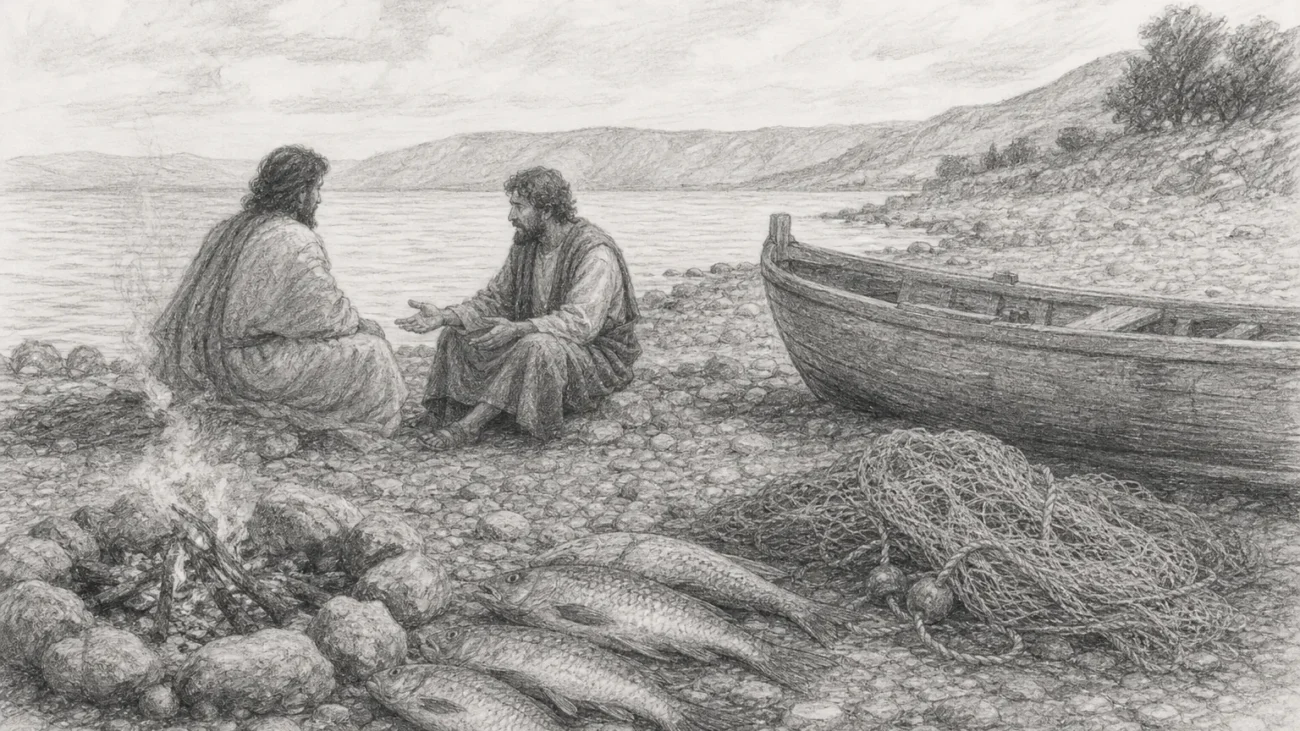
When Jesus restores Peter beside the Sea of Galilee in John 21, he answers a bitter failure with a gentle question. Peter had denied his Lord three times on the night of the arrest. Yet after the resurrection, Jesus asks him three times whether he loves him. This scene speaks to every believer who has fallen short. In fact, it shows that failure does not have to be the last word in a disciple’s story.
A Fisherman Called to Follow
Before we see how Jesus restores Peter, it helps to know who Peter was. He was a Jewish fisherman born in Bethsaida. His birth name was Simon, and his father was a man named Jonah or John. Together with his brother Andrew, he worked the nets for a living. In Matthew and Mark, Jesus calls the two brothers to leave their nets and fish for people instead.
Later, Jesus gave Simon a new name. Cephas comes from the Aramaic Kepha, meaning rock or stone, while Peter comes from the Greek Petros. Peter soon became one of the disciples most closely linked with Jesus. For this reason, his fall would hurt all the more.
Three Denials by the Fire
The story of how Jesus restores Peter begins in a cold courtyard. At the Last Supper, Jesus warned Peter that he would deny him before the rooster crowed. All four Gospels record this prediction. Peter, however, insisted that he would stay loyal even if it cost him his life. Then, later that night, the captors seized Jesus. They led him into the high priest’s house, and Peter followed at a distance.
In the hall, people kindled a fire, and Peter sat down among them. First, a servant girl stared at him and said he had been with Jesus. Peter replied, “Woman, I know him not” (Luke 22:57). Then another person accused him, and again he denied it. About an hour later, someone else insisted that Peter was a Galilean. So Peter claimed a third time that he did not understand the man.
The pressure grew with each challenge. The accusers moved from one maid, to a maid and a bystander, and finally to a whole crowd. Peter’s answers also hardened, from a plea of ignorance to oaths and curses.
The Look That Broke Peter’s Heart
Luke records a moment that readers can hardly forget:
“And the Lord turned, and looked upon Peter. And Peter remembered the word of the Lord, how he had said unto him, Before the cock crow, thou shalt deny me thrice. And Peter went out, and wept bitterly.” (Luke 22:61-62)
Christians often call this moment the Repentance of Peter. His tears marked the start of his road back. In addition, the number three carries weight here. The threefold denial has a superlative force, because it underlines how firmly Peter turned away.
Even so, grace was already on its way. In Mark 16:7, the angel at the tomb tells the women to bring the news of the resurrection to the disciples and to Peter by name. This tender detail prepares the way for the moment Jesus restores Peter by the sea.
Breakfast by the Sea: Jesus Restores Peter
After the resurrection, John still shows Peter fishing, and he tells of a remarkable catch of 153 fish. Then, once the disciples had eaten, Jesus turned to Peter. In this quiet scene, Jesus restores Peter through a simple conversation.
“So when they had dined, Jesus saith to Simon Peter, Simon, son of Jonas, lovest thou me more than these? He saith unto him, Yea, Lord; thou knowest that I love thee. He saith unto him, Feed my lambs.” (John 21:15)
Jesus asked a second time, and Peter gave the same answer. Then Jesus told him, “Feed my sheep” (John 21:16). The third time, the question cut deep. John says that Peter felt grieved because Jesus asked him a third time. So Peter answered with complete honesty: “Lord, thou knowest all things; thou knowest that I love thee” (John 21:17).
Why Jesus Restores Peter with Three Questions
The link between the two scenes is clear. Peter’s triple denial prompted the three questions by the sea. In other words, each question on the shore answers one of the denials by the fire.
At first, Peter seems to have heard the questions as a rebuke. Jesus even used his old name, Simon, which may have added to the sting. Later, however, Christians came to see the scene as a redemptive act. Jesus gave Peter the chance to declare his love publicly, just as he had once denied him publicly. So when Jesus restores Peter, he does not ignore the failure. Instead, he heals it.
Feed My Sheep, Follow Me
Notice also what Jesus gives Peter after each answer. Jesus restores Peter not only to friendship but also to work. He tells him to feed his lambs and then, twice, to feed his sheep. As a result, the man who had failed now receives the care of Christ’s flock.
Then Jesus speaks about Peter’s future. When Peter was young, he dressed himself and went wherever he wished. One day, though, he would stretch out his hands, and another would dress him and take him where he did not want to go. John explains that Jesus meant the kind of death by which Peter would glorify God (John 21:19). According to Christian tradition, Peter died in Rome under Emperor Nero, crucified upside down.
Finally, Jesus closes with two simple words: “Follow me” (John 21:19). The same call that began Peter’s journey now renews it.
What It Means That Jesus Restores Peter
The way Jesus restores Peter invites us to bring our own failures to him. Jesus did not ask Peter to prove himself first. Instead, he met him after a meal and asked about love. Love, not past success, became the ground of Peter’s new service.
Perhaps you have also said “I know him not” with your words or actions. Yet the question Jesus asked Peter still invites an honest answer. Like Peter, we can say, “thou knowest that I love thee.” Then we can rise, care for others and follow him again.
