The prodigal son parable is one of the parables of Jesus in the Bible, and it appears in Luke 15:11–32. Readers also know it as the parable of the Two Brothers, the Lost Son, the Loving Father or the Forgiving Father. The story tells of a father who welcomes home a son who had wandered to a far country. So in this article we walk through the prodigal son parable, its setting, and how it has been read.
The prodigal son parable among the parables of the lost
Jesus did not tell this story in isolation. In Luke 15, a group of Pharisees and religious leaders criticized him because he welcomed tax collectors and others seen as sinners. He even ate with them. In reply, Jesus told three stories. First came a man with 100 sheep, then a woman with ten coins, and finally a father with two sons.
The prodigal son parable is the third and final story in a cycle about loss and redemption. It follows the parables of the Lost Sheep and the Lost Coin. In addition, it is read in worship. The Revised Common Lectionary and the Roman Rite Catholic Lectionary set it for the fourth Sunday of Lent in Year C. Similarly, the Eastern Orthodox Church reads it on the Sunday of the Prodigal Son.
A younger son in a far country
The story opens simply: “A certain man had two sons” (Luke 15:11). This opening was a storyteller’s trope. It would have brought to mind Cain and Abel, Ishmael and Isaac, and Jacob and Esau. However, Jesus then confounds his listeners’ expectations, because the younger son is shown to be foolish.
The younger son asks for his share of the estate right away, and the father divides his living between his sons. A number of commentators read the request as brash, even insolent, and tantamount to wishing that the father were dead. Yet the Jewish legal scholar Bernard Jackson notes that Jewish sources give no support to that idea. Either way, the son leaves. He “took his journey into a far country, and there wasted his substance with riotous living” (Luke 15:13).
Then a mighty famine strikes the land. The young man joins himself to a citizen of that country, who sends him to feed swine. He even longs to eat the husks the pigs eat, and “no man gave unto him” (Luke 15:16). Here the prodigal son parable shows him desperately poor. This recalls Proverbs 29:3: “Whoever loves wisdom gives joy to his father, but whoever consorts with harlots squanders his wealth.” Justus Knecht also cites St. Augustine on this part of the story: the “far country”, he said, “signifies the forgetfulness of God”.
Coming to himself: repentance in the prodigal son parable
Then Scripture says the son “came to himself” (Luke 15:17). He remembers that his father’s hired servants have bread enough and to spare, while he perishes with hunger. So he prepares a speech:
I will arise and go to my father, and will say unto him, Father, I have sinned against heaven, and before thee, And am no more worthy to be called thy son: make me as one of thy hired servants. (Luke 15:18-19)
In this rehearsed speech in the prodigal son parable, the son admits his sin, declares himself unworthy to be his father’s son and asks to be made as one of the hired servants. Leviticus Rabbah 13:4 contains a short saying that matches the character of the parable: “R. Aha has said: When a Jew has to resort to carobs, he repents.” The son had come to envy the pigs for the carob pods they ate.
The father who runs to meet him
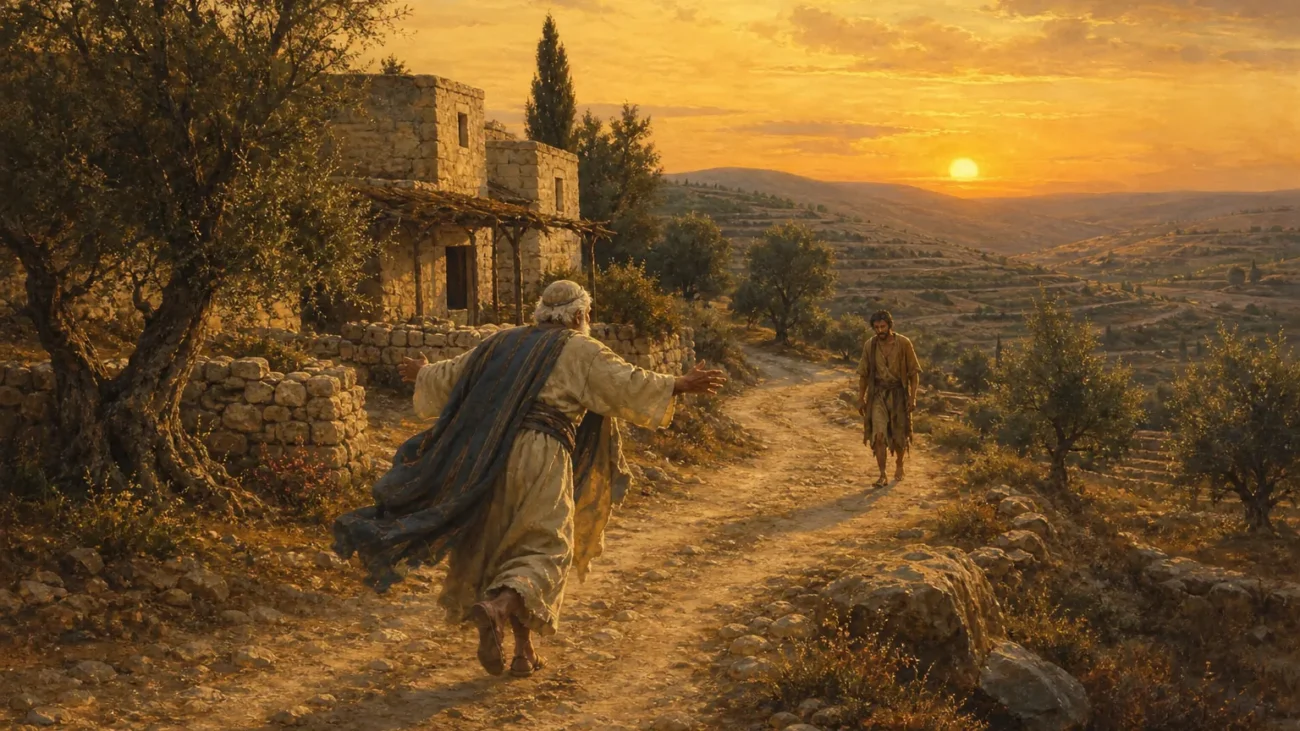
Next comes the verse: “But when he was yet a great way off, his father saw him, and had compassion, and ran, and fell on his neck, and kissed him” (Luke 15:20). The father saw his son from far off. This implies that he had been watching hopefully for his son’s return.
The son begins his rehearsed confession, but he does not finish it before his father accepts him back. The father turns to his servants. He calls for the best robe, a ring for his hand and shoes for his feet. Then he orders them to kill the fatted calf for a feast. The son is treated with a generosity far more than he had a right to expect. In the prodigal son parable, the father says: “For this my son was dead, and is alive again; he was lost, and is found” (Luke 15:24).
Jewish writers also spoke of this kind of mercy. The philosopher Philo observed that parents often do not lose thought for their wastrel children. In the same way, he said, God takes thought also for those who live a misspent life, giving them time for reformation. Similarly, the Pesikta Rabbati tells of a king’s son who had gone astray. The father sent word: “Return as far as you can, and I will come the rest of the way to you.” The father’s joy in the parable reflects “the boundless mercy of God” and “God’s refusal to limit the measure of his grace.”
The elder brother and the prodigal son parable
The story does not end with the feast. Meanwhile, the elder son had been in the field. As he drew near the house, he heard music and dancing, and a servant told him that his brother had come. He grew angry and would not go in. So the father came out and intreated him.
The elder son had his own speech: “Lo, these many years do I serve thee, neither transgressed I at any time thy commandment: and yet thou never gavest me a kid, that I might make merry with my friends” (Luke 15:29). He seems to think in terms of law, merit and reward rather than love and graciousness. In the prodigal son parable, he may represent the Pharisees who were criticizing Jesus.
The father answers him: “Son, thou art ever with me, and all that I have is thine” (Luke 15:31). He then explains that celebration was necessary: “It was meet that we should make merry, and be glad: for this thy brother was dead, and is alive again; and was lost, and is found” (Luke 15:32).
The welcoming heart of God
Some teachers, such as Justus Knecht, read the story in three parts. In his words, “The father in the parable signifies God; the elder son, the just; and the younger son, the sinner.” Seen this way, the prodigal son parable speaks of God’s dealings with both the just and the sinner.
In the story, the father sees his son from far off, runs to meet him and goes out to intreat the elder son who would not go in. The last few verses summarize the tale in accordance with the Jewish teaching of the two ways of acting: the way of life (obedience) and the way of death (sin). Above all, the prodigal son parable closes with the father’s words that the one who was lost is found.
