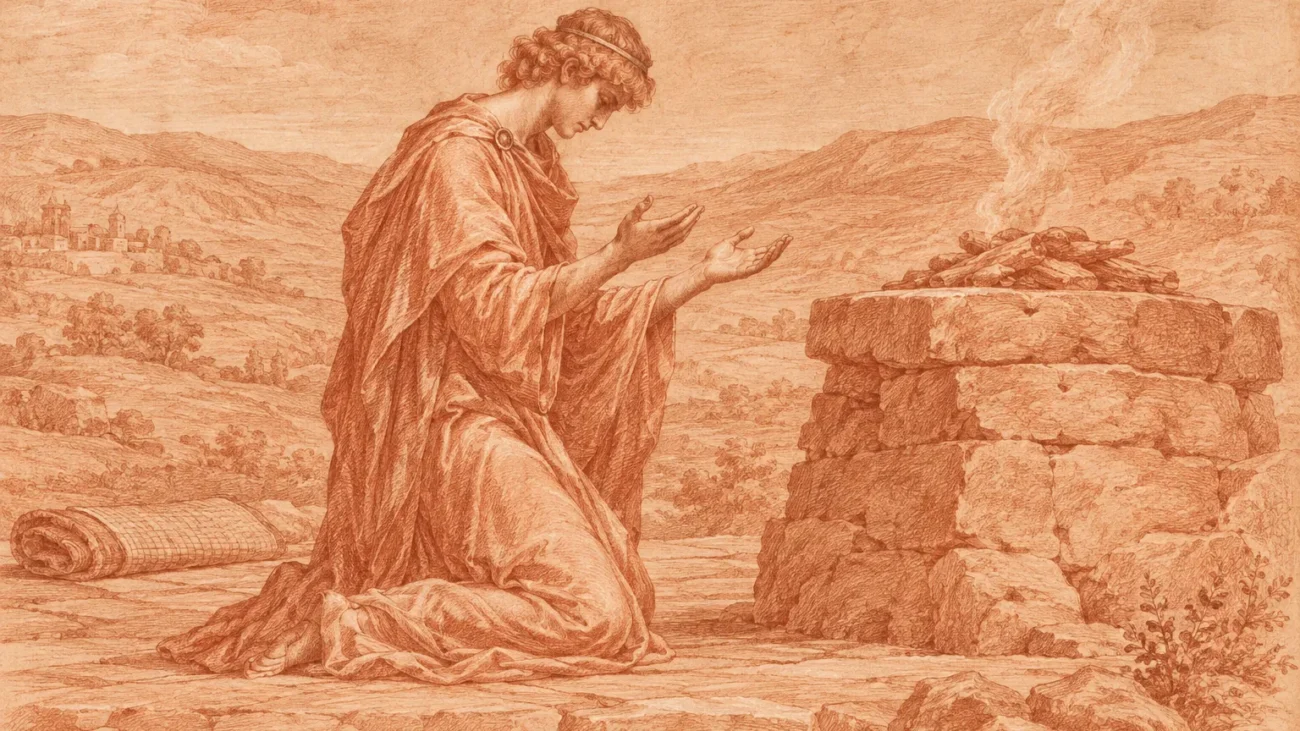
Solomon’s prayer for wisdom at Gibeon is one of the most beloved scenes in the Old Testament. In a dream by night, the LORD invited a young king to ask for anything at all. Instead of gold or a long life, Solomon asked for an understanding heart. As a result, his request has encouraged believers for generations to bring their own need for wisdom to God. In this article, we retell the story from 1 Kings 3, look at how God responded, and consider what this prayer teaches us about our own prayers.
A Young King on David’s Throne
Solomon was the son of King David and Bathsheba, and he was born in Jerusalem. Tradition takes his name to mean “peaceful.” He also carried a second name, Jedidiah, understood as “friend of God.” Yet his path to the throne was not simple. When David grew old, rival groups at court struggled for power. Adonijah, David’s heir apparent, tried to make himself king. However, Bathsheba and the prophet Nathan persuaded David to proclaim Solomon instead, even though Solomon was younger than his brothers.
Some accounts say Solomon came to the throne when he was only about fifteen. In other words, he carried the weight of a whole nation while still very young. He also followed a famous father whose shoes were hard to fill. For this reason, the new king had good reason to feel his own weakness. Knowing this background helps us understand Solomon’s prayer for wisdom and the humility behind it.
The Night at Gibeon: God’s Open Offer
The story begins with worship. Solomon offered sacrifices to God, and afterward the LORD came to him in a dream. Scripture sets the scene simply:
“In Gibeon the LORD appeared to Solomon in a dream by night: and God said, Ask what I shall give thee.” (1 Kings 3:5)
The offer is remarkable because it has no limits. God does not hand Solomon a list of options. Instead, He invites him to name his deepest desire. So the question quietly tests the heart of the new king. What a person asks for, when anything seems possible, reveals what he truly values.
Solomon could have chosen many things. In fact, God Himself later names some of them: long life, riches, and the life of his enemies. Each of these might have looked sensible for a young ruler with rivals and a kingdom to secure. Yet Solomon set them all aside. This quiet moment sets the stage for Solomon’s prayer for wisdom.
Solomon’s Prayer for Wisdom in His Own Words
Solomon’s prayer for wisdom opens with gratitude, not with a request. First, he remembers the great mercy God showed to his father David. He notes that David walked before God in truth, righteousness and uprightness of heart. Then he thanks God for keeping that kindness by giving David a son to sit on his throne.
Next, Solomon speaks honestly about himself. He calls himself “but a little child” and admits, “I know not how to go out or come in” (1 Kings 3:7). He also describes the people he must lead as a great people, too many to number or count. In other words, he sees clearly that the task is far bigger than he is.
Finally, he makes his request:
“Give therefore thy servant an understanding heart to judge thy people, that I may discern between good and bad: for who is able to judge this thy so great a people?” (1 Kings 3:9)
Notice that Solomon’s prayer for wisdom looks outward. He does not ask for wisdom to impress others. Instead, he wants to judge God’s people well and to tell good from bad. Above all, he calls them God’s people, because he knows they belong to the Lord and not to him.
How God Answered Solomon’s Prayer for Wisdom
The response came at once. The text says that Solomon’s speech “pleased the Lord” (1 Kings 3:10). God then explained why. Solomon had not asked for long life, riches or the life of his enemies. Instead, he had asked for understanding to discern judgment.
So God granted the request in full. He told Solomon that He had given him “a wise and an understanding heart” (1 Kings 3:12). In addition, God declared that no one before him had been like him, and no one after him would rise like him.
Then God went further. He also gave Solomon what he had not asked for: riches and honour, so that no king would equal him all his days. God added one more promise, and this one came with a condition. If Solomon would walk in God’s ways and keep His statutes and commandments, as David had done, God would lengthen his days. As a result, God’s answer to Solomon’s prayer for wisdom carried both a gift and a call to faithfulness.
Wisdom and Riches in Solomon’s Reign
Solomon became the biblical king most famous for his wisdom. Perhaps the best-known example is the Judgement of Solomon. Two women each claimed to be the mother of the same child. Solomon ordered that the child be cut in half and shared between them. At once, one woman gave up her claim rather than see the child die. Therefore Solomon declared that the compassionate woman was the true mother and gave her the whole child.
The gifts of riches and honour also appear in the biblical account. The biblical writers remembered his reign as a golden age of peace and prosperity, when Israel and Judah lived in safety. According to 1 Kings 10:14, he collected 666 talents of gold in a single year. He also built a royal palace and the Temple in Jerusalem. In addition, tradition regards him as the author of Proverbs, Ecclesiastes and Song of Songs.
Yet the same account adds a sober note. His growing store of wealth, horses and foreign wives, many of whom brought idolatry, led to divine punishment. In this way, the conditional promise at Gibeon reminds readers that a wise heart must keep walking in God’s ways. These stories show how deeply the answer to Solomon’s prayer for wisdom shaped his whole life.
What Solomon’s Prayer for Wisdom Teaches Us
Solomon’s prayer for wisdom offers a gentle pattern for our own prayers. First, he began with thanksgiving for God’s faithfulness. Then he admitted his limits honestly. Finally, he asked for something that would help him serve others well. Because his heart was humble, his request pleased the Lord.
The New Testament echoes this invitation. James writes:
“If any of you lack wisdom, let him ask of God, that giveth to all men liberally, and upbraideth not; and it shall be given him.” (James 1:5)
So when we feel like a little child before a task too large, we can follow Solomon’s example. We can ask God for an understanding heart, trusting the One who gives generously and does not scold.
