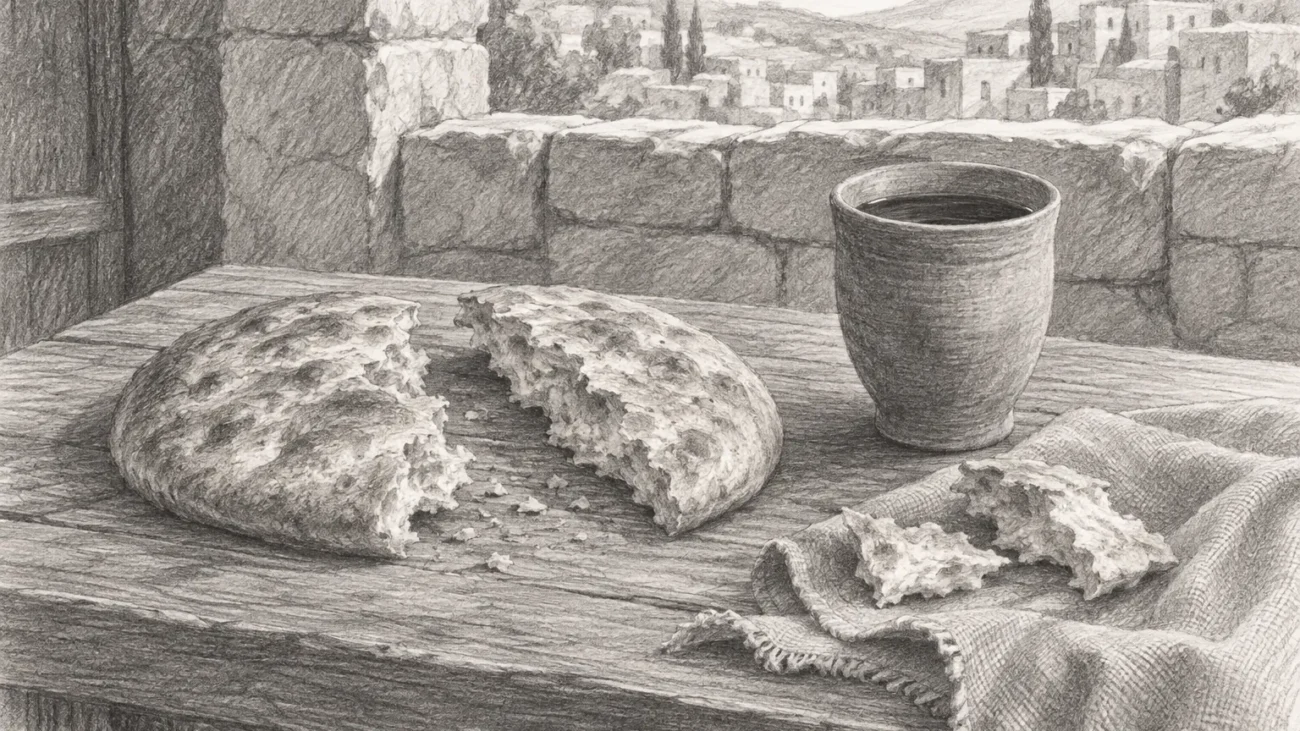
In 1 Corinthians 11, the apostle Paul gives the earliest known written mention of the meal Jesus shared with his apostles before his crucifixion. Christians call it the Last Supper. In fact, this meal forms the scriptural basis for the Eucharist, which believers also know as Holy Communion or the Lord’s Supper. So when we read Paul’s short account, we read the earliest known mention of that meal.
Why 1 Corinthians 11 Matters for the Lord’s Supper
The New Testament mentions the Last Supper in five of its books. Matthew, Mark and Luke tell the story, and John adds his own scenes. However, the passage in 1 Corinthians 11:23–25 is the earliest known mention. Paul likely wrote this letter before the Gospels, and he described the church’s practice in the mid-50s.
Scholars read this early date in different ways. Some look to the Last Supper as the source of early Christian Eucharistic traditions. Others see the Gospel accounts as derived from the first-century practice that Paul describes. In addition, Paul does not give a detailed description of the event or its background. Instead, he emphasizes the theological basis of the meal.
What Paul Received and Passed On
Paul opens his account with careful words. He presents himself as a messenger who hands on what he first received:
“For I have received of the Lord that which also I delivered unto you, That the Lord Jesus the same night in which he was betrayed took bread” (1 Corinthians 11:23).
Notice how Paul anchors the meal in a real night. The Gospels fill in that setting. During the meal, Jesus predicted that one of the apostles present would betray him. Matthew and John identify Judas as the traitor. Jesus also foretold that Peter would deny knowing him three times before the rooster crowed.
Yet Paul keeps his focus on what Jesus did. First, Jesus took bread. Then he gave thanks, broke it and spoke. Paul passes that account on to the believers in Corinth.
Roots in the Passover Meal
The four Gospels place the Last Supper in the week of Passover. It came days after Jesus’ triumphal entry into Jerusalem and before his crucifixion on Good Friday. Luke captures the longing in Jesus’ heart as the meal began:
“With desire I have desired to eat this passover with you before I suffer” (Luke 22:15).
The three Synoptic Gospels describe the Last Supper as a Passover meal. However, scholars discuss how John’s Gospel fits with them. Stéphane Saulnier argues that they disagree. Brant Pitre, on the other hand, argues that the Gospels can be reconciled through his “Passover hypothesis.” He applies John’s allusions to the Passover lamb to the seven-day festival rather than to the meal itself.
Luke also shows a slightly different order. In his account, the wine is blessed and distributed before the bread, followed by the bread, then by a second cup. Some early manuscripts of Luke lack part of this text, namely Luke 22:19b–20. Some scholars believe it is an interpolation, while others argue it is original.
Remembrance in 1 Corinthians 11
Both Paul and Luke record Jesus’ command: “do this in remembrance of me.” In 1 Corinthians 11, Paul repeats it twice, once over the bread and once over the cup. Jesus said of the bread, “this is my body, which is broken for you” (1 Corinthians 11:24). Similarly, he said of the cup, “This cup is the new testament in my blood” (1 Corinthians 11:25).
Paul explains what the church does each time it eats and drinks:
“For as often as ye eat this bread, and drink this cup, ye do shew the Lord’s death till he come” (1 Corinthians 11:26).
So the meal looks backward and forward at once. It recalls the Lord’s death, and it also looks ahead until he comes. In addition, Jesus’ actions have been linked with Isaiah 53:12 and with the blood sacrifice that Moses offered in Exodus 24:8 to seal a covenant with God. Some scholars interpret Jesus’ action as asking his disciples to consider themselves part of a sacrifice that Jesus himself was due to physically undergo.
Thanksgiving and Unity at the Table
The word Eucharist means “thanksgiving.” In Paul’s account, Jesus gave thanks before he broke the bread. Luke adds that Jesus took the cup, gave thanks and said, “Take this, and divide it among yourselves” (Luke 22:17).
In Luke, Jesus sat down with the twelve apostles. John’s Gospel adds that Jesus washed the apostles’ feet and gave them a new commandment “to love one another as I have loved you.” He also called those who follow his teachings “friends and not servants.”
Today Christians across many traditions still gather at this table. Many commemorate the Last Supper especially on Holy Thursday. Eastern Orthodox believers speak of the “Mystical Supper,” and Russian Orthodox believers also use the term “Secret Supper.” Meanwhile, Evangelical Protestants also use the term “Lord’s Supper.” Calvin taught that the Lord’s Supper is fuel for spiritual growth, so believers should come to the table expectantly every time.
Coming to the Table with 1 Corinthians 11
The words of 1 Corinthians 11 invite us to slow down whenever we receive the bread and the cup. First, they call us to remember Jesus, whose body was broken for us. Then they invite us to give thanks, just as he did on the night of his betrayal. Finally, they remind us that we come to the table together, waiting for his return.
The next time you come to the Lord’s table, let Paul’s simple words guide your heart. Remember the One who longed to share that Passover with his friends. Give thanks for the new covenant in his blood. And come expectantly, because each meal proclaims the Lord’s death until he comes.
