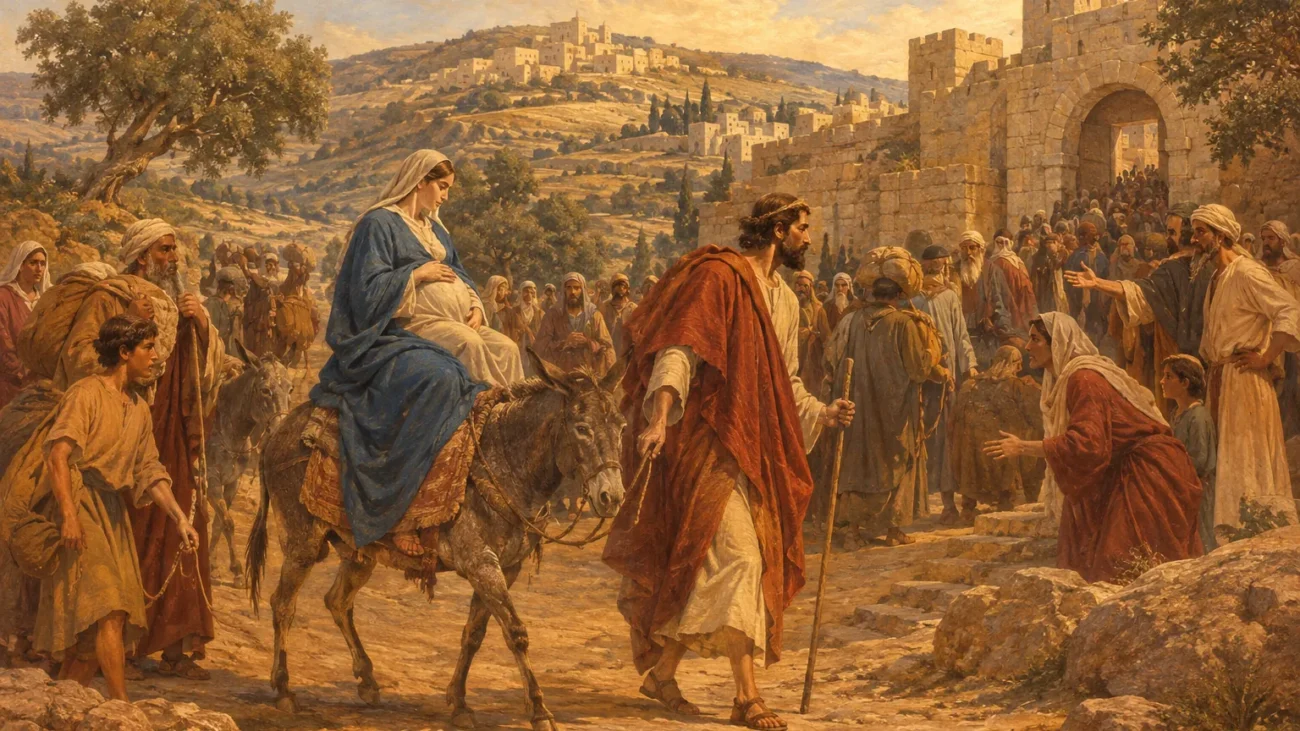
The history of Bethlehem stretches across thousands of years, from a Canaanite hilltop to the birthplace of Jesus. For believers, this small town in the hill country of Judea holds a special place. Here Ruth gleaned in the fields, and here Samuel anointed young David. Later, the prophet Micah spoke of a ruler who would come from this humble place. Finally, Luke tells how Mary laid her firstborn son in a manger there. In this article, we walk through the history of Bethlehem, its great church and the town as it stands today.
Ancient Roots in the History of Bethlehem
First, consider the name itself. In Hebrew, Bet Leḥem literally means “house of bread” or “house of food.” In Arabic, Bēt laḥm means “house of meat.” However, some scholars trace the name back even further. One longstanding suggestion links it to Laḫmu, a Mesopotamian or Canaanite fertility god. Biblical scholar William F. Albright called this idea “certainly accurate,” yet the theory is not widely accepted.
In addition, the town may appear in ancient Egyptian letters. In the Amarna correspondence, Abdi-Heba, the governor of Jerusalem, asked Pharaoh for help. He wrote that “a town near Jerusalem, Bit-Lahmi by name” had fallen to the enemy. Still, scholars debate this reading.
Archaeology also adds depth to the history of Bethlehem. In 2013, researchers discovered a burial ground with more than 100 tombs, used roughly between 2200 BCE and 650 BCE. Then, in 2012, excavators at the City of David found a clay seal impression in ancient Hebrew script. It reads “From the town of Bethlehem to the King.” It likely sealed a tax shipment of grain, wine or other goods in the 8th or 7th century BCE.
Rachel, Ruth and the Hometown of David
Scripture first mentions Bethlehem as the place of Rachel’s death and burial. Today, Rachel’s Tomb, the traditional grave site, stands at the entrance to the town. Biblical scholars also believe that Bethlehem may be the same as the Biblical Ephrath.
Then comes the gentle story of Ruth. According to the Book of Ruth, Ruth of Moab gleaned the fields in the valley east of town. Afterward, she returned to Bethlehem with Naomi. Her humble labor in those fields gives the town a tender place in Scripture.
Yet no figure looms larger in the history of Bethlehem than David. The Books of Samuel name the town as the home of Jesse, David’s father. In fact, the prophet Samuel anointed David there. For this reason, the New Testament calls Bethlehem the “City of David.” Much later, in the 4th century, the Pilgrim of Bordeaux reported that the tombs of David, Ezekiel, Asaph, Job, Jesse and Solomon lay near the town.
Micah’s Prophecy and the Birth in the City of David
Centuries after David, the prophet Micah looked toward this modest town with hope. Bethlehem seemed small, yet it had a place in God’s plan. Micah wrote:
“But thou, Bethlehem Ephratah, though thou be little among the thousands of Judah, yet out of thee shall he come forth unto me that is to be ruler in Israel; whose goings forth have been from of old, from everlasting.” (Micah 5:2)
Notice the contrast in this verse. Bethlehem is little among the thousands of Judah, but a ruler in Israel comes from it. So the prophet lifts a humble place into the center of the story.
Luke then tells how the history of Bethlehem reached its high point. Caesar Augustus issued a decree that all the world should be taxed. As a result, everyone went to his own city. Joseph traveled from Nazareth in Galilee to Bethlehem, because he belonged to the house and lineage of David. Mary, his espoused wife, went with him, and she was expecting a child.
“And she brought forth her firstborn son, and wrapped him in swaddling clothes, and laid him in a manger; because there was no room for them in the inn.” (Luke 2:7)
Both Matthew and Luke place the birth of Jesus in Bethlehem. Therefore, David’s hometown also became the birthplace of Jesus.
The Church of the Nativity in the History of Bethlehem
Christians remembered the place of Jesus’ birth from early times. Around AD 248, Origen of Alexandria wrote of “the cave” in Bethlehem “where He was born.” Earlier, in 135, Emperor Hadrian had turned the site above the grotto into a place of worship for Adonis.
Then Constantine the Great changed the story. His mother Helena visited Jerusalem and Bethlehem in 325–326. Afterward, Constantine commissioned a basilica on the site that Helena and Bishop Makarios of Jerusalem identified. Construction began in 326, and the Bordeaux Pilgrim visited the church in 333. Finally, the church received its dedication on 31 May 339.
Yet trials soon followed. Fire destroyed the building during the Samaritan revolts of 529 or 556. Emperor Justinian I then rebuilt it in its present form. In 614, Persian forces under Khosrau II spared the church. According to legend, their commander saw the Three Magi dressed as Persian priests above the entrance.
Later, the Crusaders added wall paintings and mosaics. A painter named Ephraim led one mosaic team, and a painter named Basil also worked there. In 1227, two Armenian monks, Father Abraham and Father Arakel, made a carved wooden door. Its remnants still survive in the narthex.
Today, the grotto is the oldest site in Christianity in continuous use for worship. The basilica is also the oldest major church in the Holy Land. Catholic, Armenian Apostolic and Greek Orthodox monasteries share a compound of about 12,000 square meters. Since 1852, an understanding called the Status Quo has governed their rights. In addition, UNESCO listed the church as a World Heritage Site in 2012.
Bethlehem Through the Centuries and Today
The history of Bethlehem continued under many rulers. The town became part of Jund Filastin in 637, and the Crusaders conquered it in 1099. The Mamluks tore down its walls in the mid-13th century, yet the Ottomans rebuilt them in the 16th century. In the twentieth century, Bethlehem belonged to Mandatory Palestine and later to the Jordanian-annexed West Bank. Then Israel occupied it during the 1967 Six-Day War.
Today, Bethlehem lies in the West Bank, about ten kilometres (six miles) south of Jerusalem. It serves as the capital of the Bethlehem Governorate, and it had 28,591 residents in 2017. Tourism drives much of its economy. Above all, Christmas brings Christian pilgrims to the Church of the Nativity.
The town’s Christian community has also changed. Arab Christians made up about 86% of the population in 1950. However, a 2022 report described the community as shrinking to about 20%, with Arab Muslims now a large majority. Since the Oslo Accords, Bethlehem has belonged to Area A of the West Bank. Still, the West Bank barrier limits movement around the city.
What the History of Bethlehem Teaches Believers
The history of Bethlehem carries a gentle message for every believer. Micah called the town “little among the thousands of Judah,” yet he saw a ruler coming from it. Similarly, Luke shows a family with no room in the inn and a newborn lying in a manger. In other words, these passages show great things beginning in humble places.
So when we feel small or overlooked, we can remember Bethlehem. Ruth gleaned there, David grew up there, and Mary laid her son there. The history of Bethlehem invites us to trust that the Lord sees the little places, and to meet Him there with humble hearts.
