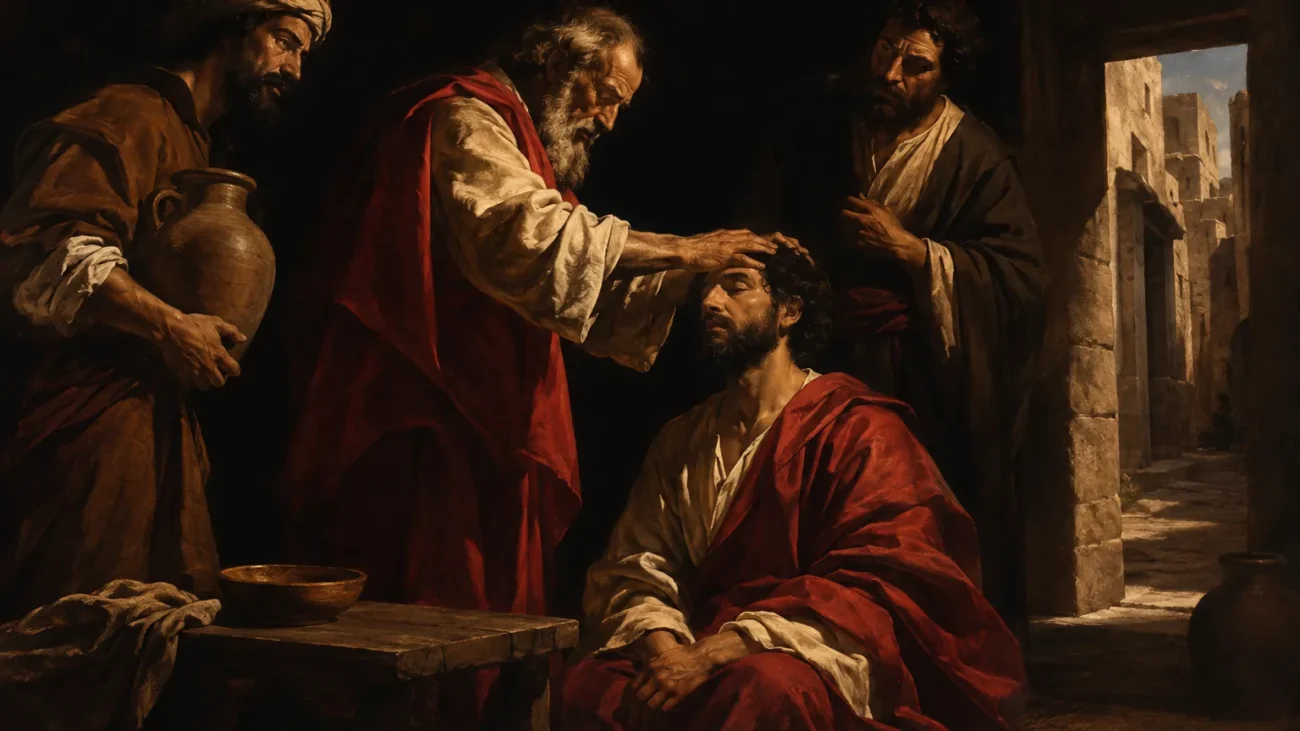
The story of Saul on the road to Damascus marks one of the most striking turning points in the New Testament. A man who set out to arrest the followers of Jesus arrived in the city blind, humbled and praying. Within days, a frightened disciple named Ananias called him “brother.” In this article, we follow that journey step by step. We also look at the ancient city where it happened, because Damascus has its own long story to tell.
Damascus, One of the Oldest Cities in the World
Long before Saul set out, Damascus was already ancient. In fact, people first settled there in the 3rd millennium BC, and it remains one of the oldest continuously inhabited cities on earth. Today it serves as the capital of Syria, and many describe it as the oldest capital city in the world. Its name appears in a geographical list of the Egyptian ruler Thutmose III from the 15th century BC. Akkadian spellings of the name also appear in the Amarna letters of the 14th century BC.
The city’s location explains much of its importance. It sits on a plateau about 680 metres above sea level, sheltered by the Anti-Lebanon Mountains. The Barada River supplied it with water, and irrigated farmland called the Ghouta surrounded it. Above all, Damascus stood at a crossroads of trade routes. One route ran north and south between Egypt and Asia Minor, while another crossed the desert from Lebanon to the Euphrates valley.
Saul’s Mission on the Road to Damascus
Saul of Tarsus was a Pharisee who fiercely opposed the early followers of Jesus. Later, writing to the Galatians, he admitted that he had persecuted the church of God intensely and tried to destroy it. He also confessed that he had been extremely zealous for the traditions of his fathers. In addition, Acts shows him taking part in the stoning of Stephen (Acts 7:57–8:3).
Acts 9 opens with Saul still full of hostility:
And Saul, yet breathing out threatenings and slaughter against the disciples of the Lord, went unto the high priest (Acts 9:1)
He asked the high priest for letters to the synagogues in Damascus. With them, he could arrest any followers of “this way,” whether men or women, and bring them bound to Jerusalem. The narrative of Acts suggests that these events took place four to seven years after the crucifixion of Jesus.
A Light from Heaven on the Road to Damascus
Then, as Saul came near the city, everything changed in a moment. Suddenly a light from heaven shone around him, and he fell to the earth. Next he heard a voice calling his name twice:
Saul, Saul, why persecutest thou me? (Acts 9:4)
Saul asked who was speaking, and the answer came: “I am Jesus whom thou persecutest” (Acts 9:5). Notice that Jesus did not speak only of his followers. Instead, he counted their suffering as his own. Trembling and astonished, Saul asked what the Lord wanted him to do. Jesus told him to rise and go into the city, where he would be told what he must do.
Meanwhile, the men travelling with Saul stood speechless. According to Acts 9:7, they heard a voice but saw no one. Paul’s later retelling in Acts 22:9 says they saw the light but did not hear the voice. Scholars have long discussed this difference. For example, Richard Longenecker suggests that everyone heard the sound, but “only Paul understood the articulated words.” Similarly, Craig Keener notes that ancient historians would not have trifled over differences in minor details, with the point being selective revelation.
Three Days in the Dark and Ananias’ Brave Obedience
When Saul got up and opened his eyes, he could see nothing. So his companions took him by the hand and led him into Damascus. For three days he stayed without sight, and he neither ate nor drank.
At the same time, the Lord spoke in a vision to a disciple in the city named Ananias. He sent him to the street called Straight, to the house of Judas, to look for Saul of Tarsus. The Lord added that Saul was praying. In fact, Saul had already seen Ananias in a vision, coming in and putting his hand on him so that he might receive his sight.
Ananias hesitated. He had heard from many people how much evil Saul had done to the saints in Jerusalem. He also knew that Saul had authority from the chief priests to bind all who called on the Lord’s name. Yet the Lord answered him firmly:
Go thy way: for he is a chosen vessel unto me, to bear my name before the Gentiles, and kings, and the children of Israel (Acts 9:15)
Scales Fall and a New Life Begins
So Ananias went. He entered the house, placed his hands on Saul, and greeted him with two remarkable words: “Brother Saul.” He explained that Jesus, who had appeared to Saul on the way, had sent him so that Saul might receive his sight and be filled with the Holy Ghost.
Immediately something like scales fell from Saul’s eyes, and he received sight. Then he rose and was baptized. After he ate, he was strengthened, and he stayed some days with the disciples in Damascus.
Paul himself later spoke of the road to Damascus only briefly in his letters. In 1 Corinthians 15, he lists those to whom the risen Christ appeared and says that Christ appeared to him last of all. Likewise, in Galatians he explains that he received his gospel by revelation from Jesus Christ. Acts also retells the event twice more, first in a speech Paul gives when arrested in Jerusalem and then when he addresses King Agrippa.
Remembering the Road to Damascus in the City Today
Visitors to Damascus can still walk Straight Street. This old Roman Decumanus Maximus runs almost a mile through the Old City from east to west. Today it forms an open-air museum known as the Via Recta, with column fragments on each side and a Roman triumphal arch midway along. Traditions differ about the house of Judas. One tradition places it near the west end of the street, yet one visitor reports that no tradition marks the spot today.
Near the eastern gate, Bab Sharqi, is the traditional house of Ananias, an underground structure. About 10 miles southwest of the city, the Monastery of the Vision of Paul marks the spot where Paul had the vision of Jesus. Its round church was constructed in 1965, and a church also stood there in the Byzantine period. Finally, tradition says Paul was lowered over the wall at the Bab Kisan gate to escape King Aretas (2 Corinthians 11:32–33).
What the Road to Damascus Teaches Us
The road to Damascus reminds us that Jesus can reach even the most determined opponent. He met Saul in the middle of his hostility and called him by name. Then he called him a chosen vessel to carry his name to the Gentiles, kings and the children of Israel.
Ananias also offers us a quiet example of courage. He brought his honest fears to the Lord, and then he obeyed. Perhaps someone in our own life needs that same welcome today. May we, like Ananias, go our way when the Lord sends us.
