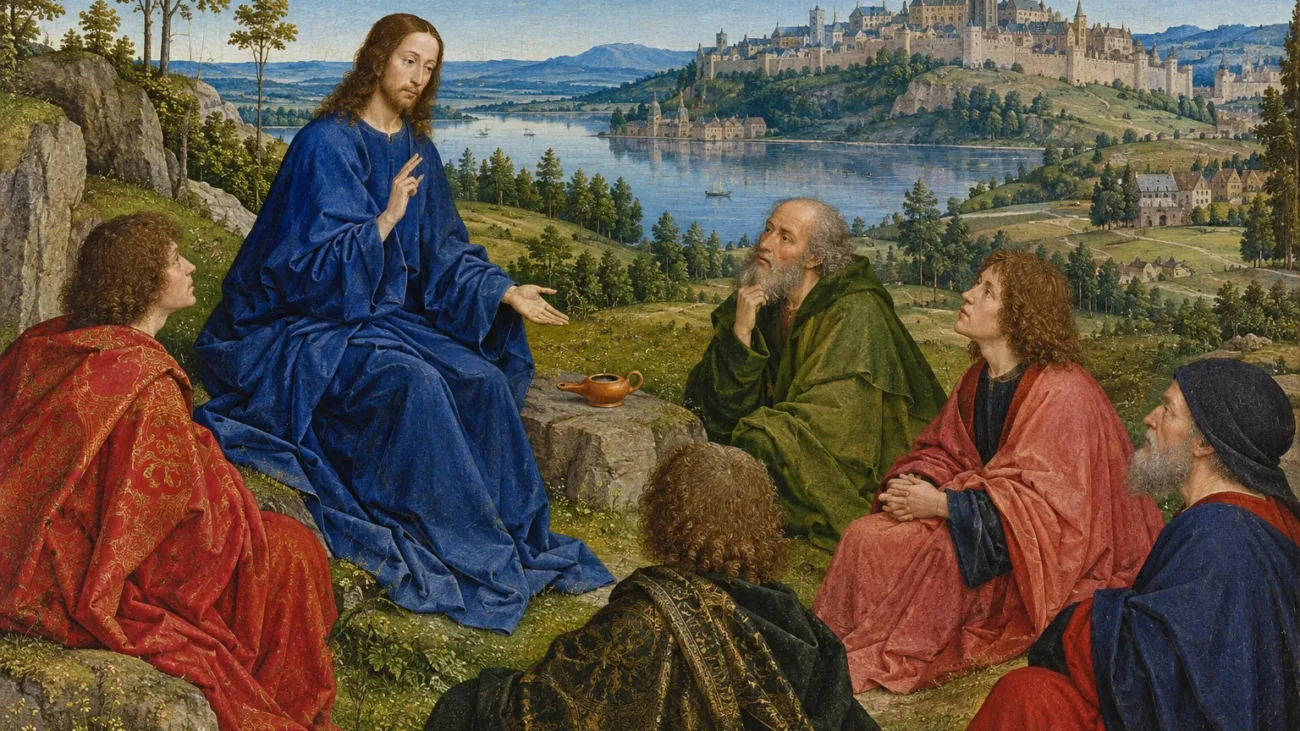
Salt and light are two of the most memorable images Jesus used in the Sermon on the Mount. In just four verses, Matthew 5:13–16, he tells his followers who they are and what he expects of them. First, he calls them the salt of the earth. Then he calls them the light of the world. These simple pictures carry a strong message, so they deserve a slow and careful reading. Here we look at where the sayings appear, what the words mean, and how they invite us to a faith that shines through good works.
Where salt and light appear in the Sermon on the Mount
The Sermon on the Mount fills chapters 5, 6 and 7 of the Gospel of Matthew. It summarizes the moral teaching of Jesus, and it is the first of five discourses in that Gospel. In fact, it has become one of the most widely quoted sections of the Gospels. Its familiar name comes from a title Augustine gave it: De sermone Domini in monte.
Matthew places the sermon early in the ministry of Jesus. Before it, John baptizes Jesus, who then faces temptation in the desert, calls four disciples and begins preaching in Galilee. Next, in Matthew 5:1–2, Jesus sees the crowds, goes up the mountain with his disciples, sits down and starts to teach. He comes down again in Matthew 8:1. Christians have traditionally remembered the Mount of Beatitudes as the place of the sermon. However, some have suggested other sites, such as Mount Arbel and the Horns of Hattin.
Several traditions also see a link with Mount Sinai and the Ten Commandments. Both events happen on a mountain, as moments when God meets his people. Joseph Ratzinger (Pope Benedict XVI) pictured Jesus seated in teaching authority on “the cathedra of the mountain”. For this reason, the words about salt and light come from a teacher who speaks with authority.
From the Beatitudes to salt and light
The sayings about salt and light do not stand alone. Just before them, in Matthew 5:3–12, Jesus speaks the Beatitudes. These blessings describe the character of the people of the kingdom of heaven. Together, they present ideals of love and humility rather than force and mastery.
Matthew 5:13–16 then completes this portrait of God’s people. At the same time, it opens the way to the next part of the sermon. The general theme of the passage is promises and expectations. In other words, the blessings come first, and the calling follows. Jesus has just described the people of his kingdom, and now he shows them their place in the world. By naming the disciples salt and light, he also implies their great value.
You are the salt of the earth
“Ye are the salt of the earth: but if the salt have lost his savour, wherewith shall it be salted? it is thenceforth good for nothing, but to be cast out, and to be trodden under foot of men.” (Matthew 5:13)
In Greek, the phrase “salt of the earth” reads tò hálas tês gês. Notice that Jesus does not tell his followers to try to become salt. Instead, he says plainly that they already are salt. That statement brings both honor and responsibility to everyone who would be salt and light.
Next, Jesus raises a warning. Salt can lose its savour, that is, its flavor. If that happens, nothing can make it salty again. As a result, it becomes good for nothing. People simply throw it out and walk over it. The image is short, yet it is sobering. It gently invites us to ask whether our lives still carry the flavor Jesus gave us.
A city on a hill and a lamp on a stand
“Ye are the light of the world. A city that is set on an hill cannot be hid.” (Matthew 5:14)
The second half of the salt and light passage turns from taste to sight. The Greek words for the city on a hill are polis epánō órous keiménē. A city on a hilltop stands in plain view, so no one can hide it. Similarly, the followers of Jesus cannot keep their calling out of sight.
Then Jesus turns to an everyday scene inside a home. Nobody lights a lamp and puts it under a bushel, a measuring basket. Instead, people set it on a candlestick, or stand. From there, it gives light to everyone in the house. The point is simple: a lamp exists to shine.
The saying about the hidden lamp also appears in Luke 8:16–18. In addition, the phrase “light of the world” returns in John 8:12. There, however, Jesus applies the title to himself. It is a beautiful thing to notice that the same title belongs both to Jesus and to those who follow him.
Salt and light shine through good works
“Let your light so shine before men, that they may see your good works, and glorify your Father which is in heaven.” (Matthew 5:16)
This verse explains the purpose of the whole passage. Jesus wants others to see the good works of his followers. Yet the final goal is not their own praise. Instead, people should glorify the Father in heaven. In other words, the light of the believer always points upward.
Matthew 6 adds an important balance. There, Jesus condemns good works done only for recognition and not from the heart. He gives three examples: giving alms (6:1–4), prayer (6:5–15) and fasting (6:16–18). Therefore, salt and light do not describe a faith that performs for an audience. Rather, they describe a faith whose good deeds shine from a sincere heart, so that God receives the glory.
The rest of the sermon fills in what these good works look like. For example, Jesus speaks of turning the other cheek and loving our enemies. He also teaches the Golden Rule in Matthew 7:12, which asks us to treat others the way we wish them to treat us.
Living as salt and light today
How can believers keep their flavor and let their lamp shine today? One help is to stay close to these words of Jesus. Many Christians find that studying and memorizing Scripture, especially the Sermon on the Mount, helps them resist online algorithms that feed on our cravings. As we carry his words in our hearts, they keep reshaping what we love.
The message of salt and light is both humbling and encouraging. Jesus does not ask us to earn our place, because he tells us who we already are. However, he also asks us not to lose our flavor or hide our lamp. So let us live as salt and light, openly and humbly, doing good from the heart. Then, as Matthew 5:16 says, others may see our good works and glorify our Father in heaven.
