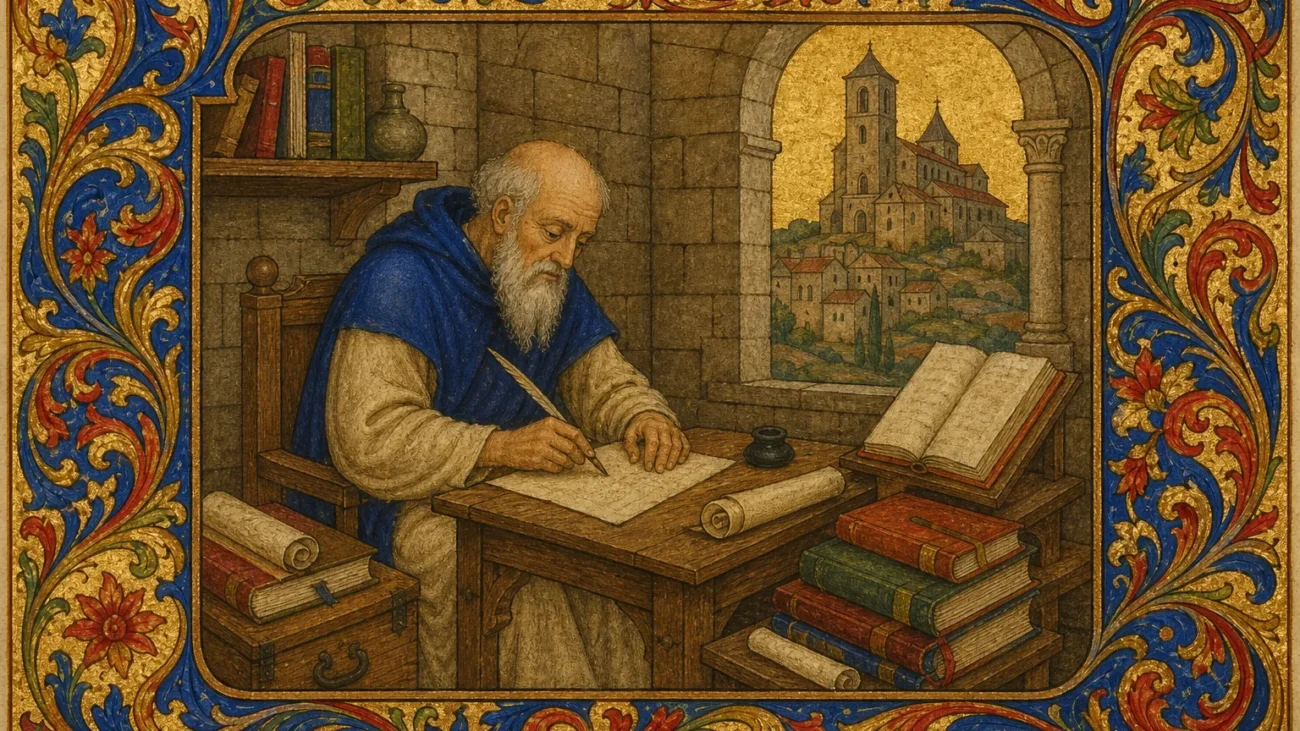
The story of Jerome and the Vulgate begins with a simple request from Rome and ends with a Bible that guided the Western Church for centuries. Jerome of Stridon, commonly known as Saint Jerome, lived from around 342–347 until 30 September 420. He served as a priest, theologian and historian, but above all as a translator. His Latin translation of the Bible later became known as the Vulgate. In this article, we follow his path from Rome to Bethlehem and see why his work mattered so much.
Jerome and the Vulgate: A Commission in Rome
Jerome was born at Stridon and later went to Rome to study rhetoric and philosophy. There he learned Latin and some Koine Greek under the philologist Aelius Donatus. He received baptism in Rome around 360–369. At first he feared Christianity, yet in the end he converted and gave his life to it.
Later, Jerome became a protégé of Pope Damasus I. In 382 the pope asked him to revise the Vetus Latina, the older Latin text of the four Gospels used by the Roman Church. Jerome worked from the best Greek texts he could find. By the death of Damasus in 384, he had finished the Gospels. He also made a quicker revision of the Psalms then in use in Rome, based on the Greek Septuagint. However, he later disowned that version, and it is now lost. In fact, the story of Jerome and the Vulgate starts here, although Jerome did not yet plan a whole new Bible.
Learning Hebrew and Settling in Bethlehem
Even before his work in Rome, Jerome had sought a life of ascetic penance in the desert of Chalcis, southeast of Antioch. Many hermits lived there, so people called it the “Syrian Thebaid.” During this time he made his first attempt to learn Hebrew, guided by a converted Jew. As a result, he already knew some Hebrew when his great project began.
After Damasus died on 10 December 384, Jerome faced growing hostility among the Roman clergy and had to leave his position. He moved to Jerusalem to deepen his grasp of Jewish commentary on Scripture. Then Paula, a wealthy Roman aristocrat, paid for his stay in a monastery in nearby Bethlehem. There he settled next to the Church of the Nativity. Emperor Constantine had ordered that church built about half a century earlier, over the reputed site of the Nativity of Jesus.
For this reason, Jerome and the Vulgate stay tied to Bethlehem in a special way. Jerome completed his translation there. Readers today may recall the praise of Luke’s Gospel when they picture him at work beside that church:
“Glory to God in the highest, and on earth peace, good will toward men.” (Luke 2:14)
Jerome and the Vulgate: Translating from the Hebrew
By 390, Jerome turned to translating the Hebrew Bible from the original Hebrew. Earlier, he had translated portions from the Septuagint, the Greek version that came from Alexandria. He finished the whole work by 405. Before him, every Latin translation of the Old Testament rested on the Septuagint rather than the Hebrew.
However, his choice went against the advice of most Christians of his day. Augustine, for example, thought the Septuagint inspired. Jerome believed that mainstream Rabbinical Judaism had rejected the Septuagint because of mistranslations. So he went back to the Hebrew. With this decision, Jerome and the Vulgate broke new ground. Scholars usually credit the Vulgate as the first Latin Old Testament translated directly from the Hebrew Tanakh. Still, some modern scholars believe the Greek Hexapla served as a main source for part of his work.
The Psalms show how his method grew. Jerome is connected to three Latin versions. The Versio Romana of 384, once credited to him, revised the older Latin text. Next, the Versio Gallicana (386–389) came from the Greek Hexapla and became the most common version in Bibles. Finally, the Versio juxta Hebraicum (c. 390–398) came straight from the Hebrew. In addition, Jerome translated Tobit and Judith from Aramaic versions.
A Composite Bible Shaped by Many Hands
Tradition attributes most of the Vulgate to Jerome, yet the text is not entirely his work. His Gospels are revisions of the Vetus Latina, checked against the Greek. In contrast, another reviser produced the rest of the New Testament. Scholars have suggested Rufinus of Aquileia, Rufinus the Syrian, Pelagius or Pelagian groups, though no specific evidence points to any of them. This unknown reviser had completed the New Testament by 410 at the latest.
Also, several older Latin books entered the Vulgate without revision. These include 1 and 2 Maccabees, Wisdom, Sirach, Baruch and the Letter of Jeremiah. Jerome also treated Ezra–Nehemiah as a single book of “Ezra.” For this reason, scholars describe the Vulgate as a composite collection. Even so, Jerome and the Vulgate remain inseparable in the memory of the Church.
How the Vulgate Shaped a Thousand Years
Over the following centuries, the Western Church gradually adopted the Vulgate as its Bible text. Slowly, it eclipsed the older Vetus Latina texts. A famous edition, the Alcuinian pandects from the end of the 700s, shows how the collection had taken shape. By the 13th century, people called it the versio vulgata, the “version commonly used.” In that century, Roger Bacon made the earliest known use of the term Vulgata.
Later, in 1538, Robert Estienne used the term in an edition that set the Vulgate beside newer Latin translations by Pagninus, Beza and Baduell. Then the Catholic Church affirmed the Vulgate as its official Latin Bible at the Council of Trent (1545–1563). Official editions followed: the Sixtine Vulgate in 1590, the Clementine Vulgate in 1592 and the Nova Vulgata in 1979. The Clementine text remained the standard Bible of the Roman Rite until 1979. In fact, the Latin Church still uses the Vulgate today, so the influence of Jerome and the Vulgate reaches well beyond a thousand years.
Jerome himself receives wide honor. The Catholic Church counts him, along with Ambrose, Augustine of Hippo and Pope Gregory the Great, among the four Great Latin Church Fathers. Similarly, the Eastern Orthodox Church, the Lutheran Church and the Anglican Communion recognize him as a saint. His feast day falls on 30 September.
Jerome and the Vulgate: A Lamp for Our Path
The story of Jerome and the Vulgate reminds us that God’s word deserves our best care. Jerome left Rome, studied a difficult language and labored for years in Bethlehem. His work gave the Western Church a Latin Bible it read for centuries. The psalmist captures the heart of such devotion:
“Thy word is a lamp unto my feet, and a light unto my path.” (Psalms 119:105)
So as we open our Bibles today, we can give thanks for faithful translators like Jerome. Their patient labor helps the word shine as a lamp for our own feet. In the same way, we too can treat Scripture with love, study it carefully and let it guide each step we take.
