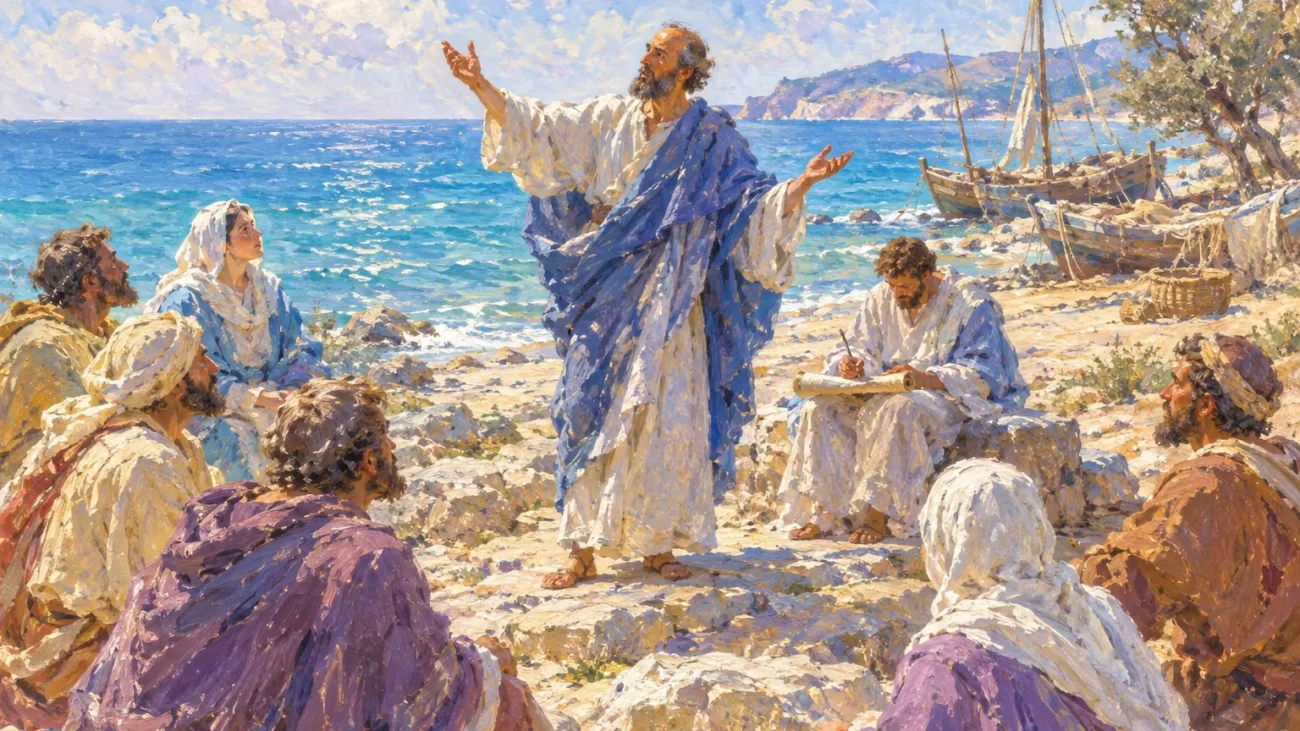
Few passages offer more comfort than the close of Romans 8, where Paul declares that nothing can separate us from the love of God. In just twelve verses, the apostle moves from quiet confidence to a shout of triumph. First, he reminds believers that God works all things for good. Then he asks a series of bold questions. Finally, he lists every power he can imagine and insists that none of them can cut us off from Christ. For anyone facing uncertain days, these verses still speak with fresh force.
The Letter Behind the Promise
The Epistle to the Romans is the sixth book of the New Testament. It is also the longest of the thirteen Pauline epistles. Scholars agree that Paul wrote it to explain how God offers salvation through the gospel of Jesus Christ. Most likely, Paul was staying in the house of Gaius in Corinth at the time. His helper Tertius probably wrote the words down for him. Most scholars place the letter between late AD 55 and early 57.
Paul had already preached in the lands around the Aegean Sea. In addition, he hoped to carry the gospel on to Spain and to visit Rome along the way. The believers in Rome came from both Jewish and Gentile backgrounds, so Paul spoke to the church as a whole. Some textual variants name Phoebe, a deacon of the church in Cenchreae, as the one who carried the letter. Anglican bishop N. T. Wright describes Romans as “by common consent his masterpiece.” Within that masterpiece, chapter 8 builds steadily toward one great conviction: nothing can separate us from God’s love.
God Works All Things Together for Good
Paul opens this closing movement with a sentence many believers know by heart:
“And we know that all things work together for good to them that love God, to them who are the called according to his purpose.” (Romans 8:28)
Notice that Paul does not call every event good in itself. Instead, he says that all things “work together” for good. In other words, the promise rests on God’s purpose, not on our circumstances. Paul also names the people who receive it. They are those who love God and whom God has called.
Next, Paul traces that purpose from beginning to end. God foreknew his people and planned for them to share the image of his Son. As a result, the Son becomes the firstborn among many brothers and sisters. Then Paul links a chain of divine actions. God called, God justified, and God glorified. Because God begins and finishes the whole chain, Paul can already sense where his argument leads. Even here, the hint is clear that nothing can separate us from the love behind this plan.
If God Be for Us, Nothing Can Separate Us
Having laid this foundation, Paul turns to a set of searching questions:
“What shall we then say to these things? If God be for us, who can be against us?” (Romans 8:31)
Paul then reasons from the greater gift to the lesser. God did not spare his own Son. Instead, he gave him up for us all. So how could he hold back anything else? In fact, Jesus’s perfect life and sacrificial death count for all believers. For this reason, God’s righteousness is not merely his judgment. It is also his gift.
Paul presses the point further. Who can bring a charge against God’s chosen people? Yet it is God himself who justifies them. Who can condemn them? Christ died, and even more, he rose again. Now he sits at the right hand of God and pleads on our behalf. Therefore, the very One who could condemn us is the One who prays for us. With such a judge and such an advocate, nothing can separate us from his favor.
Trouble Cannot Break the Bond
Next, Paul names the hard realities that might seem to tear believers away from Christ. He lists tribulation, distress, persecution, famine, nakedness, peril and sword. These are not imaginary fears. Similarly, Paul recalls an older Scripture that pictures God’s people facing death all day long, like sheep headed for slaughter. He does not pretend that faith removes suffering.
However, his answer rings out with a firm “Nay”:
“Nay, in all these things we are more than conquerors through him that loved us.” (Romans 8:37)
Paul does not say that believers escape these things. Instead, he says that “in all these things” they are more than conquerors. Above all, the victory comes “through him that loved us.” So the strength belongs to Christ, and his love carries his people through the trial. Even famine and sword stand on the list of things that cannot win. In the middle of loss, nothing can separate us from the love of Christ.
Why Nothing Can Separate Us from God’s Love
Finally, Paul reaches the summit of the chapter. He gathers every power he can think of and sets them all aside:
“For I am persuaded, that neither death, nor life, nor angels, nor principalities, nor powers, nor things present, nor things to come, Nor height, nor depth, nor any other creature, shall be able to separate us from the love of God, which is in Christ Jesus our Lord.” (Romans 8:38-39)
The list moves in pairs that cover the whole of existence. First come death and life. Then come angels and rulers, along with every other power. Next, Paul names the present and the future. After that, he names height and depth. Finally, he adds “any other creature,” so that nothing in all creation remains outside his claim.
Notice also how personal the language is. Paul writes, “I am persuaded.” He speaks as someone who has weighed the dangers and still stands firm. Moreover, he locates this love in a specific place: “in Christ Jesus our Lord.”
Resting in the Truth That Nothing Can Separate Us
These verses invite us to read our own uncertain times through Paul’s eyes. He begins with the quiet knowledge that God works all things together for good. Then he reminds us that God did not spare his own Son. As a result, we can trust him to give us all we need. Christ died, rose and now prays for us.
So when trouble comes, we do not need to measure God’s love by our circumstances. Instead, we can repeat Paul’s confident question: who shall separate us from the love of Christ? The answer stands as firm today as when Paul first sent it to Rome. Nothing can separate us from the love of God, which is in Christ Jesus our Lord.
