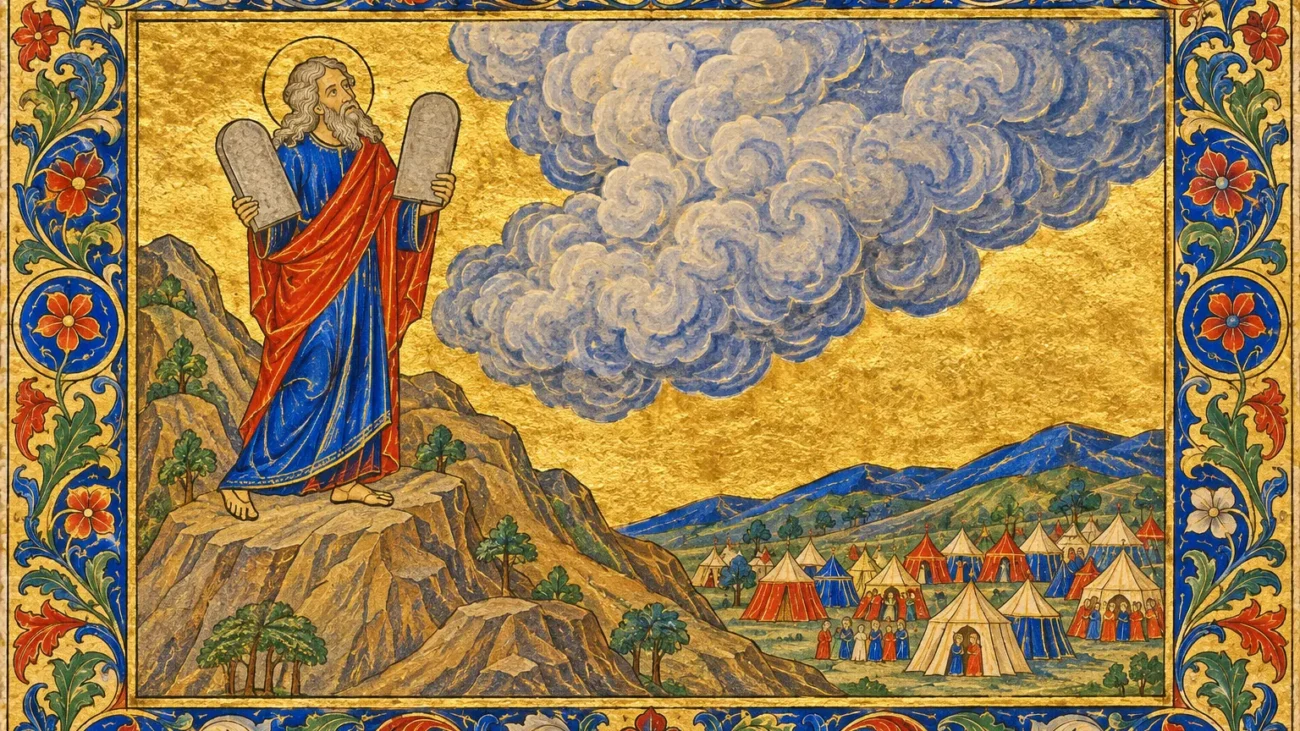
Few passages reveal the heart of God as clearly as the moment when the LORD calls Himself merciful and gracious before Moses. In Exodus 34, God passes before His servant and proclaims His own name. He describes Himself with words of compassion, patience and abundant goodness. Moreover, these words do not stay on the mountain. Instead, they return again and again in the Psalms, the prophets and the prayers of God’s people. In this study, we look at the setting of this confession, the meaning of its words and the way it echoes through Scripture.
The Golden Calf Behind Exodus 34
To appreciate this revelation, we first need to remember what came before it. While Moses stayed on the mountain, the people grew restless. Aaron told them to take off their gold earrings, and he made the gold into a molten calf (Exodus 32:4). The people then hailed the calf as the gods who brought them out of Egypt.
When Moses came down and saw the calf, he became furious. He threw the two tablets to the ground and shattered them. Then he burned the calf, ground it to powder, mixed it with water and made the Israelites drink it (Exodus 32:20). Afterward, Aaron offered a strange excuse. He claimed he simply threw the gold into the fire and out came the calf (Exodus 32:24).
In other words, the covenant lay in pieces at the foot of the mountain. Yet God did not abandon His people. Jewish tradition sees the words of Exodus 34 as a renewed covenant between God and Israel, replacing the one the golden calf had broken. So the merciful and gracious name of the LORD shines brightest right after a great failure.
The Merciful and Gracious Name Proclaimed to Moses
In Exodus 34:5, God comes down to meet Moses. The LORD descended in the cloud, stood with Moses and proclaimed His name. Then He passed by and spoke these words:
“And the LORD passed by before him, and proclaimed, The LORD, The LORD God, merciful and gracious, longsuffering, and abundant in goodness and truth, Keeping mercy for thousands, forgiving iniquity and transgression and sin, and that will by no means clear the guilty; visiting the iniquity of the fathers upon the children, and upon the children’s children, unto the third and to the fourth generation.” (Exodus 34:6-7)
Notice who speaks here. God Himself announces who He is. This passage carries special weight for every believer who wants to know the character of the Lord.
In addition, the order of the words matters. God speaks of mercy and grace first. He also mentions justice, because He will not clear the guilty. His mercy reaches to thousands, while the visiting of iniquity reaches to the third and fourth generation. The merciful and gracious God holds both truths together.
Compassion, Patience and Steadfast Love
Each phrase in Exodus 34:6-7 opens a window onto God’s heart. Jewish tradition counts thirteen attributes in these verses, a number that comes from Talmudic and rabbinic tradition. However, the teachers did not agree on how to divide the words. In fact, Shadal described no fewer than thirteen different opinions.
One common division begins with the first “LORD” in verse 6 and ends with “pardoning” in verse 7. In that reading, the repeated divine name speaks of compassion before a person sins and compassion after a person has sinned. Next comes El, the God with power to bestow kindness. Then follow Raḥum, merciful, and Ḥanun, gracious. After these come Erekh appayim, slow to anger, and Rav ḥesed, plenteous in lovingkindness.
The list continues with Emet, truth, which this tradition links to God fulfilling His promises. It also includes keeping kindness to thousands of generations and forgiving iniquity, transgression and sin. Interestingly, in the Torah scroll a letter at the start of the phrase about keeping kindness is enlarged.
Jewish thinkers also reflected on what these attributes are. According to Maimonides, they are not qualities inherent in God but methods of His activity, by which the divine governance appears to the human observer to be controlled. Similarly, the Sifre calls them derakhim, or ways. These are the ways of God which Moses prayed to know and which God proclaimed to him.
Merciful and Gracious in Psalm 103
Psalm 103 echoes the confession of Exodus 34:
“The LORD is merciful and gracious, slow to anger, and plenteous in mercy.” (Psalms 103:8)
Then the psalmist continues. God will not always chide, nor keep His anger forever. He has not dealt with us after our sins. As the heaven is high above the earth, so great is His mercy toward those who fear Him.
The psalm also gives a picture of forgiveness:
“As far as the east is from the west, so far hath he removed our transgressions from us.” (Psalms 103:12)
Finally, the psalmist compares the LORD to a father who pities his children: the LORD pities those who fear Him (Psalms 103:13).
An Echo Through the Prophets and Israel’s Prayers
Psalm 103 does not stand alone. Verses where God is described using all or some of the attributes include Numbers 14:18, Joel 2:13, Jonah 4:2, Micah 7:18, Nahum 1:3, Psalms 86:15, 103:8, 145:8 and Nehemiah 9:17.
Moses mentioned the attributes as an argument for sparing the people after the sin of the spies. According to the source, he was referencing the covenant of the thirteen attributes. After the golden calf, by contrast, he had referenced the covenant with the patriarchs.
Furthermore, the confession lives on in Jewish prayer. The Thirteen Attributes are recited many times in the Selichot prayers. They must not be recited by only one person in prayer, but by a congregation of at least ten persons, a minyan. In Ashkenazi synagogues, on the fast days when Exodus 32:11–14 and 34:1–10 are read, it is customary for the reader to stop at the word “Vayikra” so the congregation may recite the attributes, after which he continues his reading.
Living Under a Merciful and Gracious God
What does this mean for us today? Exodus 34 shows God proclaiming His merciful name after His people’s failure with the golden calf. Psalm 103 says that He has not dealt with us after our sins. The prophets and the prayers of Israel return to this confession.
When you feel distant from God, remember the words He proclaimed for Himself. He is merciful and gracious, longsuffering, and abundant in goodness and truth. So let that name shape your prayers and your hope.
