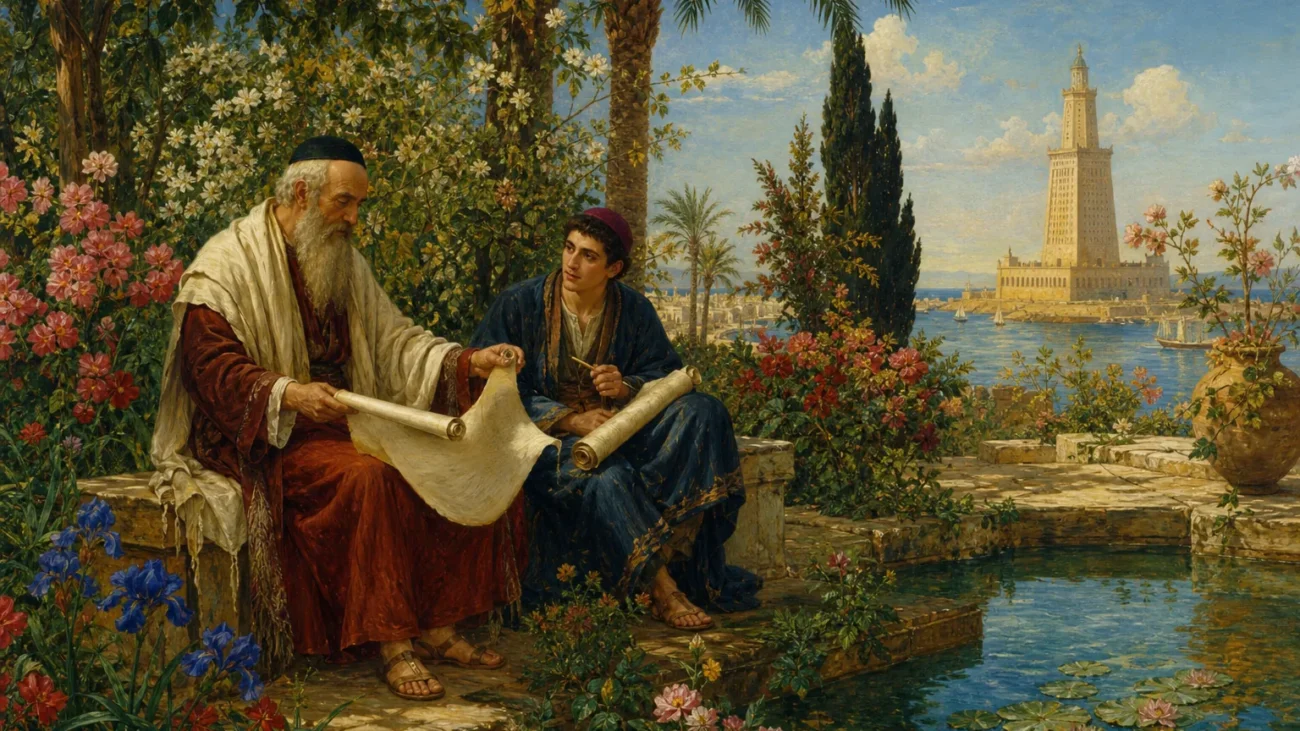
The septuagint translation is the earliest Greek version of the Hebrew Bible that still survives today. People also call it the Greek Old Testament or the Translation of the Seventy, and they often shorten its name to LXX. Jews living in the Ptolemaic Kingdom, probably in or around Alexandria, first produced it. Later, Christian communities carried it into new languages and new lands. In this article, we trace its story, from an ancient legend to the gospel pages where Isaiah’s prophecy speaks again.
The Legend Behind the Septuagint Translation
The full Greek title comes from a story in the Letter of Aristeas, which Aristeas addressed to his brother Philocrates. According to this account, Ptolemy II Philadelphus, who ruled from 285 to 247 BC, asked for “the laws of the Jews” in Greek. So he sent for seventy-two Hebrew translators, six from each of the Twelve Tribes of Israel. They traveled from Jerusalem to Alexandria to translate the Torah for the Library of Alexandria.
However, some scholars consider the letter pseudepigraphical. Even so, the story lived on. Philo repeated it, and Josephus retold it in Antiquities of the Jews. Later, Augustine, Bishop of Hippo, also passed it on. In addition, the Tractate Megillah of the Babylonian Talmud tells how King Ptolemy placed 72 elders in separate rooms. Each man worked alone, yet the result matched perfectly: “God put it in the heart of each one to translate identically as all the others did.”
A Name, a Festival and an Honest Debate
The word “Septuagint” comes from a Latin phrase meaning “The Old Testament from the version of the Seventy Translators.” In fact, writers only began using the Latin term Septuaginta in the time of Augustine of Hippo (354–430 AD). Today, readers often meet the Roman numeral LXX, which simply means seventy.
The Jews of Alexandria celebrated this work every year with a festival on Pharos, where the Lighthouse of Alexandria stood. Tradition said the septuagint translation took place there. During the festival, many Jews and some Gentile visitors gathered on the beach for a grand picnic.
Yet not everyone accepted the legend at face value. For example, in 1844 Lancelot Charles Lee Brenton called the account of Aristeas a pious fiction. Instead, he thought the name came from the Sanhedrin in Alexandria, which edited and approved the earliest version. Similarly, scholars urge caution about Philo’s claim of six men from each tribe, because Assyria had resettled the ten northern tribes centuries earlier.
When and Why the Septuagint Translation Was Made
Biblical scholars agree on the core facts. Jews translated the first five books of the Hebrew Bible into Koine Greek in the mid- or late 3rd century BCE. Several clues support this date. First, its Greek reflects early Koine. Then, citations appear as early as the 2nd century BC, and early manuscripts also date from that century.
After the Torah, translators turned to the other books over the next two to three centuries. Most were presumably finished in the 2nd century BCE, and the Greek text was complete by 132 BC. Still, Jewish and Christian communities kept revising the septuagint translation through the fourth century CE.
Why did anyone need it? During the Second Temple period, few people could speak Hebrew, and even fewer could read it. Instead, Koine Greek and Aramaic served as the common languages of the Jewish community. As a result, the LXX met a need in the Jewish community.
The Language and Shape of the Greek Old Testament
The translators wrote in Koine Greek. Some sections, however, carry Semiticisms, which are idioms based on Hebrew and Aramaic. Other books, such as Daniel and Proverbs, show a stronger Greek influence. The style also varies a great deal. Some books follow the Hebrew closely, while others paraphrase or interpret.
In addition, the LXX is not one unified book. Rather, it gathers many ancient translations of the Tanakh, along with other Jewish texts now often called apocrypha. Different people made these translations in different places and times, often from different Hebrew manuscripts. The Hebrew Bible has three parts: the Law, the Prophets and the Writings. By contrast, the septuagint translation has four: law, history, poetry and prophets.
The work even helps scholars with pronunciation. Hebrew texts of that time lacked vowel marks. The Greek, however, spells many proper names with vowels, which offers clues about how people may have spoken them.
From Alexandria to Isaiah’s Sign in Matthew
As early Christianity spread, the LXX traveled with it. Believers rendered it into Latin in several versions, known together as the Vetus Latina. Moreover, the septuagint translation formed the basis for the Old Church Slavonic, Syro-Hexaplar, Classical Armenian, Old Georgian and Coptic versions of the Christian Old Testament.
The Gospel of Matthew quotes the words of the prophet Isaiah. Long before, Isaiah had announced a sign:
“Therefore the Lord himself shall give you a sign; Behold, a virgin shall conceive, and bear a son, and shall call his name Immanuel.” (Isaiah 7:14)
Then Matthew, telling the story of Jesus’ birth, turns to this very prophecy. He presents it as words “spoken of the Lord by the prophet” (Matthew 1:22). Next, he repeats the promise of a son named Emmanuel. Finally, he adds a short explanation so his readers can grasp the name: “which being interpreted is, God with us” (Matthew 1:23). Matthew makes sure his readers understand the name’s meaning.
What the Septuagint Translation Teaches Us Today
The septuagint translation reminds us that Scripture has traveled across languages. Translators in Alexandria worked so that the Jewish community could have the Law in a language it knew. Likewise, Matthew paused to explain that Emmanuel means “God with us.”
So we may give thanks for every faithful hand that has carried Scripture across languages. Above all, Isaiah’s sign and Matthew’s words invite us to reflect on the name Emmanuel, “God with us.”
