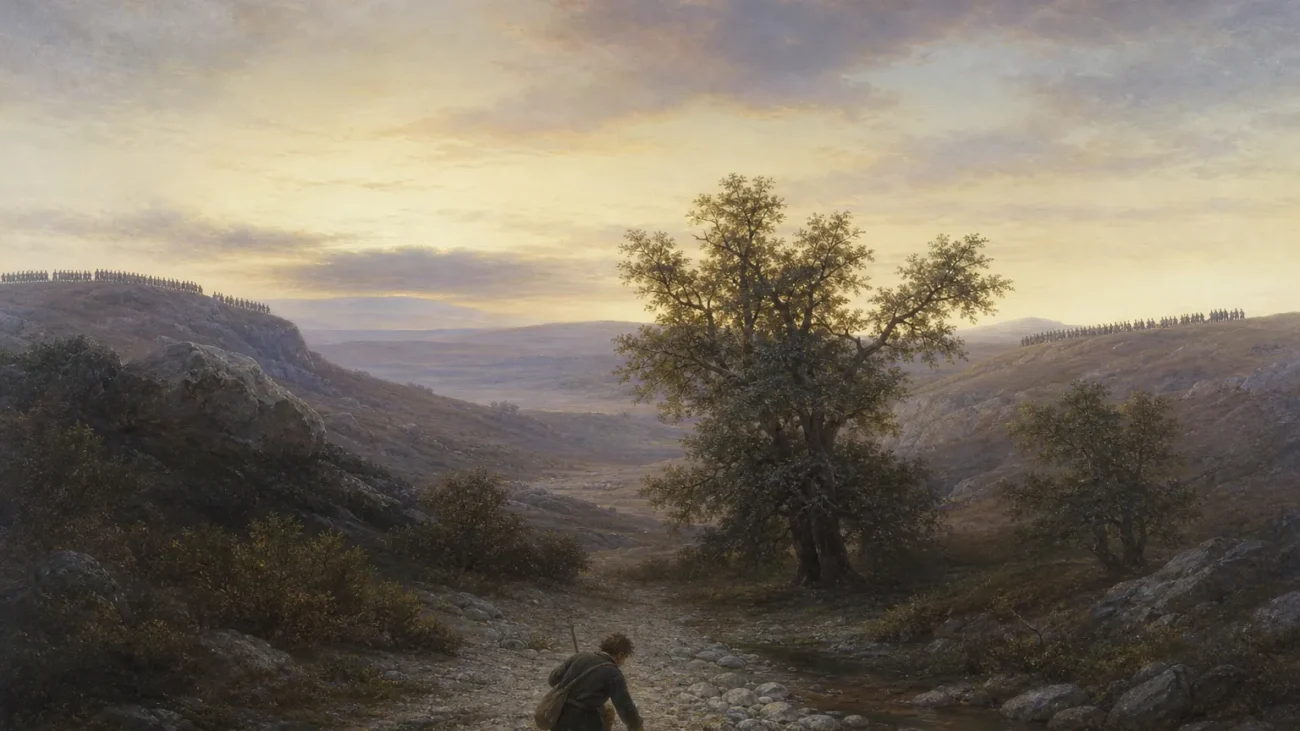
The story of David and Goliath is one of the best-known accounts in the whole Bible. Yet many readers know it only as a tale of a small fighter beating a big one. In fact, 1 Samuel 17 places the battle in a real valley and roots David’s courage in his trust in the Lord. So this article walks through the setting, the challenge and the words David spoke. Then it asks what the passage teaches about true courage.
The Valley of Elah, Setting of David and Goliath
The Valley of Elah is a long, shallow valley in the Shephelah area of Israel. Its Hebrew name means “valley of the terebinth,” after the large, shady trees that grow there. In Arabic, people call it Wadi es-Sunt, after its white acacia trees. Near Socho, on the west side, one ancient terebinth stands 55 feet tall and marks the valley’s upper end.
The opening of 1 Samuel 17 names nearby towns such as Azekah and Sokho, and archaeologists have identified sites linked to both. In addition, the ruins of Khirbet Qeiyafa lie on the valley’s north side. Many identify this fortress with Shaaraim, a town the same chapter mentions. In 2009, Professor Yosef Garfinkel uncovered a fortified city there, dated between 1050 and 915 BC. Some see it as support for the biblical picture of the United Monarchy. Others remain skeptical.
Travelers in the late 19th century described the valley as an open, flat vale about half a mile across. Down its center ran a narrow trench full of white pebbles that winter water had worn smooth. That detail helps readers of David and Goliath imagine the kind of brook where a shepherd might choose his stones.
A Challenge That Silenced an Army
In 1 Samuel 17, Saul and the Israelites face the Philistines across this valley. Twice a day for 40 days, morning and evening, Goliath steps out between the lines. He is the Philistine champion, and he dares Israel to send one man to settle the war in single combat. However, Saul is afraid, and no one answers.
The ancient copies differ on Goliath’s height. The Masoretic Text gives “six cubits and a span,” about 9 feet 9 inches. Yet the Dead Sea Scrolls, Josephus and the Septuagint give “four cubits and a span,” about 6 feet 9 inches. Many scholars think the smaller number came first. Either way, every telling of David and Goliath presents him as a fearsome warrior.
Saul’s fear stands out, because Saul stood a head taller than anyone in Israel (1 Samuel 9:2). He seemed the obvious man to answer the challenge. Instead, the answer came from a young shepherd. In the longer Hebrew text, David arrives because his father has sent him with food for his brothers. He hears the challenge and wants to accept it.
David’s Confidence Rooted in the Lord
This conversation with the king sits at the heart of David and Goliath. First, David speaks to calm the people’s fear: “Let no man’s heart fail because of him; thy servant will go and fight with this Philistine” (1 Samuel 17:32). Saul objects that David is only a youth, while Goliath has fought since his own youth.
David then explains where his courage comes from. While keeping his father’s sheep, he chased a lion and a bear that had taken a lamb. He rescued the lamb and struck down the attacker. Yet David does not credit his own strength. Instead, he says:
“The LORD that delivered me out of the paw of the lion, and out of the paw of the bear, he will deliver me out of the hand of this Philistine.” (1 Samuel 17:37)
So David’s confidence rests on what God has already done. He also sees the real issue: Goliath has defied “the armies of the living God” (1 Samuel 17:36). Finally, Saul agrees and offers David his own armour. David declines it. He takes only his staff, his sling and five stones from a brook.
The Battle Is the Lord’s in David and Goliath
When the two men meet, the contrast is plain. Goliath carries his armor and javelin, and he curses David by his gods. David, however, answers with words of faith:
“Thou comest to me with a sword, and with a spear, and with a shield: but I come to thee in the name of the LORD of hosts, the God of the armies of Israel, whom thou hast defied.” (1 Samuel 17:45)
David adds that all the earth will know there is a God in Israel. He also declares that “the LORD saveth not with sword and spear: for the battle is the LORD’S” (1 Samuel 17:47). In other words, David wants God, not himself, to receive the glory.
Then the giant advances, and David runs toward the battle line to meet him. He reaches into his bag, slings a stone and strikes Goliath in the forehead. The giant falls on his face to the ground. As a result, the Philistines flee, and Israel chases them as far as Gath and the gates of Ekron. The chapter sums it up simply: David won “with a sling and with a stone,” and “there was no sword in the hand of David” (1 Samuel 17:50). Afterward, Abner brings the young man to Saul. David tells the king he is the son of Jesse the Bethlehemite.
David and Goliath: More Than an Underdog Story
Today, people use the phrase “David and Goliath” for any contest where a weaker side faces a stronger one. Yet the chapter itself points further. Scholars note that the story contrasts David with Saul. God had chosen Saul to lead Israel against its enemies, yet he held back. David, by contrast, acts like a shepherd who protects the flock. His lion-and-bear imagery hints at the kind of king Israel truly needed.
Readers may also meet scholarly discussion about how the account took shape. For example, 2 Samuel 21:19 credits Elhanan, a Bethlehemite, with killing Goliath the Gittite. Many scholars consider that the older account. Meanwhile, 1 Chronicles 20:5 says Elhanan killed Lahmi, the brother of Goliath. The Septuagint also preserves a shorter version of 1 Samuel 17, and scholars debate which form came first. Whatever view readers hold, the message of David and Goliath in 1 Samuel 17 is not mainly about size. Instead, it is about trust.
Courage for Our Own Valleys
The story of David and Goliath invites us to face our fears the way David did. He remembered how the Lord had delivered him before, and that memory gave him strength for a new danger. Similarly, we can recall God’s past help when a fresh challenge stands before us.
Above all, David reminds us that the battle is the Lord’s. True courage does not deny the size of the giant. Rather, it trusts the God who saves not with sword and spear. Therefore, whatever valley we face, we can step forward in His name.
