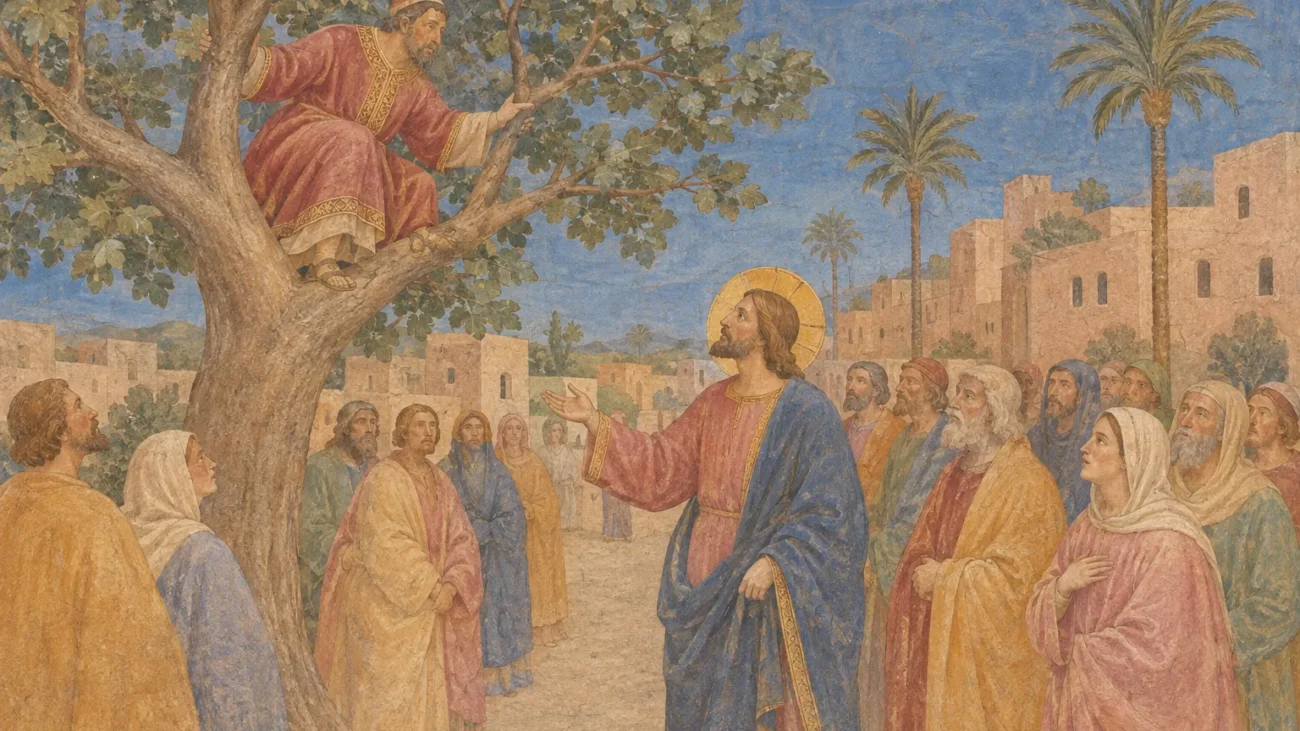
The story of Zacchaeus the tax collector is one of the most vivid encounters in the Gospel of Luke. A rich man in Jericho, he climbed a tree simply to catch a glimpse of Jesus. Yet Jesus did far more than pass by. He stopped, called him by name and stayed at his house. As a result, a life that many people had written off turned around in a single day. In fact, the account closes with one of the clearest statements of why Jesus came into the world.
Jericho, the Setting for Zacchaeus the Tax Collector
Luke opens the scene simply: “And Jesus entered and passed through Jericho” (Luke 19:1). Jesus was on his way to Jerusalem, and Jericho lay along his route. The city sits in the Jordan Valley, with the Jordan River to the east and Jerusalem to the west. It is among the oldest cities in the world. Its copious springs have drawn people to live there for thousands of years. The Bible also describes it as the “city of palm trees.”
Jericho was also a place of wealth. The production and export of balsam centered there, and this lucrative trade made a tax post in the city both important and profitable. So when Luke introduces Zacchaeus the tax collector, we should picture a man at the top of a rich local economy. Even the city’s name suits the setting. Its Arabic name means “fragrant,” and most link its Hebrew name to the same Canaanite root.
A Rich Man Who Longed to See Jesus
Luke tells us that Zacchaeus “was the chief among the publicans, and he was rich” (Luke 19:2). His name carries a striking meaning: “pure, innocent.” However, his neighbors would hardly have used those words about him. People in his day despised tax collectors as traitors, because they worked for the Roman Empire rather than for their own Jewish community. Many also regarded them as corrupt.
Still, something stirred in Zacchaeus the tax collector. He wanted to see who Jesus was. Yet he faced a practical problem, because a crowd pressed around Jesus and Zacchaeus was short. Luke puts it plainly: “he sought to see Jesus who he was; and could not for the press, because he was little of stature” (Luke 19:3).
Instead of giving up, Zacchaeus ran ahead of the crowd. Then he climbed a sycamore tree along the road, because Jesus was about to pass that way (Luke 19:4). The tree was actually a sycamore-fig. For a wealthy official, running and climbing like this was hardly dignified. Even so, Christian readers have long seen this climb as a sign of his faith.
Jesus Calls Zacchaeus the Tax Collector by Name
Then comes the turning point. When Jesus reached the spot, he looked up into the branches and spoke directly to the man there:
“Zacchaeus, make haste, and come down; for to day I must abide at thy house.” (Luke 19:5)
Notice that Jesus used his name. Zacchaeus the tax collector had come only to look, yet Jesus saw him first and invited himself to his home. In addition, Jesus said he “must” stay there, as if this visit lay at the heart of his purpose that day. Zacchaeus responded at once. He “made haste, and came down, and received him joyfully” (Luke 19:6).
Eastern churches have long found a lesson in this moment. For them, the call to come down from the tree symbolizes the divine call to humility. Similarly, every believer can hear in it an invitation to lay aside pride and welcome Jesus gladly.
The Crowd Murmurs at a Sinner’s Guest
Not everyone shared his joy. The crowd that had blocked his view now grumbled. Luke records that “they all murmured, saying, That he was gone to be guest with a man that is a sinner” (Luke 19:7). In their eyes, a religious teacher and prophet should not soil himself by staying in such a house. As a result, the shock of the crowd reveals how low Zacchaeus the tax collector stood in public opinion.
Yet Jesus did not change his plans. He went to the home that others avoided. Therefore the story quietly challenges every reader. It asks whether we, too, decide too quickly who lies beyond God’s reach.
How Zacchaeus the Tax Collector Changed His Life
Something changed in Zacchaeus that day. He stood before the Lord and made a remarkable promise:
“Behold, Lord, the half of my goods I give to the poor; and if I have taken any thing from any man by false accusation, I restore him fourfold.” (Luke 19:8)
His response went far beyond what anyone demanded. First, he gave half of all he owned to the poor. Then he promised a fourfold repayment to anyone he had cheated. In other words, generosity replaced greed, and honesty replaced false accusation. Some connect this generosity with the preaching of John, who urged people to give away their excess possessions (Luke 3:7–14).
Jesus answered with words of welcome: “This day is salvation come to this house, forsomuch as he also is a son of Abraham” (Luke 19:9). Then he summed up his whole mission in one sentence. “For the Son of man is come to seek and to save that which was lost” (Luke 19:10). The man the crowd called a sinner was, in fact, exactly the kind of person Jesus came to find.
Zacchaeus in Later Christian Tradition
The church never forgot the story of Zacchaeus the tax collector. At Er-riha, the modern Jericho, tradition gives the name House of Zacchaeus to a large, square tower. The later Apostolic Constitutions name “Zacchaeus the Publican” as the first bishop of Caesarea. In addition, a medieval legend identified him with Saint Amadour and made him the founder of the French sanctuary of Rocamadour. Clement of Alexandria mentions him once in a way some read as linking him with Matthew or Matthias. However, Luke places Matthias with Jesus from the baptism of John (Acts 1:21–22).
His story also shapes worship. In Eastern Orthodox and Greek-Catholic churches, believers hear this Gospel on the penultimate Sunday before Great Lent, known as “Zacchaeus Sunday.” These churches chose it because it speaks of humility and repentance. In the Russian tradition, this Sunday always comes immediately before Great Lent. Meanwhile, Western Christianity reads the account at the dedication of a church or its anniversary. In Southern Bavaria, some churches even fly a red banner with a white cross, the Zacchaeus flag, on that day.
A Reflection for Today
The story of Zacchaeus the tax collector reminds us that no one is too small or too far away for Jesus to notice. He looked up into the tree and called a despised man by name. So this passage invites us to seek Jesus with the same eagerness. It also invites us to come down quickly when he calls and to receive him joyfully. Above all, it points us to the purpose Jesus himself declared: he came “to seek and to save that which was lost.”
