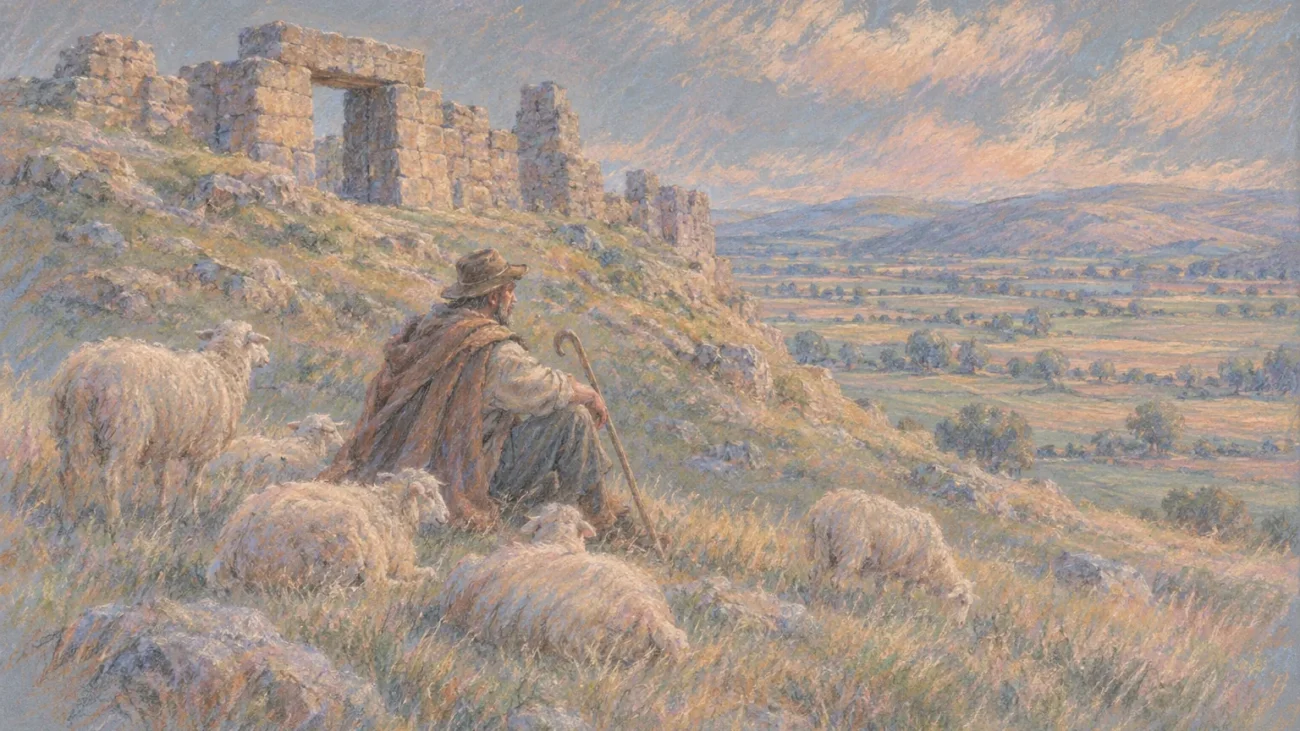
Biblical Megiddo was a real city long before its name echoed through the Book of Revelation. Its ruins rise as a mound, or tell, in northern Israel at the western edge of the Jezreel Valley. In the Bronze Age, it was a powerful Canaanite city-state. Later, in the Iron Age, it became a royal city in the Kingdom of Israel. Today, many readers know it best through its Greek form, Armageddon. So let us walk through its long story, from ancient worship to the words of Scripture.
Where Biblical Megiddo Stood
The tell lies about 30 kilometres southeast of Haifa. It sits at the northern end of the Wadi Ara, a pass through the Carmel Ridge. From there, the city looked out over the rich Jezreel Valley. In addition, it guarded a narrow pass on the most important trade route of the ancient Fertile Crescent. Today people call that road the Via Maris. It linked Egypt with Mesopotamia and Anatolia.
Because of this position, biblical Megiddo became a center of trade, politics and war. Armies often met nearby, and the site saw several battles. Different peoples also gave it different names. The Assyrians wrote Magiddu, while Egyptian texts used forms such as Maketi and Makedo. The Amarna letters spell it Magidda. Later, the Greek Septuagint used Mageddo, and the Latin Vulgate kept Mageddo as well.
Thousands of Years Beneath One Mound
The story of biblical Megiddo reaches back to the dawn of settled life. Archaeologists have uncovered 20 layers of ruins at the site. The earliest belong to the Neolithic age, around 5000 BCE. In fact, some expedition archaeologists suggest people lived there even around 7000 BCE. People then occupied the city continuously from about 3000 BCE until the Persian period, around 332 BCE. As a result, the mound holds massive walls and gates, palaces, temples, houses and an advanced water system.
For a long time, however, scholars argued about where Megiddo actually stood. In the 19th century, Edward Robinson linked it with Lajjun. He noticed that Scripture rarely mentions Megiddo except together with Taanach, a circumstance that implied they lay close to each other. Then Schumacher dug at Tell el-Mutesellem in 1903–5, and the Oriental Institute of Chicago University later renewed the work. Their results showed that the true site was the tell about a mile north of Lejjun. Today Megiddo National Park protects the site, and UNESCO lists it as a World Heritage Site.
Canaanite Worship at Biblical Megiddo
Long before Israel’s kings, biblical Megiddo was a place of worship. Around 3000 BCE, its people built a temple that excavators Adams, Finkelstein and Ussishkin called “the most monumental single edifice so far uncovered” in the early Bronze Age Levant. South of it stood a compound of long, parallel stone walls, each 4 meters wide. Between them ran narrow corridors, filled hip-deep with the remains of animal sacrifice. Later, large megaron temples rose above these walls in the Early Bronze III period, 2700–2300 BCE.
Recent digs beside a highway near the site added a more personal picture. Archaeologists from the Israel Antiquities Authority found a ritual burial pit, or favissa, from the end of the Late Bronze Age, about 3,300 years ago. It lay outside the city walls but in clear sight of the large temple. Nearby, a rock outcrop may have served as an open-air altar. Perhaps these worshippers could not enter the temple precinct, so they found another place to bring their offerings.
The pit held a model shrine, storage jars, and jugs and juglets from Cyprus. Above all, it contained a ram-shaped vessel for pouring liquids such as milk, oil or wine. The same team also found a small rock-cut winepress about 5,000 years old. Excavation directors Amir Golani and Barak Tzin described it as “unique, one of very few known from such an ancient period when urbanization first took place in our region.”
Solomon Builds Up Megiddo
During Israel’s monarchy, Megiddo joined the great building works of King Solomon. The First Book of Kings explains the reason for the levy the king raised:
“And this is the reason of the levy which king Solomon raised; for to build the house of the LORD, and his own house, and Millo, and the wall of Jerusalem, and Hazor, and Megiddo, and Gezer.” (1 Kings 9:15)
So biblical Megiddo stood beside Jerusalem, Hazor and Gezer in Solomon’s plans. Excavators traced a wall that runs almost all round the mound. They also found a city gate of well-dressed ashlar. Many presumed that Phoenician masons working for Solomon built it, though it also shows some Hittite features.
The ruins also tell of hard times. Debris and ashes above this layer suggest that the city suffered destruction. Higher up, two layers belong to the period of the northern Israelite monarchy. There diggers found a cartouche of Pharaoh Shoshenk, whom the Hebrew Bible calls Shishak. His record at Karnak lists the cities he subdued, and it includes both Megiddo and Taanach.
King Josiah Falls at Biblical Megiddo
Later, biblical Megiddo became the scene of a painful moment in Judah’s history. Pharaoh Necho of Egypt marched north toward the Euphrates against the king of Assyria. King Josiah went out to meet him. Second Kings records the outcome in one brief verse:
“In his days Pharaoh-nechoh king of Egypt went up against the king of Assyria to the river Euphrates: and king Josiah went against him; and he slew him at Megiddo, when he had seen him.” (2 Kings 23:29)
The verse gives no long speech or battle report. Instead, it simply states that the Egyptian king killed Josiah at Megiddo. Once again, this city on the great trade road stood where empires crossed paths. Nothing in the upper layers dates later than about 350 BC. Around that time, the inhabitants seem to have moved a mile south, to a site the Romans later fortified and named Legio.
From Megiddo to Armageddon
The name appears once more, in a new form, in the last book of the Bible. Revelation describes a great gathering:
“And he gathered them together into a place called in the Hebrew tongue Armageddon.” (Revelation 16:16)
The Greek word Armageddon, or Harmagedon, transliterates the Hebrew Har Megiddo, which means “Mount Megiddo.” Because of this well-known verse, the word Armageddon has also come to mean any world-ending catastrophe in everyday speech.
Reflecting on Biblical Megiddo Today
The story of biblical Megiddo spans thousands of years. People worshipped there, Solomon’s building works included it, and King Josiah fell there. Yet its name lives on in a single verse of Revelation.
This invites us to read the Bible with fresh attention. When we read about Solomon’s levy, Josiah’s death or the gathering at Armageddon, we can remember the long story of this ancient hill and the real place behind these words.
