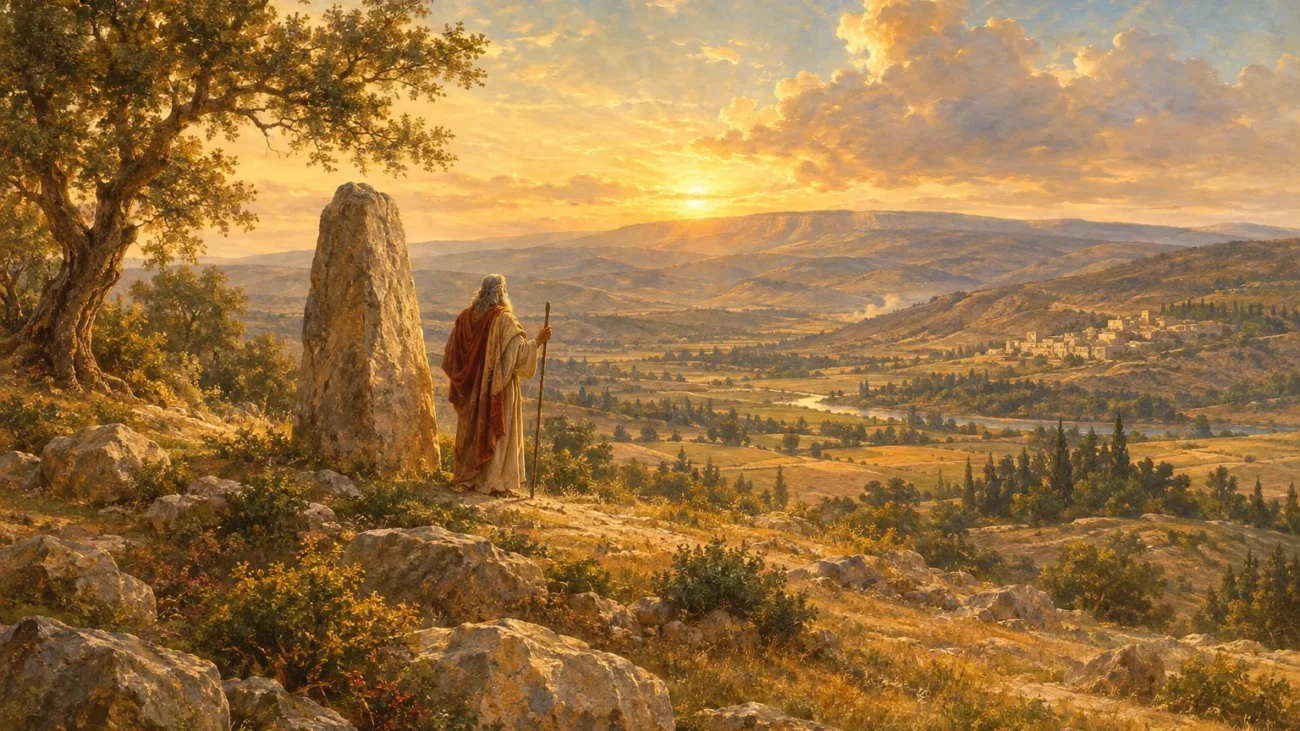
The Ebenezer stone is one of the simplest monuments in the Old Testament, yet its message still speaks to believers. After a day of deliverance, the prophet Samuel set a single stone on the ground and gave it a name. That name later traveled from the hills of ancient Israel into the songs of the church. In this article, we look at why Samuel raised the stone, what its name means, and how it became a lasting sign of remembering God’s help.
What the Ebenezer stone means
The Hebrew phrase behind the name, ‘éḇen hā’ēzer, literally means “the stone of help.” In other words, Samuel gave the monument a name that preached a short sermon to anyone who passed by. A rock in a field normally says nothing. This one, however, pointed every traveler back to what God had done.
Samuel also explained the name himself. As he set the stone in place, he spoke words that summed up the whole story:
“Hitherto hath the LORD helped us.” (1 Samuel 7:12)
The old word “hitherto” simply means “up to this point.” So the Ebenezer stone looks back over the road Israel had traveled. In addition, it confesses that God’s help reached them at every step along the way.
Interestingly, the Books of Samuel use the name Eben-Ezer in two stories. First, it appears as the site of a painful defeat. Then it appears as the name Samuel gave to his memorial. In fact, the place name in the earlier story seems to come from the stone Samuel set up later.
Defeat at Eben-Ezer and the loss of the Ark
The first story is a sad one (1 Samuel 4:1–11). Israel went out to fight the Philistines and brought the Ark of the Covenant onto the battlefield. The people hoped the Ark would guarantee victory. Instead, the Philistines defeated them and carried the Ark away.
The news struck hard at Shiloh. Eli, the priest in whose care the young Samuel had been left, heard that the Ark was taken and that his sons had died. As a result, he collapsed and died. Meanwhile, the Philistines kept the Ark for seven months. Yet calamities and misfortunes followed them, and finally they decided to send it back (1 Samuel 6:1–2).
Even so, the trouble did not end. Israel lived under Philistine control for 20 years. During this long season, Samuel helped keep the people’s faith and identity alive. He served in roles that rarely met in one person, as priest, prophet and judge.
Returning to the Lord at Mizpeh
After those 20 years, Samuel called the whole nation to a turning point. He told them that true return to God meant more than words:
“If ye do return unto the LORD with all your hearts, then put away the strange gods and Ashtaroth from among you.” (1 Samuel 7:3)
Samuel also promised that the Lord would deliver them from the Philistines if they served Him alone. Remarkably, the people listened. They put away Baalim and Ashtaroth and served the Lord only (1 Samuel 7:4).
Next, Samuel gathered all Israel to Mizpeh and promised to pray for them. There the people drew water and poured it out before the Lord. They also fasted that day and openly confessed, “We have sinned against the LORD” (1 Samuel 7:6). Therefore, the story of the Ebenezer stone begins not with a battle but with repentance.
Why Samuel set up the Ebenezer stone
The Philistines soon heard about the gathering at Mizpeh. Their lords marched up against Israel, and the people grew afraid. Instead of reaching first for weapons, they turned to Samuel and begged him: “Cease not to cry unto the LORD our God for us” (1 Samuel 7:8).
Samuel then took a young lamb and offered it to the Lord as a whole burnt offering. He cried out to God for Israel, and the Lord heard him (1 Samuel 7:9). While Samuel was still offering the sacrifice, the Philistines advanced to attack. At that moment, the Lord thundered with a great thunder against them and threw them into confusion (1 Samuel 7:10).
Afterward, the men of Israel left Mizpeh, chased the Philistines and struck them down as far as the area below Beth-car (1 Samuel 7:11). Finally, Samuel took a stone and set it between Mizpeh and Shen. So the Ebenezer stone marked a victory that Israel had not won by its own strength. Above all, it honored the God who heard a prayer and answered. A long period of peace followed.
Searching for the site of the Ebenezer stone
Today, no one knows exactly where Eben-Ezer stood. The biblical place lay less than a day’s walk from Shiloh, near Aphek and in the area of Mizpah. It also sat near the western entrance of the pass of Bethoron. Some identify it with Beit Iksa, while others prefer Dayr Aban.
For the first battle, many Israeli archaeologists and historians point to the area near modern Kafr Qasim, close to Antipatris, the ancient city of Aphek. They propose the Izbet Sartah mound, north of Rosh HaAyin, as the site. By contrast, the text does not describe the second battle’s location clearly enough for certainty.
Older writers offered other views. Eusebius placed Eben-Ezer between Jerusalem and Ascalon, near Beth Shemesh. Similarly, Epiphanius of Salamis identified a site near Beth Shemesh. Yet the exact spot of the Ebenezer stone matters less than the truth it proclaimed.
From a field stone to a beloved hymn
Over the centuries, Samuel’s monument did not stay in the fields of Israel. Instead, it found a home in Christian worship. The hymn “Come Thou Fount of Every Blessing” refers directly to this stone.
For this reason, many believers know the word “Ebenezer” from singing long before they read 1 Samuel 7. When they sing it, they join Samuel in looking back with gratitude. In other words, the hymn turns an ancient landmark into a personal confession of God’s faithful help.
Remembering God’s help with the Ebenezer stone
The Ebenezer stone invites us to pause and look back. Israel’s story moved from defeat, to repentance, to prayer, and then to deliverance. At each stage, the people needed God, and at the end they could say He had helped them.
Likewise, this passage encourages us to return to the Lord with all our hearts and to cry out to Him in our fears. Then, when He answers, we can mark the moment and give thanks. Hitherto, the Lord has helped His people, and that memory gives us courage for the road ahead.
