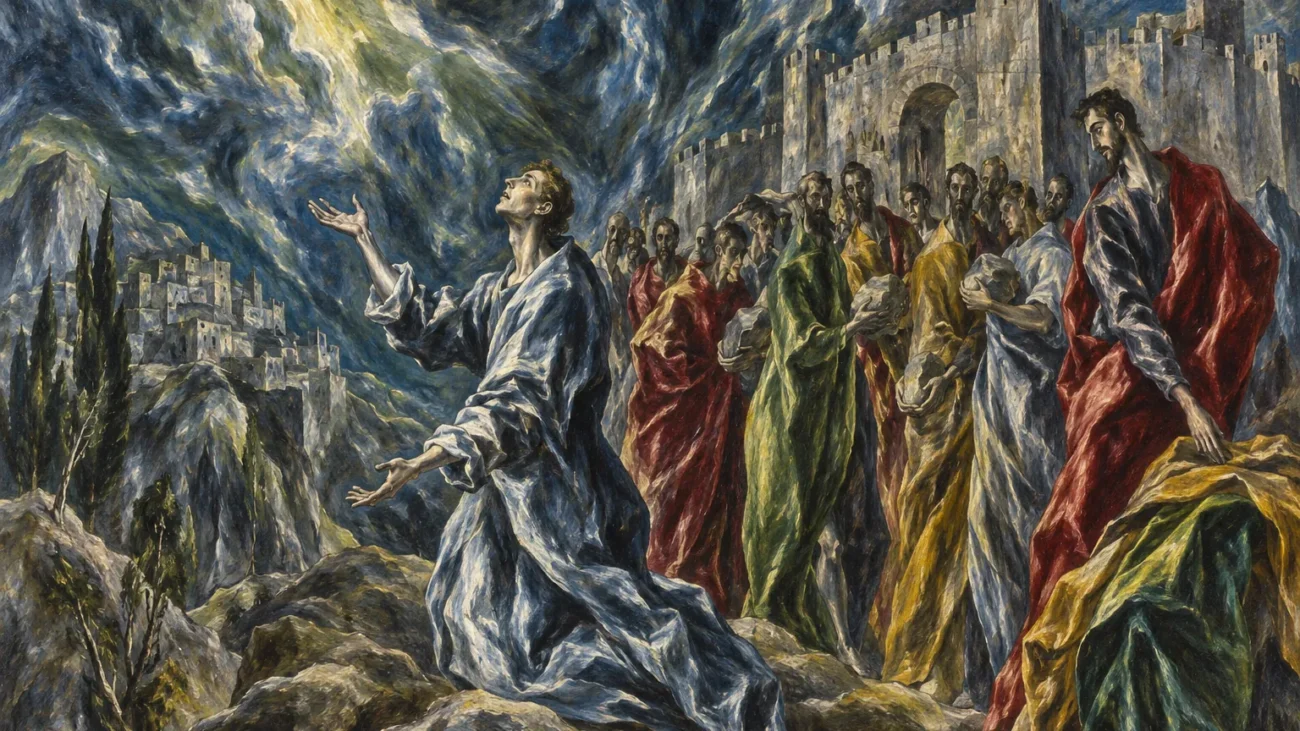
Stephen the first martyr holds a special place in the story of the early church. The Acts of the Apostles is the only source that tells us about him, and its account is short but powerful. Stephen served tables, worked wonders, spoke boldly before the highest court of his people, and died praying for the men who killed him. For this reason, Christians have traditionally honored him as the protomartyr, the first martyr of the faith. His name comes from the Greek Stephanos, which means “wreath” or “crown.” So, as we follow his story, we meet a man who carried a fitting name.
A Growing Church Chooses Seven Servants
The story begins in Jerusalem, where the number of disciples kept growing. However, growth also brought tension. The Greek-speaking believers complained against the Hebrews, because the community was neglecting their widows in the daily distribution of food. As a result, the twelve apostles gathered all the disciples to find an answer.
The apostles did not want to leave the preaching of God’s word in order to serve tables. Instead, they asked the church to look for seven trustworthy men. They said:
“Wherefore, brethren, look ye out among you seven men of honest report, full of the Holy Ghost and wisdom, whom we may appoint over this business.” (Acts 6:3)
Meanwhile, the apostles would give themselves to prayer and to the ministry of the word. The whole community liked this plan. Here Stephen the first martyr enters the story. The believers named him first, describing him as “a man full of faith and of the Holy Ghost” (Acts 6:5). They also chose Philip, Prochorus, Nicanor, Timon, Parmenas, and Nicolas, a proselyte of Antioch.
Stephen the First Martyr, Full of Faith and Power
The believers brought the seven men to the apostles. Then the apostles prayed and laid their hands on them. After this, the word of God kept spreading. In addition, the disciples in Jerusalem multiplied greatly, and many priests became obedient to the faith.
His name is Greek, so many assume Stephen was one of these Greek-speaking Hellenistic Jews. Beyond that, we know nothing about his earlier life. According to Orthodox belief, he was the eldest of the seven, and that tradition therefore calls him “archdeacon.” Yet Acts focuses less on his rank and more on his heart.
Acts describes Stephen the first martyr with rich words. He was “full of faith and power,” and he “did great wonders and miracles among the people” (Acts 6:8). In other words, his humble work at the tables did not limit him. Rather, the man who served food to widows also carried the power of God among the crowds.
Stephen the First Martyr Before the Council
Stephen seems to have taught among synagogues of Hellenistic Jews. Members of the Synagogue of the Libertines opposed him, along with Cyrenians, Alexandrians, and people from Cilicia and Asia. They challenged his teaching in debate. However, Stephen got the better of them.
Furious at this defeat, his opponents found false witnesses. These witnesses claimed that Stephen had spoken blasphemy against Moses and God. Then they dragged him before the Sanhedrin, the supreme court of the Jewish elders. There they accused him of preaching against the Temple and the Law. Even so, Stephen the first martyr stayed calm. In fact, his face looked like “that of an angel.”
The Longest Speech in Acts
Stephen answered with the longest speech in the Acts of the Apostles. It fills almost the whole of Acts 7. First, he retold the history of Israel. He began with the God of glory, who appeared to Abraham in Mesopotamia. This opening already pointed to a major theme: God does not dwell only in one building.
Next, Stephen walked through the stories of the patriarchs. He spoke in even more detail about Moses. God appeared to Moses in the burning bush and moved him to lead the people out of Egypt. Nevertheless, the Israelites turned to other gods. This showed a second theme, Israel’s disobedience to God.
Stephen faced two charges. His accusers said he claimed Jesus would destroy the Temple, and that he had changed the customs of Moses. In 2012, Pope Benedict XVI said Stephen used the Jewish scriptures to show that Jesus fulfilled the laws of Moses instead of overturning them. Finally, Stephen turned to his listeners directly. He called them “stiff-necked” people who resisted the Holy Spirit, just as their ancestors had done.
Some scholars point out small differences between his retelling and the older scriptures. For example, Stephen placed Jacob’s tomb in Shechem, while Genesis 50:13 records a burial in the cave of Machpelah at Hebron. Some theologians see a condensed summary for listeners who already knew the stories. Other scholars consider these differences errors, and still others see deliberate theological choices.
A Vision of Heaven Opened
His words cut the council members to the heart, and they gnashed their teeth at him. Yet Stephen the first martyr, full of the Holy Spirit, looked steadily into heaven. There he saw the glory of God and Jesus standing at God’s right hand. Then he told them what he saw:
“Behold, I see the heavens opened, and the Son of man standing on the right hand of God.” (Acts 7:56)
His words pushed the crowd past their limit. They shouted, covered their ears, and rushed at him together. Next, they threw him out of the city and began to stone him. Meanwhile, the witnesses laid their clothes at the feet of a young man named Saul. That same Saul of Tarsus, a Pharisee and Roman citizen, would later become Paul the Apostle.
A Prayer of Forgiveness
While the stones fell, Stephen called on God. He prayed, “Lord Jesus, receive my spirit” (Acts 7:59). Then he knelt down and cried out with a loud voice one final time:
“Lord, lay not this sin to their charge.” (Acts 7:60)
After he said this, he “fell asleep.” Even at the end, Stephen the first martyr did not curse his enemies. Instead, he asked the Lord not to hold their sin against them. Saul, for his part, “was consenting unto his death.”
After Stephen’s death, the remaining disciples, except the apostles, fled to distant lands. Many went to Antioch. Acts does not name the exact place of the stoning, so two traditions arose. The archaeologists Louis-Hugues Vincent and Félix-Marie Abel considered one tradition ancient; it points to Jerusalem’s northern gate. They dated the other, which points to the eastern gate, no earlier than the 12th century.
Today the Catholic, Anglican, Oriental Orthodox, Eastern Orthodox, and Lutheran churches, along with the Church of the East, venerate Stephen as a saint. Artists often show him with a crown that symbolizes martyrdom. They also add three stones and a martyr’s palm frond.
Following Stephen the First Martyr Today
The story of Stephen the first martyr invites us to look up, as he did. He served widows at the tables, and he spoke for God before a hostile court. In both places, Acts describes him as full of faith and of the Holy Spirit. So his life gently reminds us that faithful service and bold witness belong together.
Above all, his last prayer calls us to forgive. Stephen asked God not to charge the sin against the very people who were killing him. Similarly, when we cry out for justice, we can remember that we pray as forgiven sinners. May his steady gaze toward heaven and his merciful words shape our own prayers.
