Psalm 46 has comforted God’s people for centuries with one bold opening line: “God is our refuge and strength, a very present help in trouble” (Psalm 46:1). The sons of Korah wrote the song, according to its heading. Today, the psalm forms a regular part of Jewish, Catholic, Lutheran, Anglican and other Protestant liturgies. In fact, many people know it as “Luther’s Psalm,” because Martin Luther used it as the starting point for “A Mighty Fortress Is Our God.” So let us walk through the psalm verse by verse and then follow its echo into one of the church’s best known hymns.
A Song of Holy Confidence
Charles Spurgeon called this psalm a “song of holy confidence.” The text has three sections. Each section ends with the word “Selah,” which comes after verses 3, 7 and 11 in English Bibles. In the Hebrew numbering, however, these breaks fall after verses 4, 8 and 12. The Greek Septuagint and the Latin Vulgate number it Psalm 45. In Latin, its title is “Deus noster refugium et virtus.”
Matthew Henry suggested that David may have composed the psalm after he defeated the enemies of ancient Israel from surrounding lands. The Hebrew heading also calls for musicians to play the psalm “on alamot.” Spurgeon noted that this could denote a high-pitched instrument. Alternatively, it could refer to the soprano voices of young girls who went out to dance in celebration of David’s victory over the Philistines. The Jerusalem Bible renders the word as an oboe. However, the Midrash Tehillim reads it as the “hidden things” that God does for his people. Above all, the psalm praises God as a source of power and salvation in times of trouble.
When the Earth Shakes: Psalm 46:1-3
The opening verse states the main theme at once. God is “a very present help in trouble.” The next line continues:
“Therefore will not we fear, though the earth be removed, and though the mountains be carried into the midst of the sea” (Psalm 46:2).
The psalm pictures mountains carried into the sea, waters that roar and are troubled, and mountains that shake with the swelling of the waters. Then the first section closes with “Selah.” Jewish prayer also includes the first verse (verse 2 in the Hebrew) in the Selichot.
The River That Gladdens the City of God
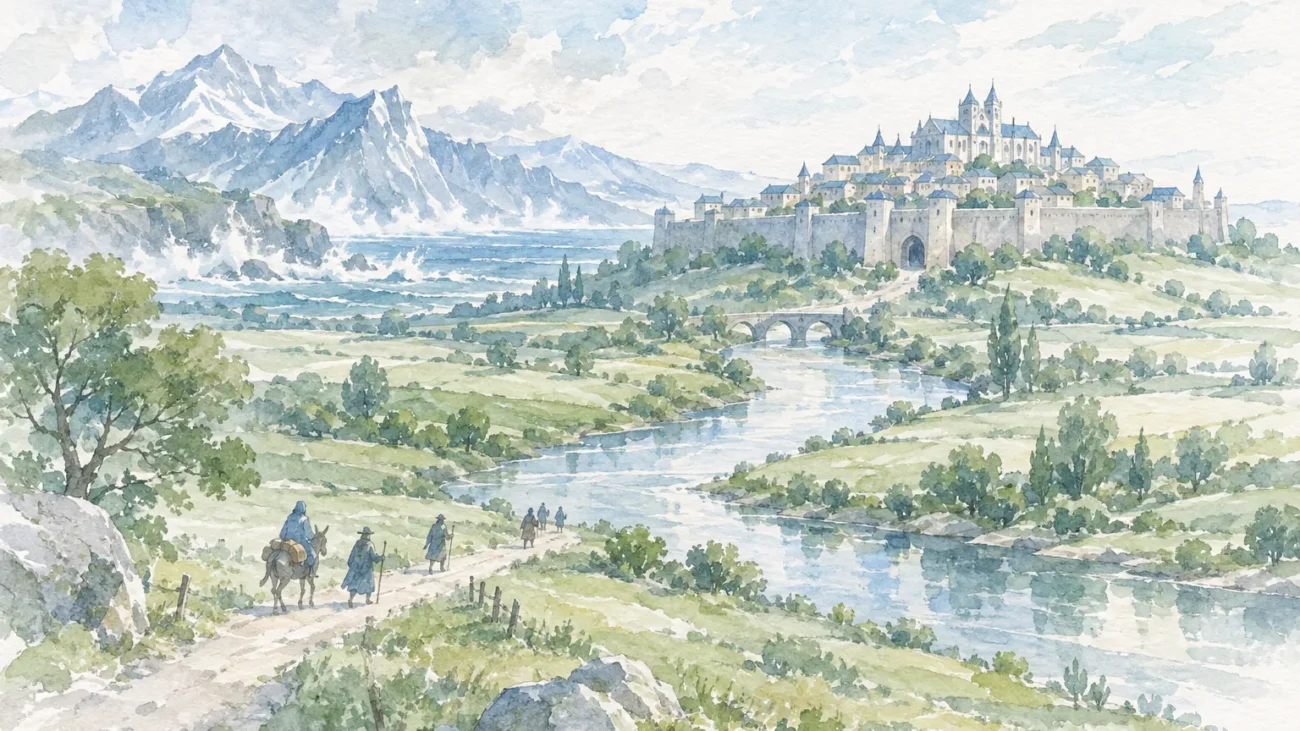
Next, the scene changes. After the roaring waters comes a river: “There is a river, the streams whereof shall make glad the city of God” (Psalm 46:4). The psalm then says that God is in the midst of her, and she shall not be moved. Moreover, God shall help her “right early.” The reference to “morning” or the “break of day” in verse 5 alludes to Abraham, who would rise at daybreak to pray to God.
Christian scholars differ on which river the psalm means. Some point to the Jordan. However, the Jordan lies 20 miles (32 km) northeast of Jerusalem, so some have found this possibility unlikely. A second view sees a river in Jerusalem during the millennial reign of Christ, running from beneath the Temple eastward to the Dead Sea, as the forty-seventh chapter of the Book of Ezekiel describes. A third view sees a river in Jerusalem after the millennial reign of Christ, the river that flows from the New Jerusalem, as the twenty-second chapter of the Book of Revelation describes. Others have also proposed that this psalm prophesies the kingdom of God under Jesus Christ.
Verse 6 then turns to the nations: “The heathen raged, the kingdoms were moved: he uttered his voice, the earth melted” (Psalm 46:6). After that comes the refrain: “The LORD of hosts is with us; the God of Jacob is our refuge” (Psalm 46:7). Jewish worship also uses this verse (verse 8 in the Hebrew) in the daily morning service. In the same way, these words close the whole song.
Be Still and Know: The Closing Verses of Psalm 46
The third section opens with an invitation: “Come, behold the works of the LORD” (Psalm 46:8). The psalm speaks of what God has done. He maketh wars to cease unto the end of the earth; he breaketh the bow, and cutteth the spear in sunder; he burneth the chariot in the fire (Psalm 46:9).
Then God himself speaks:
“Be still, and know that I am God: I will be exalted among the heathen, I will be exalted in the earth” (Psalm 46:10).
Psalm 47 develops this verse further. It opens with the words “Oh, clap your hands, all you peoples!” and addresses all the nations of the world. Finally, the refrain returns in verse 11: “The LORD of hosts is with us; the God of Jacob is our refuge.”
How Psalm 46 Inspired A Mighty Fortress
Martin Luther wrote the words and composed the tune of “Ein feste Burg ist unser Gott” between 1527 and 1529. English speakers know it as “A Mighty Fortress Is Our God.” The words are mostly original, although the first line paraphrases that of Psalm 46. Many believe Joseph Klug included the hymn in his Wittenberg hymnal of 1529, but no copy remains, and its title there was “Der xxxxvi. Psalm. Deus noster refugium et virtus.” The earliest extant hymnal in which it appears is that of Andrew Rauscher (1531).
Several accounts of the hymn’s origin exist. Heinrich Heine said that Luther and his companions sang it as they entered Worms in 1521. Another account calls it a tribute to Luther’s friend Leonhard Kaiser, whom authorities executed in 1527. Others connect it with the Diet of Augsburg in 1530, and some scholars with the Diet of Speyer in 1529. Alternatively, John M. Merriman writes that the hymn “began as a martial song to inspire soldiers against the Ottoman forces.”
People have called the hymn the “Battle Hymn of the Reformation.” Heinrich Heine named it “the Marseillaise of the Reformation.” Translators have rendered it into English at least seventy times. For example, Myles Coverdale made the first English translation in 1539. Later, Frederick H. Hedge translated “A mighty fortress is our God, a bulwark never failing” in 1853. Johann Sebastian Bach also used the hymn as the basis of his chorale cantata Ein feste Burg ist unser Gott, BWV 80, which he wrote for a celebration of Reformation Day. Today it is a suggested hymn for Catholic Masses in the U.S.
A Refuge for Every Season
Psalm 46 speaks of shaking mountains, roaring waters and raging nations. Yet it keeps returning to one refrain: “The LORD of hosts is with us; the God of Jacob is our refuge.”
Luther took the psalm as a starting point for a hymn that many Christians still sing. So when the ground seems to shift beneath you, let Psalm 46 speak once more: “Be still, and know that I am God.”
