Mary Magdalene stands among the most faithful followers of Jesus in the Gospels. She travelled with him, helped support his work, and watched him die on the cross. Then, at the empty tomb, she met the risen Lord and carried his message to the disciples. The Gospels tell us little about her life. Yet what they do say reveals a woman of deep love and steady courage. In this article we gather their witness, from her healing to her joyful encounter at the empty tomb.
A Name and a Hometown
Mary was by far the most common Jewish name for women in the first century. For this reason, the Gospel writers needed a way to set her apart from the other Marys who followed Jesus. So they called her “the Magdalene.” Most readers take this to mean she came from Magdala, a fishing village on the western shore of the Sea of Galilee. Early Christian tradition also linked her with a town of that name.
However, the question is more complex than it first appears. The Bible never explicitly connects her with a place called Magdala. In addition, the site known today as Magdala, about four miles north of Tiberias, bore the name Taricheae in the time of Jesus. It was a busy port with a harbor, warehouses, baths and at least two synagogues. Christian pilgrims began visiting it as Magdala only in the sixth century.
The word itself simply means “tower,” and several towns in Roman Palestine carried it. Joan Taylor suggests that Migdal Nunayya, a small Jewish village beside ancient Tiberias, fits best; its name means “Tower of the Fish.” Taylor and Elizabeth Schrader Polczer have also argued that “Magdalene” might be an honorific nickname. We may never know for certain. Still, scholars both secular and religious agree that Mary Magdalene was a real historical figure.
Healed and Following: Mary Magdalene in Luke’s Gospel
Mark’s Gospel, which scholars consider the earliest, does not mention her until the crucifixion. Luke, however, offers a brief summary of her role during the ministry of Jesus. He describes Jesus travelling through every city and village, preaching the good news of the kingdom of God. The twelve went with him, and so did a group of women. Among them, Luke names first “Mary called Magdalene, out of whom went seven devils” (Luke 8:2).
The longer ending of Mark repeats this detail in Mark 16:9, although that passage is missing from the earliest manuscripts. In the first century, people widely believed that demons caused illness of body and mind. Bruce Chilton suggests the number may mean Mary went through seven exorcisms over a long time. Others note that seven was the number of completion in Jewish tradition. In that case, the phrase may mean evil had overwhelmed her completely.
Casey and Ehrman infer that she must have suffered severe emotional or psychological trauma, and that her devotion to Jesus resulting from this healing must have been very strong.
A Generous Supporter of the Ministry
Luke also tells us how these women served. Alongside Mary stood Joanna, the wife of Chuza, Herod’s steward, and Susanna, together with many others. Luke says they “ministered unto him of their substance” (Luke 8:3). Because Mary is listed among the women who supported Jesus’ ministry financially, Casey and Ehrman conclude that she must have been relatively wealthy.
Her place in these lists is also striking. Whenever the Synoptic Gospels name a group of women, she appears first, which indicates that she was seen as the most important among them. Carla Ricci notes that she holds a place among the female followers similar to that of Simon Peter among the male apostles.
Mary Magdalene at the Cross and the Burial
When Jesus suffered, Mary Magdalene did not stay away. All four Gospels agree that several women watched the crucifixion from a distance, and three of them name her. Mark 15:40 lists Mary Magdalene, Mary the mother of James, and Salome. Similarly, Matthew 27:55–56 names her with Mary the mother of James and Joseph and the mother of the sons of Zebedee. John 19:25 places her there with Mary the mother of Jesus, her sister, and Mary the wife of Clopas. Luke 23:49 mentions the women but gives no names.
Historians take her presence seriously. Ehrman argues that Christians would hardly invent women as the main witnesses, and both the Synoptics and John attest it independently. E. P. Sanders suggests the women stayed after the men fled because they were less likely to be arrested, because they were braver, or both.
All four Gospels say that Joseph of Arimathea took the body down and buried it. Mark 15:47 names Mary Magdalene and another Mary as witnesses of the burial. Likewise, Matthew 27:61 places her there with “the other Mary.” Luke 23:55 speaks of the women who had followed him from Galilee.
Mary Magdalene Meets the Risen Lord
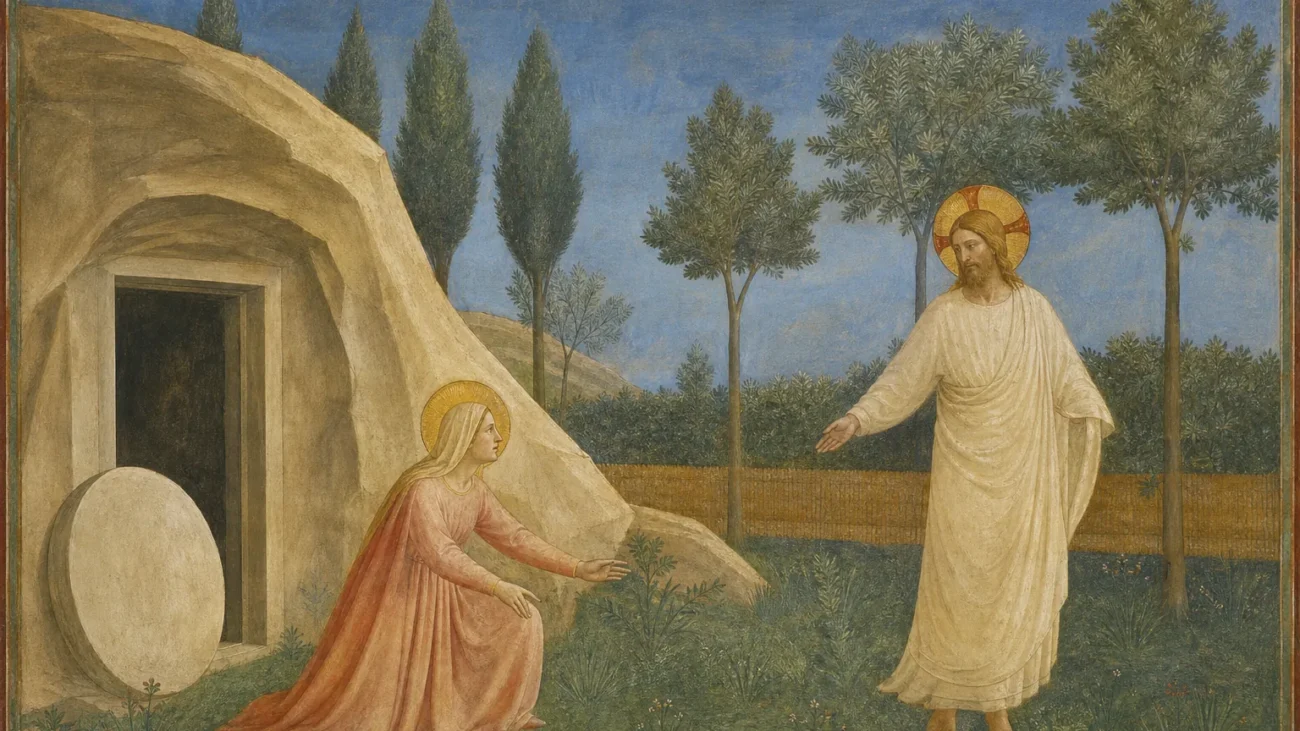
John’s Gospel tells the most tender scene of all. Mary stands outside the tomb, weeping. As she weeps, she stoops to look inside. There she sees two angels in white, one at the head and one at the feet of the place where Jesus had lain. They ask her why she is crying, and she answers:
“Because they have taken away my Lord, and I know not where they have laid him.” (John 20:13)
Then she turns and sees Jesus standing there, yet she does not know that it is Jesus. He repeats the question and asks whom she is seeking. Supposing him to be the gardener, she asks him to tell her where he has laid the body, so that she can take it away.
Next comes the moment of recognition. Jesus speaks a single word, her own name:
“Jesus saith unto her, Mary. She turned herself, and saith unto him, Rabboni; which is to say, Master.” (John 20:16)
Jesus then gives her a mission. He tells her not to touch him, because he has not yet ascended to his Father. Instead, she must go to his brethren with a message: he ascends to his Father and their Father, to his God and their God. Then “Mary Magdalene came and told the disciples that she had seen the Lord, and that he had spoken these things unto her” (John 20:18).
How the Church Remembers Her
Over the centuries, her image changed. The early Church Fathers mentioned her only briefly, and later writers often confused her with other women in the Bible. In the West, a sermon by Pope Gregory I in 591 helped shape the view of her as a repentant prostitute, although there is no biblical basis for that portrayal.
Other traditions honor Mary Magdalene in different ways. The Eastern Orthodox Church has always viewed her as a virtuous Myrrhbearer and “Equal to the Apostles.” The Catholic Church, for its part, later emphasized her role as the first witness to the resurrection. It honored her as the “Apostle to the Apostles.”
What Mary Magdalene Teaches Us Today
The story of Mary Magdalene invites us to a faith that stays close to Jesus. She followed him after he healed her, gave from what she had, and remained near him as he was crucified. Then, in her grief, she heard him call her by name. Her encounter encourages us to listen for his voice in our own sorrow. Finally, her going to tell the disciples reminds us to tell others what the Lord has done.
