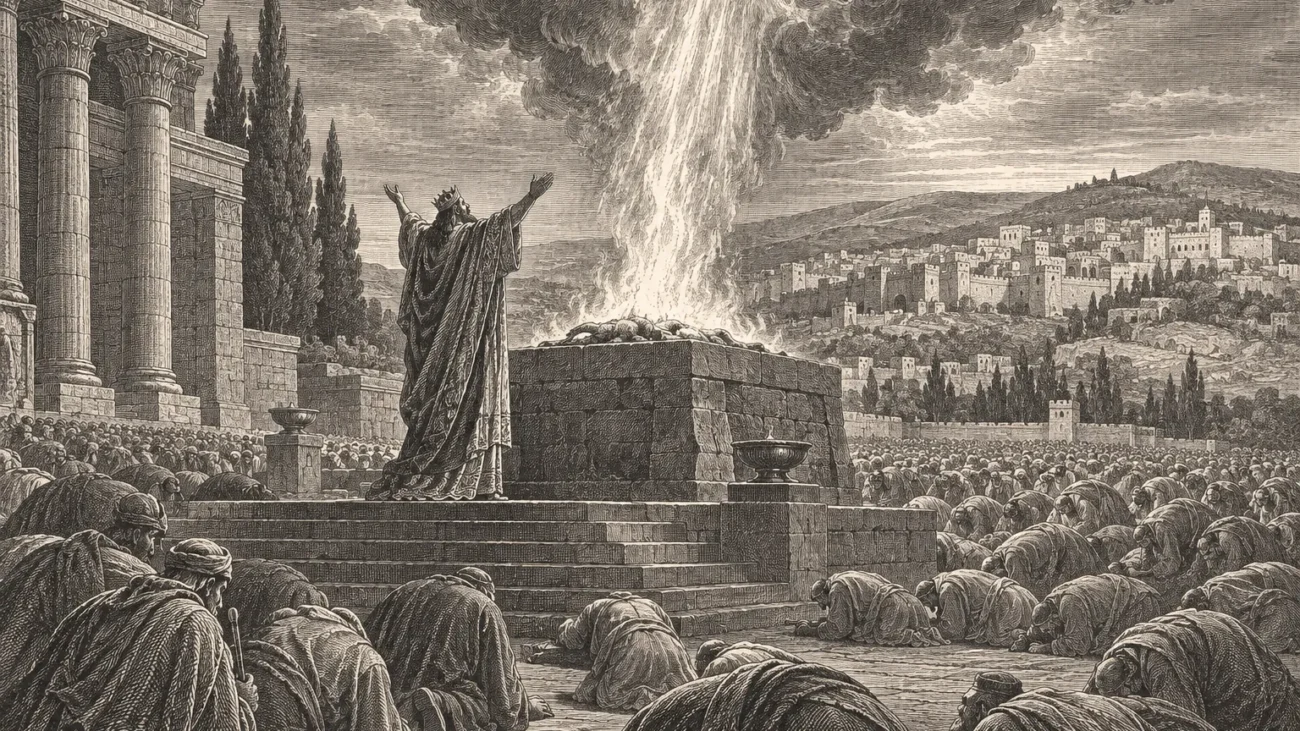
The dedication of Solomon’s Temple stands among the most moving moments in the story of ancient Israel. After years of work, King Solomon, the son of David, gathered the people in Jerusalem and lifted his hands toward heaven. He asked the Lord to hear every prayer offered toward this house. In response, the Lord filled the house with his glory and sent fire from heaven. This article walks through the building of the First Temple, the arrival of the Ark and Solomon’s great prayer. Above all, it invites us to share Solomon’s confidence that God listens.
Building the First Temple on Mount Moriah
According to the Bible, Solomon built the Temple on Mount Moriah in Jerusalem, where an angel of God had appeared to David (2 Chronicles 3:1). In fact, the site began as a threshing floor that David bought from Araunah the Jebusite (2 Samuel 24:18–25). So the place chosen for the dedication of Solomon’s Temple already carried a memory from David’s life.
The First Book of Kings gives a careful timeline. Workers laid the foundation in Ziv, the second month of the fourth year of Solomon’s reign. Then they finished in Bul, the eighth month of his eleventh year. As a result, the work took about seven years.
Solomon also had help from abroad. Hiram, king of Tyre, had made an alliance with David, and the friendship continued with Solomon. The two kings even called each other brothers. Hiram supplied cedar and cypress trees and sent them by sea as rafts. The Second Book of Chronicles adds that the rafts went to Joppa on the Mediterranean coast. In return, Solomon sent wheat, oil and wine. Similarly, a skilled craftsman from Tyre, also named Hiram (or Huram-abi), oversaw the building, while stonemasons from Gebal cut the stones.
The Ark Comes Into the Holy of Holies
The purpose of the house was clear. In the biblical narrative, the Temple served as a House of God, a place where God would dwell. In the seventh month, during the Feast of Tabernacles, the priests and the Levites carried the Ark of the Covenant from the City of David. The Ark held the Ten Commandments. The priests then set it inside the Holy of Holies, a windowless inner sanctum.
This moment opened the dedication of Solomon’s Temple in a striking way. When the priests came out, an overpowering cloud filled the house. In fact, the glory of the Lord filled it so fully that the priests could not stand to minister (1 Kings 8:10–11). Solomon took the cloud as a sign that God had accepted his work. He recalled that the Lord had said he would dwell in thick darkness. Then he declared that he had built an exalted house for God to dwell in forever.
Solomon’s Prayer at the Dedication of Solomon’s Temple
Next, at the dedication of Solomon’s Temple, the king stood before the altar in front of the whole congregation of Israel. He spread his hands toward heaven and began to pray (1 Kings 8:22). First, he praised God’s faithfulness:
“LORD God of Israel, there is no God like thee, in heaven above, or on earth beneath, who keepest covenant and mercy with thy servants that walk before thee with all their heart” (1 Kings 8:23)
Solomon then looked back on God’s word to David. God had spoken a promise with his mouth and fulfilled it with his hand (1 Kings 8:24). For this reason, Solomon asked the Lord to keep the rest of that promise. He prayed that a man would never fail to sit on the throne of Israel, as long as David’s children walked before God (1 Kings 8:25–26).
Yet Solomon did not imagine that a building could hold God. Instead, he asked a humble question:
“But will God indeed dwell on the earth? behold, the heaven and heaven of heavens cannot contain thee; how much less this house that I have builded?” (1 Kings 8:27)
In other words, the king knew that his finest work remained small before the Lord of heaven.
A House of Prayer for God’s Name
Because God is so great, Solomon did not ask him to live inside the walls. Instead, he asked God to keep watch over the house. He prayed that God’s eyes would stay open toward it night and day (1 Kings 8:29). After all, God had said of this place, “My name shall be there.”
This request lies at the heart of the dedication of Solomon’s Temple. Solomon pictured himself and the people turning toward the house whenever they prayed. Then he asked God to listen from his true home:
“And hearken thou to the supplication of thy servant, and of thy people Israel, when they shall pray toward this place: and hear thou in heaven thy dwelling place: and when thou hearest, forgive.” (1 Kings 8:30)
Notice the order of the request. First, Solomon asks God to hear. Then he asks God to forgive. So, in Solomon’s prayer, the Temple becomes more than a beautiful building. It becomes a meeting point between a praying people and a listening, forgiving God. In addition, the First Temple also served as a place of assembly for the Israelites.
Fire From Heaven at the Dedication of Solomon’s Temple
The Second Book of Chronicles tells what happened next. When Solomon finished praying, fire came down from heaven. It consumed the burnt offering and the sacrifices, and the glory of the Lord filled the house (2 Chronicles 7:1). Once again, the priests could not enter because of God’s glory (2 Chronicles 7:2).
The people responded at once. All the children of Israel saw the fire and the glory on the house. They bowed with their faces to the ground on the pavement and worshipped. Then they praised the Lord with these words:
“For he is good; for his mercy endureth for ever.” (2 Chronicles 7:3)
Thus the dedication of Solomon’s Temple ended not in pride but in worship. The people did not praise the cedar, the stone or the king. Instead, they praised the goodness and lasting mercy of the Lord.
The First Temple Through the Centuries
Many believe the First Temple stood in Jerusalem from the 10th to the 6th century BCE. Nebuchadnezzar II of Babylon reportedly destroyed it during the siege of Jerusalem in 586 BCE. Josephus wrote that this came 470 years after its building. Seventy years later, Cyrus of Persia allowed the exiles to return to Judea and build the Second Temple.
Scholars still discuss the details. Many once accepted the biblical account as authentic. However, since the 1980s some have doubted whether a temple stood in Jerusalem that early. Others suggest that Solomon’s first building was modest and that later builders enlarged it. Because the site is so sensitive, no one has excavated the Temple Mount in recent times. Still, a shrine model from Khirbet Qeiyafa and the Tel Motza temple resemble the biblical description. Even so, the dedication of Solomon’s Temple remains a vivid scene for every reader of Scripture.
Praying With the Dedication of Solomon’s Temple in Mind
The dedication of Solomon’s Temple reminds us that God’s greatness and God’s nearness belong together. Solomon confessed that heaven cannot contain the Lord. Yet he still asked God to open his eyes toward a house of prayer. In the same way, we can bring our requests with humility and hope. Solomon’s words invite us to pray, to seek forgiveness and to trust the One who keeps covenant and mercy. Finally, like Israel bowing on the pavement, we can confess that the Lord is good and his mercy endures for ever.
