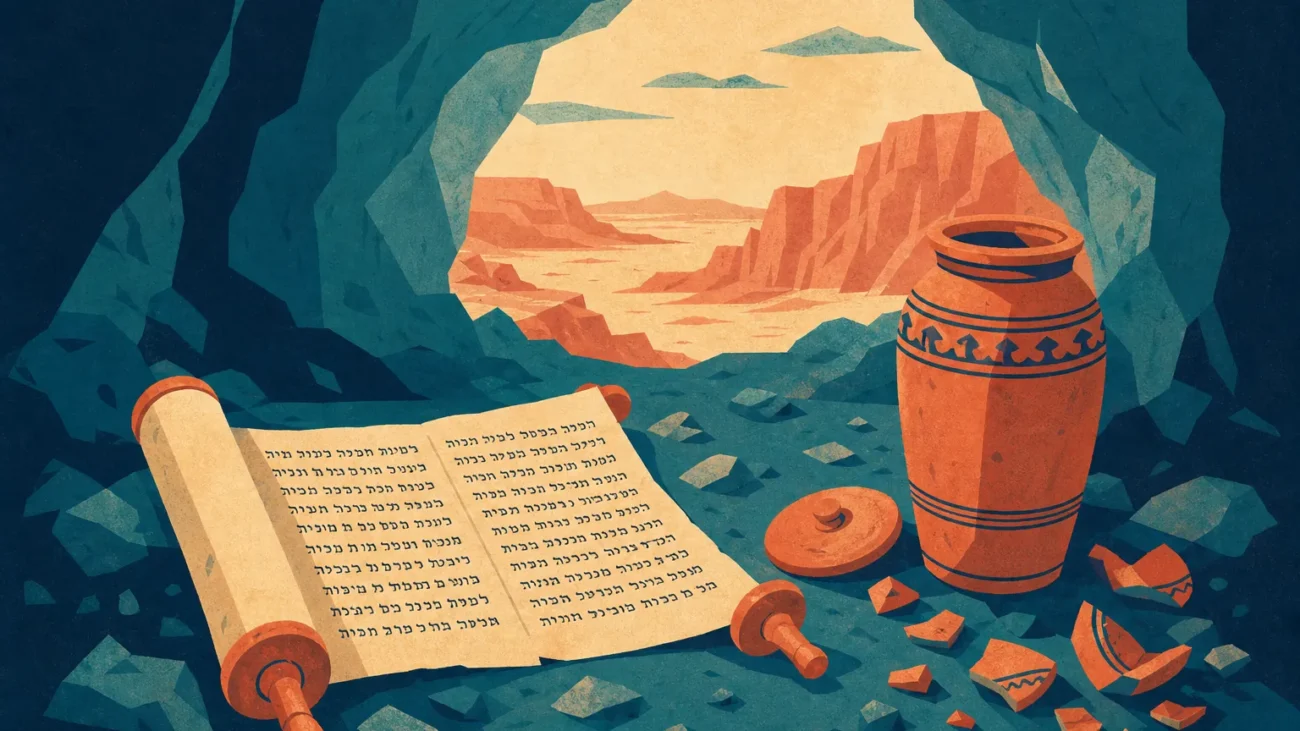
The Great Isaiah Scroll stands among the most precious finds in the history of the Bible. In fact, it belongs to the famous Dead Sea Scrolls, a collection of ancient Jewish manuscripts from the Second Temple period. Shepherds and archaeologists uncovered these texts in caves near the Dead Sea over ten years, between 1946 and 1956. For believers today, the story offers more than an exciting discovery. It also shows how faithfully earlier generations handed on the words of the prophet Isaiah.
How Shepherds Found the Dead Sea Scrolls at Qumran
The first discovery took place between November 1946 and February 1947. Three Bedouin shepherds, Muhammed edh-Dhib, his cousin Jum’a Muhammed, and Khalil Musa, were near the northwest shore of the Dead Sea. While searching for a lost animal from the flock, one of them threw a rock. Then he heard the sound of shattering pottery.
The shepherds agreed to come back together a few days later. However, the youngest, Muhammed edh-Dhib, returned alone first. Inside the cave he found broken and whole jars along with fragments of scrolls. Most of the intact jars were empty, yet one held reddish earth. Another held a parchment scroll and two oblong bundles coated in black wax or pitch. Scholars later identified the parchment as the Great Isaiah Scroll. They also recognized the two bundles as the Habakkuk Commentary and the Community Rule.
Over the following years, researchers explored more caves around the site of Khirbet Qumran. These caves lie about 1.5 kilometres west of the northwestern shore of the Dead Sea. In time, scholars assembled 981 different manuscripts from 11 caves. The texts date from the 3rd century BCE to the 1st century CE. About 40% of the identified texts are copies of books from the Hebrew Scriptures. As a result, the find gave the world the oldest surviving manuscripts of entire biblical books.
The Journey of the Great Isaiah Scroll
At first, the shepherds did not know what they had found. They carried the scrolls to a site southeast of Bethlehem and kept them in a bag hanging from a tent pole for several weeks. During that time, the front cover of the Isaiah scroll broke off. Later, an antiques dealer named Khalil Iskander Shahin, known as Kando, acquired it. Because he could not read the writing, he sold the Great Isaiah Scroll to Mar Samuel, the Syrian Orthodox archbishop in East Jerusalem.
Mar Samuel wanted experts to confirm what he owned. In July 1947, the Dutch scholar J. van der Ploeg identified one manuscript as a Hebrew copy of the Book of Isaiah. Still, a colleague doubted him and thought such old scrolls must be fakes. Then, in January 1948, Professor Eleazar Sukenik of the Hebrew University examined the scrolls and realized they were authentic. Soon after, John Trever photographed them, and William F. Albright dated the Isaiah manuscript to around 100 BCE. Finally, on 11 April 1948, Millar Burrows announced the discovery to the public.
The American Schools of Oriental Research published the scroll in 1950. Four years later, an advertisement in the Wall Street Journal offered the scrolls for sale. Israeli archaeologist Yigael Yadin bought them for $250,000 in 1954 and brought them back to Israel. Today the Great Isaiah Scroll rests in the Shrine of the Book at the Israel Museum in Jerusalem. In addition, a 2011 digital project with Google created a high-quality image of the entire scroll for readers everywhere.
What Makes the Great Isaiah Scroll Unique
This remarkable manuscript contains the entire Book of Isaiah from beginning to end, apart from a few small damaged spots. Scholars date it to about 125 BCE. That makes it the oldest known complete copy of Isaiah. In fact, it is roughly 1000 years older than the oldest Hebrew manuscripts known before the discovery. Moreover, it is the only scroll from the Qumran Caves that survived almost in its entirety.
Its size impresses as well. A scribe wrote it on 17 sheets of parchment, and it stretches about 734 cm, or 24 feet. Its height ranges from 25.3 to 27 cm, and it holds 54 columns of text. Interestingly, the Great Isaiah Scroll divides into two halves of 27 columns and 33 chapters each. Later versions do not show this split, so it may mark the earliest dividing point for the book.
Who Copied the Scroll and When
No one knows the exact authors of the scroll or the exact date of writing. However, two dating methods point to the same general era. Radiocarbon testing gave a range between 356 and 103 BC, while the study of handwriting suggested 150–100 BCE. Likewise, the script is typical of 125–100 BCE, and its longer spellings of words fit this period.
Many scholars connect the Great Isaiah Scroll with the Essenes, an ancient Jewish sect. This view remains the most accepted one. For example, scholars Abegg, Flint, and Ulrich argue that the scribe who copied the Community Rule also made a correction to the Isaiah scroll. Even so, some recent interpretations challenge the Essene connection. Instead, they suggest that priests in Jerusalem or other unknown Jewish groups wrote the scrolls. Scholars also debate whether one scribe copied the whole scroll or two scribes mirrored each other’s style.
The Great Isaiah Scroll and Faithful Copying
For Bible readers, the most moving part of the story concerns the text itself. The Great Isaiah Scroll generally agrees with the Masoretic version of the Hebrew text. It preserves all sixty-six chapters in the same order. Only small areas of cracked leather leave a few words missing. In other words, a copy far older than any previously known manuscript matches the later Hebrew text in its overall shape.
The wider collection points the same way. The Dead Sea Scrolls show that scribes passed on the Masoretic tradition with remarkable overall stability from the 2nd century BCE onward. At the same time, the scrolls reveal real textual variation before standardization around 100 CE. Later scribes also added corrections and insertions to the Isaiah scroll before 68 CE. Thus the scroll bears witness both to careful copying and to the hands that kept checking it.
Because the scroll holds every chapter, readers can turn to Isaiah 53 and find these familiar words:
But he was wounded for our transgressions, he was bruised for our iniquities: the chastisement of our peace was upon him; and with his stripes we are healed. (Isaiah 53:5)
The same chapter also confesses, “All we like sheep have gone astray; we have turned every one to his own way” (Isaiah 53:6).
The Word of Our God Shall Stand Forever
Isaiah himself offers a fitting reflection on this story. “The grass withereth, the flower fadeth: but the word of our God shall stand for ever” (Isaiah 40:8). Jars broke, a cover fell away, and the scrolls passed through many hands. Yet the Great Isaiah Scroll survived to carry the prophet’s words to a new generation.
Therefore, this ancient scroll invites us to treasure the Scriptures and to give thanks for the faithful people who copied them. Above all, we can take time to read Isaiah 53 slowly and receive its message with grateful hearts.
