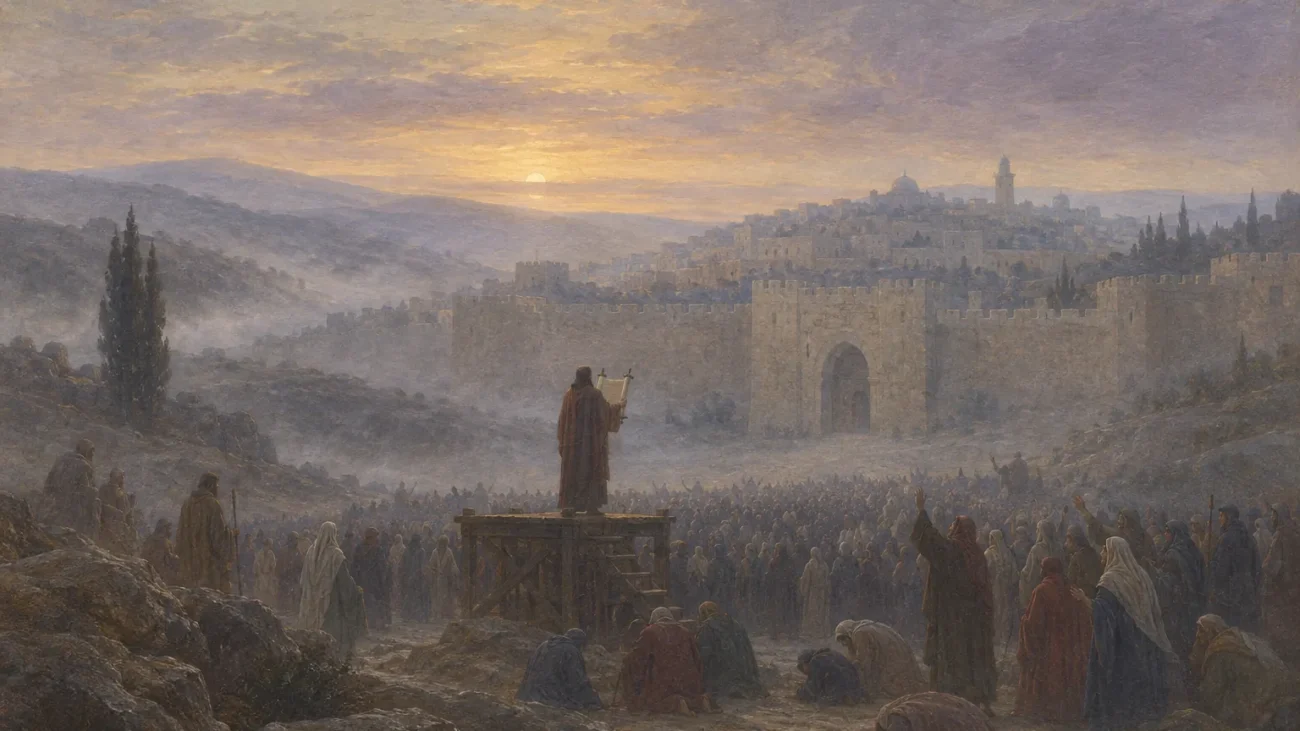
The joy of the Lord shines out of one of the most moving scenes in the Old Testament. In Nehemiah 8, the people of Jerusalem gather in a street before the water gate. There Ezra the scribe reads to them from the book of the law of Moses. At first the listeners weep. Then their leaders tell them to stop mourning, to share food and to celebrate. This article walks through that day and asks why joy in God gives strength.
A People Back from Exile
The story unfolds in the second half of the 5th century BC. The Babylonians had conquered and destroyed Jerusalem in 586 BC, and the city still lay in ruins long afterward. Then Nehemiah, cup-bearer to King Artaxerxes I in Susa, learned that the wall of Jerusalem lay broken. He prayed, asked the king for permission, and went to Jerusalem as governor of Judah. Despite mockery and threats from Sanballat, Tobiah and Geshem, the families of the city rebuilt the wall.
Ezra had come earlier. According to the Bible, Artaxerxes sent him from Babylon around 457 BCE to teach God’s laws to any Israelite who did not know them. Ezra was a scribe and a priest, and his name probably means “Yah helps.” In other words, he stepped into a story God had already begun. Scholars still debate how much of this account is history; some read it as a historical record, while others question it. Either way, once the wall stood complete, Nehemiah had Ezra read the law to the assembled people. So the stage was set for a day when the joy of the Lord would fill the city.
Gathered as One Man at the Water Gate
The chapter opens with a striking picture of unity:
“And all the people gathered themselves together as one man into the street that was before the water gate” (Nehemiah 8:1)
Notice who takes the first step. The people themselves asked Ezra to bring the book of the law of Moses. Nobody dragged them there. Instead, they spoke to the scribe as one body. Ezra then brought the law before the men and the women, and before all who could understand. This happened on the first day of the seventh month.
Ezra read from morning until midday. That is a long time to stand and listen. Yet Scripture notes that the ears of all the people were attentive to the book of the law. Here we glimpse a hunger that comes before the joy of the Lord: a deep desire to hear what God has said. Their attention invites us to ask how eagerly we come to the same Word.
Ezra Opens the Book and the People Worship
Ezra stood on a wooden pulpit that the people had made for the purpose. Thirteen men stood beside him, six on his right hand and seven on his left. Among them were Mattithiah, Hilkiah, Pedaiah and Meshullam. Then Ezra opened the book in the sight of everyone, and the whole crowd stood up. After that, he blessed the LORD, the great God.
“And all the people answered, Amen, Amen, with lifting up their hands: and they bowed their heads, and worshipped the LORD with their faces to the ground.” (Nehemiah 8:6)
Look at the order of events. First comes reverence, then response. Standing, lifting hands and bowing low all show that the people treated the reading as an encounter with God himself. In fact, they answered with a double “Amen” before they had heard much at all. This posture of honor prepares the heart for the joy of the Lord.
Understanding That Leads to the Joy of the Lord
Reading aloud was not the whole task. A group of Levites, including Jeshua, Bani, Sherebiah and Pelaiah, also helped the people understand the law. Meanwhile, the people stood in their place and listened.
“So they read in the book in the law of God distinctly, and gave the sense, and caused them to understand the reading.” (Nehemiah 8:8)
In other words, the leaders did more than pronounce words. They read clearly, explained the meaning and made sure the crowd grasped it. As a result, Scripture reached minds and hearts, not only ears. This detail matters for the rest of the story, because the final celebration rests on understanding. Believers today can take this to heart. The joy of the Lord grows as we listen to God’s Word and let faithful teachers help us grasp its sense.
From Tears to the Joy of the Lord
Something unexpected happened as the people listened. They began to weep. The passage states it plainly: “For all the people wept, when they heard the words of the law” (Nehemiah 8:9). God’s Word touched them so deeply that tears came first.
However, Nehemiah the governor, Ezra the priest and the Levites spoke up together. They told the crowd that this day was holy to the LORD their God, so they should not mourn or weep. Then came the famous instruction:
“Go your way, eat the fat, and drink the sweet, and send portions unto them for whom nothing is prepared: for this day is holy unto our Lord: neither be ye sorry; for the joy of the LORD is your strength.” (Nehemiah 8:10)
The leaders did not ask the people to forget what they had heard. Instead, they called them to feast, to eat rich food and sweet drink, and to share with those who had nothing ready. Finally, the Levites quieted the crowd and reminded them again that the day was holy. Sorrow had its moment, yet holiness called for gladness.
Why the Joy of the Lord Is Your Strength
The scene ends in celebration. All the people went their way to eat, to drink, to send portions and to make great mirth, “because they had understood the words that were declared unto them” (Nehemiah 8:12). Afterward, they went on to keep the Feast of Booths, to confess their sins in prayer and to enter into a covenant to keep the law.
So the joy of the Lord, in this passage, is no shallow mood. It springs from hearing God’s Word, understanding it and receiving his day as holy. It also flows outward, because the feast included gifts for those who had nothing prepared. For this reason, Nehemiah 8 invites us to open Scripture with the same attentive hearts. When we feel weak or sorrowful, we can remember the words spoken over Jerusalem that day: the joy of the Lord is your strength.
