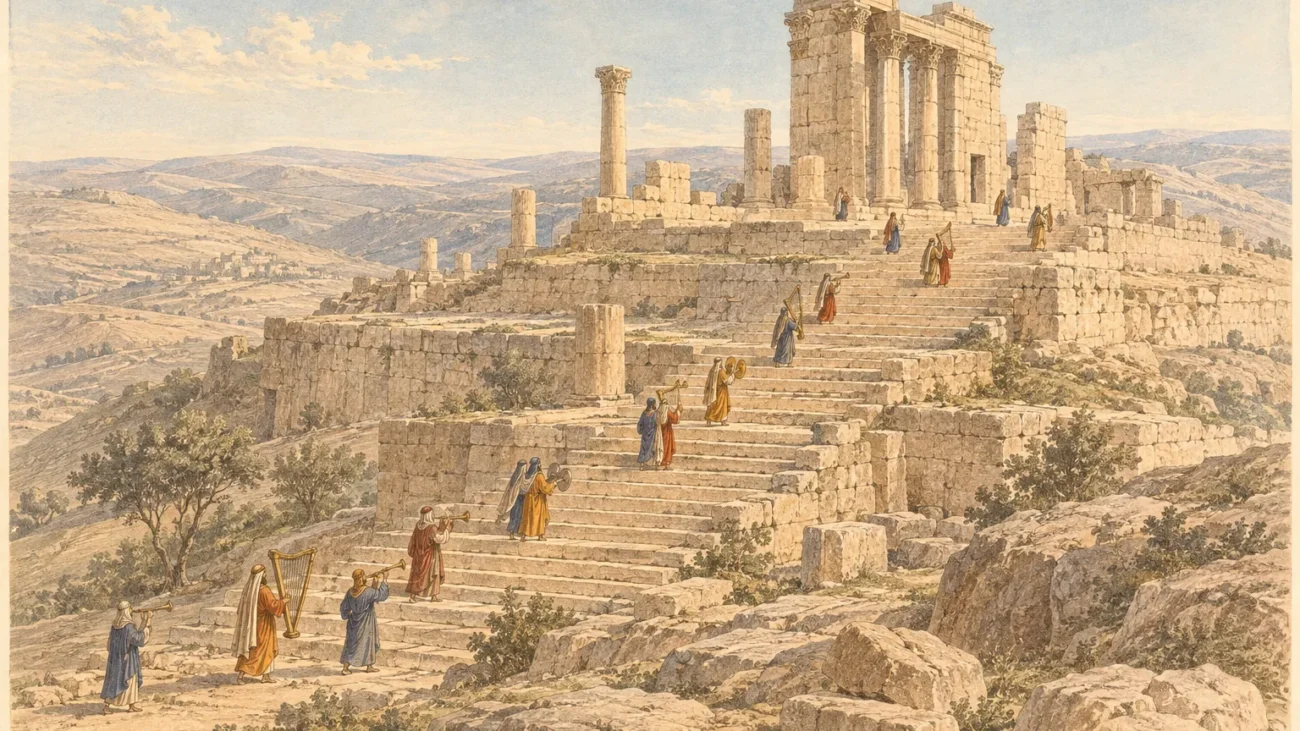
Selah in the psalms is a small word that has puzzled readers for centuries. It appears again and again, often at the end of a verse. Yet no one knows its exact meaning. Even so, the word points us toward something important. People did not only read the psalms; they sang them, often with instruments. In this article, we explore what we know about that music, from the titles above the psalms to the instruments of Israel’s neighbors. Along the way, we hope you will hear the psalms with fresh ears and pray them with a renewed heart.
A Book of Praises Meant to Be Sung
To understand selah in the psalms, we first need to remember that the Psalter is a songbook. Its Hebrew name is Tehillim, which means “praises.” In fact, the book contains many praises and supplications to God. Its English title also points to music. It comes from the Greek word psalmoi, meaning “instrumental music,” and by extension the words that go with that music.
Jewish and Western Christian traditions count 150 psalms, while Eastern churches include several more. The book falls into five sections, and each one closes with a doxology, a hymn of praise. Inside, we find many kinds of songs. For example, there are hymns of praise, laments of the community and of individuals, royal psalms, thanksgivings, wisdom songs and pilgrimage psalms. So the Psalter gives believers words for joy, sorrow and gratitude alike.
Musical Directions in the Superscriptions
Many psalms carry a short title, which readers know as a superscription. In fact, 116 of the 150 psalms have one, from a single word to a lengthy comment. Over a third of these titles seem to be musical directions. They speak to the “leader” or “choirmaster” with notes such as “with stringed instruments” and “according to lilies.” Other titles name a type of song, such as “A psalm” or “Song.” Still others mention an occasion, like “On the dedication of the temple” or “For the memorial offering.” These titles help us read selah in the psalms as part of a musical world.
Many titles also carry names. The most common is “of David,” which appears on 73 psalms, and thirteen of these relate to events in the king’s life. Other names include Asaph with twelve psalms and the sons of Korah with eleven. Solomon has two, while Moses, Ethan the Ezrahite and Heman the Ezrahite have one each. Tradition links many psalms to King David. However, modern scholars do not accept Davidic authorship as historical fact. They also find the dating of the psalms notoriously difficult. Some psalms likely come from before the exile and others from after it.
Where Selah in the Psalms Appears
The word selah occurs 74 times in the Hebrew Bible. Of these, 71 occurrences come in 39 psalms, and three more come in Habakkuk 3. Most of the time, selah in the psalms stands at the end of a verse. It even closes Psalms 3, 24 and 46. Yet a few cases break the pattern, such as Psalms 55:19 and 57:3, where it falls inside a verse.
The word also has a clear link to music. Of the thirty-nine psalms with the caption “To the choir-master,” thirty-one include selah. Psalm 3 shows how the word works in practice. It appears three times in only eight verses:
“Many there be which say of my soul, There is no help for him in God. Selah. But thou, O LORD, art a shield for me; my glory, and the lifter up of mine head.” (Psalms 3:2-3)
Here the word follows the enemies’ taunt. Then the psalmist turns to the Lord as his shield. In this way, selah works almost like underlining before the next thought. Also, readers should not confuse selah with the similar Hebrew word sela’, which means “rock.”
Old and New Ideas About Selah in the Psalms
For centuries, selah in the psalms has invited many explanations. Even ancient commentators apparently did not know its meaning. As a result, early translations handled it in many ways. The Septuagint, Symmachus and Theodotion rendered it as diapsalma, “apart from psalm,” a Greek word just as puzzling. The Hexapla simply wrote sel. In contrast, Aquila, Jerome and the Targum chose “always.” Similarly, Jewish liturgy uses the word to mean “forever,” notably in the Amidah. Hippolytus thought the term marked a change in rhythm or melody, or a change in theme. However, Baethgen noted that selah also appears at the end of some psalms.
Proposals From Modern Scholars
One view reads the word as a command, “lift up,” much like “fortissimo.” In that picture, musicians break in with cymbals and trumpets while the singers fall silent. Another view links it to a verb meaning “pause,” but this idea has won little favor. The Brown-Driver-Briggs lexicon connects selah to a root meaning “to lift up (voices)” or “to exalt.” On this reading, the writer tells the reader to pause and exalt the Lord.
Heinrich Grätz, by contrast, saw selah as a marker of a new paragraph or a quotation. B. Jacob concluded that it signifies a pause in or for the Temple song. Finally, some trace it to a root meaning “to hang” or “to measure (weigh).” So the precise meaning remains unknown. Still, the word is probably a liturgical-musical mark or a reading instruction meaning “stop and listen.”
Instruments and Musicians of Biblical Times
How did these songs actually sound? Honestly, we cannot fully know. No ancient music notation survives to show how Israel arranged its psalms in the Iron Age. In addition, the oldest psalms may go back to the 14th century B.C.E., a time with little Israelite documentation. Because of the prohibition against graven images in Exodus 20:4, we also have no pictures of Israelites performing psalms.
Nevertheless, Israel’s neighbors offer helpful clues. Stone reliefs across the Levant show singers with players on instruments. For example, an eighth-century B.C.E. relief from Samal, in modern Turkey, shows a meditative lute player. Texts from Ugarit, on the coast of modern Syria, and Akkadian “lifted-hand” prayers also include notes on genre, purpose and ritual, much like the psalm titles. Then a fourth-century B.C.E. papyrus from Elephantine, an island on Egypt’s southern border, shows musicians attending the Lord. It names a player of the bass lyre (nevel) and a player of the lyre (kinnor). Such clues help us imagine selah in the psalms within real worship.
The Bible itself celebrates this music. Psalm 150 calls for a whole orchestra of praise:
“Praise him with the sound of the trumpet: praise him with the psaltery and harp. Praise him with the timbrel and dance: praise him with stringed instruments and organs.” (Psalms 150:3-4)
Then the psalm adds cymbals, both loud and high sounding. Finally, it invites every living creature to join the song.
Praying With Selah in the Psalms Today
Selah in the psalms may never give up all its secrets. Yet even its mystery can shape our prayer. Perhaps it calls us to stop and listen. Perhaps it asks us to lift up our voices, or to pause and exalt the Lord. In every case, the word invites us to slow down. Psalm 3 shows the pattern. After crying out under pressure, the psalmist says:
“I cried unto the LORD with my voice, and he heard me out of his holy hill. Selah.” (Psalms 3:4)
So the next time you meet selah, take a breath. Let the words sink in before you read on. Then, as Psalm 150 urges, let everything that has breath praise the LORD.
