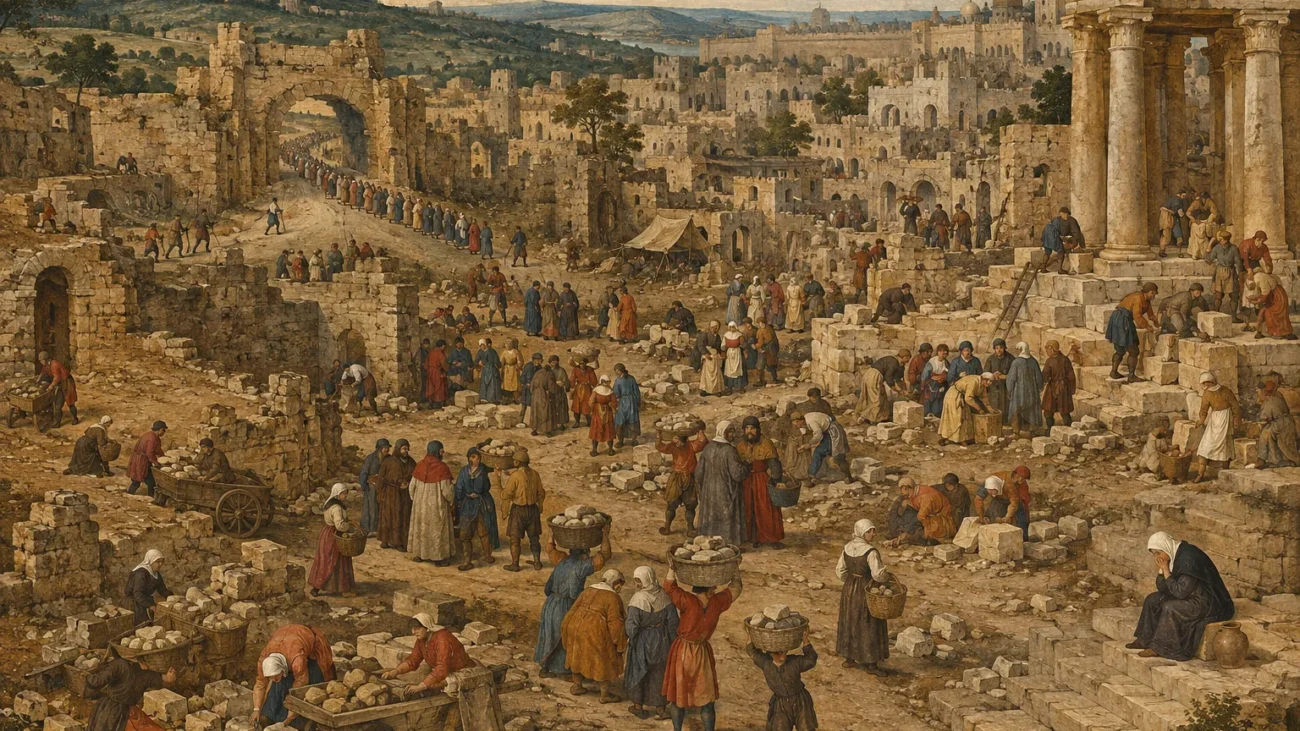
The book of Lamentations gives God’s people words for grief when everything familiar lies in ruins. It gathers poetic laments for the destruction of Jerusalem in 586 BCE. Yet these poems do not hide pain behind polite religious language. Instead, they weep, confess and plead with honesty. Then, in the middle of the darkness, a quiet voice remembers the mercies of the LORD. For this reason, the book still speaks to believers who carry heavy loss today.
Where the Book of Lamentations Belongs in Scripture
The Hebrew title of the book is ʾĒḵā, which means “how.” It comes from the first word of the opening poem, a cry of shock and disbelief. In the Hebrew Bible, the book sits among the Writings. In fact, it forms one of the Five Scrolls, together with the Song of Songs, Ruth, Ecclesiastes and Esther.
Christian Bibles, however, place the book of Lamentations right after Jeremiah. Tradition names the prophet Jeremiah as its author, since he foretold the city’s fall in his own time. By the mid-19th century, German scholars began to doubt this view. Today most scholars consider the author or authors anonymous. Some think one poet wrote all five chapters, while others see a different hand in each. Still, most agree that the poems came shortly after Jerusalem fell. Their language also fits the period of the Exile, and the poets were probably Judeans who stayed in the land.
Five Poems from a Fallen City
The book of Lamentations contains five separate poems, one for each chapter. They do not follow a strict timeline. Instead, each one looks at the disaster from a new angle. In the first chapter, the city sits alone like a weeping widow, crushed by misery. The opening verse captures that picture:
“How doth the city sit solitary, that was full of people how is she become as a widow she that was great among the nations, and princess among the provinces, how is she become tributary” (Lamentations 1:1)
The poet then adds that she weeps through the night with tears on her cheeks, and no one comforts her. Her friends have turned into enemies. Judah has gone into captivity, and the roads to Zion mourn because nobody comes to the feasts. Her gates stand empty, and her priests sigh.
Chapter 2 connects these miseries with the nation’s sins and with the acts of God. The third poem then turns toward hope, as a later section will show. Next, chapter 4 mourns the ruined city and temple, yet it also traces the ruin to the people’s sins. Finally, chapter 5 becomes a prayer that God would remove Zion’s disgrace as the people repent and recover. In fact, some Greek copies, along with the Latin Vulgate, Syriac and Arabic versions, give this last chapter the heading “The Prayer of Jeremiah.”
The Acrostic Structure of the Book of Lamentations
One striking feature of the book of Lamentations is its alphabetic design. The first four poems are acrostics. Chapters 1, 2 and 4 each have 22 verses, one for each letter of the Hebrew alphabet. The first verse begins with the first letter, the second with the next, and so on. Chapter 3 goes even further. It has 66 verses, so each letter opens three lines.
The fifth poem breaks the pattern, yet it still keeps 22 lines. Nobody knows for certain why the poets chose this form. However, many readers think a full alphabet expresses completeness, from alef to tav. In English we might say “from A to Z.” There is also a small surprise in the order. In the middle chapters, the letter pe comes before ayin, the reverse of the usual sequence.
The first four poems also share a rhythm that scholars name the qinah meter. Each line has three stresses followed by two. The scholar Dobbs-Allsopp describes it as “the rhythmic dominance of unbalanced and enjambed lines.” The fifth chapter, by contrast, lacks this rhythm. Sadly, few English translations capture either the acrostic or the meter, and even fewer try to capture both.
Honest Sorrow and the Ancient City Laments
The book of Lamentations does not soften its pain. God does not speak in these poems. The suffering feels overwhelming, and the poet expects little future rescue. At its end, the book even faces the bitter possibility that God has finally rejected Israel. Yet the poet does not accuse God. Again and again, he admits that the city, and he himself, sinned greatly against the LORD. As a result, he presents God as righteous and just, and at times even merciful.
This honesty draws on old patterns of mourning. Lamentations blends the funeral dirge, or kinah, with the communal lament that pleads for a people’s restoration. It also echoes the ancient Near Eastern “city lament.” Only five examples of that genre survive. The best known, the Lament for Ur, mourns the fall of the southern Mesopotamian city of Ur to Elamite forces in 2004 BCE. Like Lamentations, it describes a destroyed city, slaughtered people and a lost temple.
However, the differences matter just as much. In those laments, a city’s own god often begs the chief gods to change their decision. Because Israel worshipped one God, that scene has no place here. In addition, the Sumerian laments ended on a hopeful note, since people recited them when a temple rose again. By contrast, the book of Lamentations came before any rebuilding. Therefore it offers pleas to God with no answer and no resolution.
Hope Rises in the Book of Lamentations
At the center of the book, in chapter 3, the voice of grief changes direction. First, the speaker remembers his affliction, “the wormwood and the gall” (Lamentations 3:19). His soul still carries that memory and bows low. Then something shifts. He calls to mind a different truth:
“This I recall to my mind, therefore have I hope. It is of the LORD’S mercies that we are not consumed, because his compassions fail not. They are new every morning: great is thy faithfulness.” (Lamentations 3:21-23)
Notice where this hope comes from. It does not deny the ruins or pretend the pain has ended. Instead, it rises from remembering who God has been. The poet then declares, “The LORD is my portion, saith my soul; therefore will I hope in him” (Lamentations 3:24). He also adds that the LORD is good to those who wait for him and seek him.
Even here, the book of Lamentations stays honest. Remembering God’s past goodness gives the poet reason to cry out for deliverance, yet it does not guarantee an answer. God remains free to give or withhold grace. Still, the book affirms with confidence that the mercies of the LORD never end. They are new every morning.
Waiting for the Morning
The book of Lamentations shows us that faith can weep. It invites us to bring our sorrow to God without masks, even when no answer has come yet. Above all, it shows that hope can grow among ruins, not only after them.
So if your own life feels like a city in ashes, you may pray as this poet prayed. Remember the LORD’s faithfulness, and let each new morning remind you of his mercies. As the poem says, “It is good that a man should both hope and quietly wait for the salvation of the LORD” (Lamentations 3:26).
