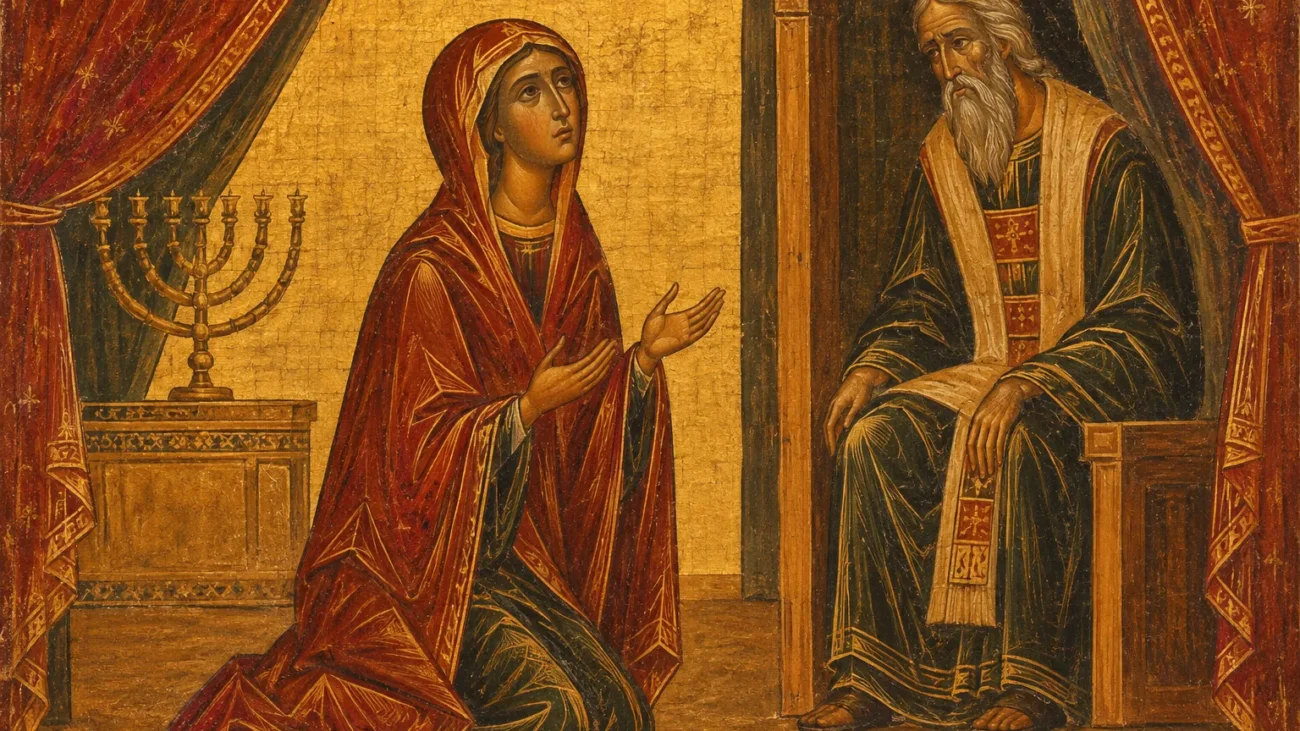
Hannah’s prayer is one of the memorable moments in the Old Testament. In the first two chapters of 1 Samuel, a grieving woman pours out her sorrow before God at Shiloh. Then, after the birth of her son Samuel, she lifts her voice in a song of thanksgiving. Her name means “favor” or “grace.” Outside these chapters, the Bible does not mention her again. So let us follow her journey from tears to joy, and then see how readers have compared her song with Mary’s Magnificat.
A Home Marked by Longing
Hannah was one of two wives of Elkanah. The other wife, Peninnah, had given Elkanah children, yet Hannah remained childless. Even so, Elkanah preferred Hannah. Her place as the primary wife, together with her barrenness, recalls Sarah and Rebecca in Genesis.
Every year, Elkanah went up to offer a sacrifice at the sanctuary in Shiloh. He gave Peninnah and her children their portions. However, he gave Hannah a double portion, because he loved her, and the LORD had closed her womb. One commentator, Lillian Klein, notes that a woman’s child-bearing capacities enhanced her value, and that the narrative sets Hannah’s pain in a communal context. Hannah’s prayer grows out of this ache.
Hannah’s Prayer at Shiloh
One year, after the family had eaten and drunk at Shiloh, Hannah rose up. Meanwhile, Eli the priest sat on a seat by a post of the temple of the LORD. Scripture describes her grief with honest words:
“And she was in bitterness of soul, and prayed unto the LORD, and wept sore.” (1 Samuel 1:10)
Hannah brought her sorrow to the LORD with tears. Then she made a vow. She asked the LORD of hosts to look on her affliction, to remember her, and to give her a son. In return, she promised to give the boy to the LORD all the days of his life. Also, no razor would ever touch his head.
She promised that her son would remain a Nazarite all his life, devoted to God’s service.
From Misunderstanding to the Birth of Samuel
Hannah prayed silently in her heart. Only her lips moved, and no one heard her voice. As a result, Eli watched her mouth and thought she was drunk. He told her to put away her wine. Hannah answered him:
“No, my lord, I am a woman of a sorrowful spirit: I have drunken neither wine nor strong drink, but have poured out my soul before the LORD.” (1 Samuel 1:15)
She also asked him not to count her as a daughter of Belial. Then Eli answered her. He told her to go in peace and asked the God of Israel to grant her petition. Hannah went her way and ate, and her countenance was no more sad.
Early the next morning, the family worshipped before the LORD and returned home to Ramah. Then the LORD remembered Hannah. She conceived and gave birth to a son, and she named him Samuel, saying, “Because I have asked him of the LORD.” (1 Samuel 1:20). The name means “heard by God.”
The next time Elkanah went to Shiloh, Hannah stayed home to care for the boy. She told her husband she would present him to the LORD when he was weaned. Elkanah replied, “Do what you think best.” Readers still debate how old Samuel was at that point. Hannah brought him to the sanctuary along with a sacrifice. Leviticus made provision for redeeming vows with money, so Hannah could have chosen that option.
Hannah’s Prayer Turns into a Song of Praise
The story does not end in silence. Hannah prayed again, and this time her words overflowed with joy. Her song in 1 Samuel 2:1–10 opens with delight:
“My heart rejoiceth in the LORD, mine horn is exalted in the LORD: my mouth is enlarged over mine enemies; because I rejoice in thy salvation.” (1 Samuel 2:1)
First, Hannah praises God for who he is. She declares that none is holy as the LORD, and that there is no rock like our God. Then she tells the proud to talk no more so exceeding proudly, because the LORD is a God of knowledge, and he weighs actions.
Next, the song celebrates great reversals. It breaks the bows of the mighty men, while it girds those who stumbled with strength. Those who were full have hired out themselves for bread, and those who were hungry ceased. In addition, the barren has borne seven, while she who has many children has grown feeble. The LORD maketh poor and maketh rich; he bringeth low and lifteth up. He raises the poor out of the dust and lifts the beggar from the dunghill, to set them among princes. Finally, the song looks ahead to the LORD judging the ends of the earth and giving strength to his king, his anointed.
Tradition also considers Hannah a prophetess. In her song of thanksgiving the text portrays her as inspired to discern, in her own individual experience, the universal laws of the divine economy.
Echoes in Mary’s Magnificat
The New Testament records another song of thanksgiving. Mary sings the Magnificat in Luke 1:46–55, and readers may compare it with Hannah’s song.
However, the likeness is subtle. The biblical commentator A. F. Kirkpatrick notes that “the Magnificat should be carefully compared with Hannah’s song, of which it is an echo rather than an imitation.” He adds: “The resemblance lies in thought and tone more than in actual language.”
Later traditions have also remembered Hannah. The Jerusalem Talmud took her as an exemplar of prayer. Early English Protestantism, which emphasized the importance of private prayer, also treated her as an important figure. Her story is the Haftarah reading for Rosh Hashanah.
What Hannah’s Prayer Teaches Us Today
Hannah’s prayer invites us to bring our deepest sorrows honestly before God. She wept, and she poured out her soul before the LORD. Her song then reminds us that the LORD raises the poor out of the dust.
So whatever we carry today, we can pour it out before him. Eli blessed Hannah again, and she conceived three more sons and two daughters. May Hannah’s prayer teach us to move from tears to praise.
