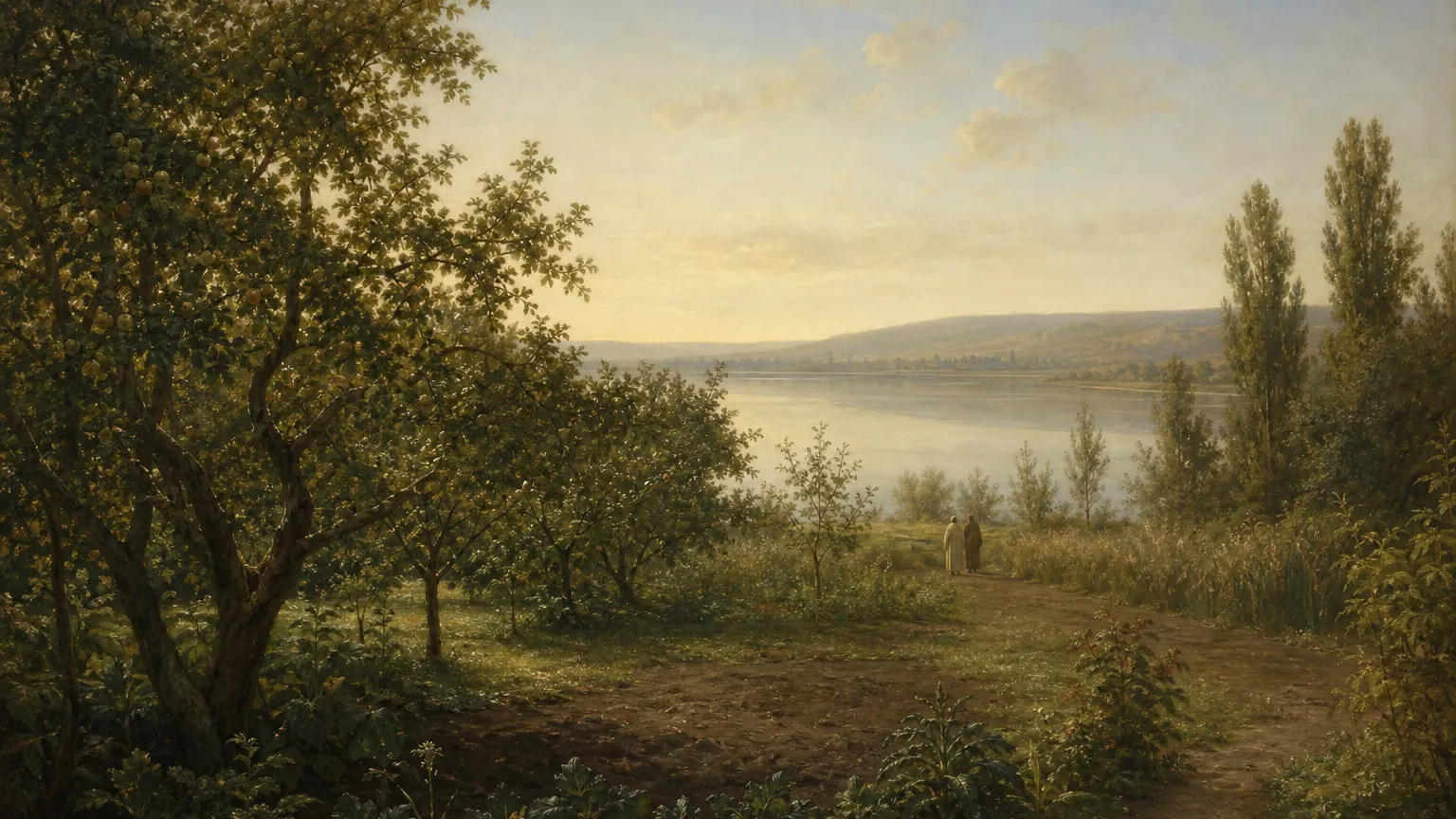
The garden of Eden in Genesis 2 offers one of the most tender scenes in all of Scripture. Here the LORD God forms a man, plants a garden, gives him meaningful work and then creates a companion for him. In fact, this chapter tells the story of beginnings from a fresh angle. Instead of a sweeping view of the heavens, it brings us close to the soil, the trees and the first human relationship. As a result, it speaks to daily life: to our labor, our limits and our deep need for one another. In this article we walk through the chapter and also look at where ancient readers placed Eden.
A Second Account of Creation
The second part of the creation story runs from Genesis 2:4 to Genesis 3:24. It opens with a name for God, Yahweh-Elohim, which English Bibles render as “the LORD God.” Before the garden of Eden appears, the chapter describes a bare earth. No plant covers the field, because the LORD God has not yet sent rain. Also, no man exists to till the ground.
Yet the earth is not dry. A mist rises from the ground and waters its whole face. Then God acts with remarkable closeness:
“And the LORD God formed man of the dust of the ground, and breathed into his nostrils the breath of life; and man became a living soul.” (Genesis 2:7)
Notice the two movements in this verse. First, God shapes the man from the dust, the humblest material. Then he breathes the breath of life into him. So the human being belongs to the earth and yet lives by the breath of God.
The LORD God Plants the Garden of Eden
Next, God becomes a gardener. According to Genesis 2:8, the LORD God planted a garden eastward in Eden and placed there the man he had formed. From the ground he makes every tree grow that is pleasant to see and good for food. In the middle of the garden stand two special trees: the tree of life and the tree of the knowledge of good and evil.
The name itself carries meaning. In Hebrew the garden of Eden is gan-ʿĒḏen, and it also bears the title Garden of God. The word likely comes from the Akkadian edinnu, which goes back to a Sumerian word edin, meaning “plain” or “steppe.” In addition, it closely relates to an Aramaic root meaning “fruitful, well-watered.” Another reading links the name to a Hebrew word for “pleasure.” For this reason the Latin Vulgate speaks of paradisum voluptatis in Genesis 2:8. Similarly, the Douay–Rheims Bible speaks of “a paradise of pleasure.”
Scholars also notice that the Eden story shares features with Solomon’s Temple and Jerusalem. In other words, the garden is more than a park. It is a sacred place.
Called to Tend and Keep the Garden of Eden
Work appears in this chapter before any trouble enters the story. Earlier the text noted that no man was there to till the ground. Now God answers that need:
“And the LORD God took the man, and put him into the garden of Eden to dress it and to keep it.” (Genesis 2:15)
Work, then, is not a punishment here. Instead, it forms part of God’s good design from the start. The man receives a garden to cultivate and protect, so his labor continues what God himself planted.
God also gives the man generous freedom. He may eat freely from every tree, with one exception. He must not eat from the tree of the knowledge of good and evil, because on the day he eats of it he will surely die. So the gift of abundance comes with a clear boundary. Trust in God’s word shapes life in the garden just as much as the work of human hands.
For believers today, this offers a gentle invitation. Our daily tasks can become a way of caring for what God entrusts to us. Likewise, our limits can remind us to listen to his word.
Not Good to Be Alone: The Gift of Companionship
In the garden of Eden, God now names something that is not good:
“It is not good that the man should be alone; I will make him an help meet for him.” (Genesis 2:18)
First, God forms every beast of the field and every bird of the air from the ground. He brings them to Adam to see what he will call them, and whatever Adam calls each creature becomes its name. Adam names the cattle, the birds and the wild animals. Yet among them all, he finds no suitable helper for himself.
So God acts again. He causes a deep sleep to fall on Adam, takes one of his ribs and closes up the flesh. From the rib he makes a woman and brings her to the man. Adam responds with joy:
“This is now bone of my bones, and flesh of my flesh” (Genesis 2:23)
He calls her Woman, because God took her out of Man. The chapter then draws a lasting lesson: a man leaves his father and mother, holds fast to his wife, and the two become one flesh. Finally, the narrator adds that the man and his wife were both naked and felt no shame. The woman, later named Eve, stands beside Adam as a true companion.
Where Ancient Readers Placed the Garden of Eden
Genesis 2:10–14 gives the garden of Eden a geography. A river flows out of Eden to water the garden and then divides into four heads. The first, the Pishon, winds around the land of Havilah, a land of good gold, bdellium and onyx. The second, the Gihon, flows around the whole land of Cush. The third is the Tigris, Hiddekel in Hebrew, and the fourth is the Euphrates, or Perath.
Readers have long tried to trace these rivers. Many translations render Cush as Ethiopia. However, some think it refers to Cossaea, a Greek name for the land of the Kassites, east of ancient Babylon. In the first century, the Jewish historian Josephus identified the Pishon with the Ganges and the Gihon with the Nile.
Later suggestions vary widely. Juris Zarins argued for the head of the Persian Gulf, where the Tigris and Euphrates run into the sea. Others point to the Armenian Highlands, a large region of Mesopotamia, or even the whole Fertile Crescent. Terje Stordalen observes that the Book of Ezekiel places Eden in Lebanon. British archaeologist David Rohl proposed Iran near Tabriz, although mainstream scholars have not adopted his view. Even Christopher Columbus, on his third voyage in 1498, thought he might have reached the Earthly Paradise.
The Bible itself keeps remembering Eden. For example, Genesis 13:10, Isaiah 51:3, Ezekiel 36:35 and Joel 2:3 all mention it.
Living the Lessons of the Garden of Eden
The garden of Eden reminds us that God gives every good thing. He forms us, breathes life into us and places us where we can flourish. He gives us work that matters and boundaries that protect us. Above all, he sees our loneliness and answers it with companionship.
Wherever scholars place Eden on a map, its message reaches every home. Therefore, as you go about your tasks this week, remember the man who tended the garden. Also, treasure the people God has placed beside you, because Genesis 2 shows that God did not intend us to live alone.
