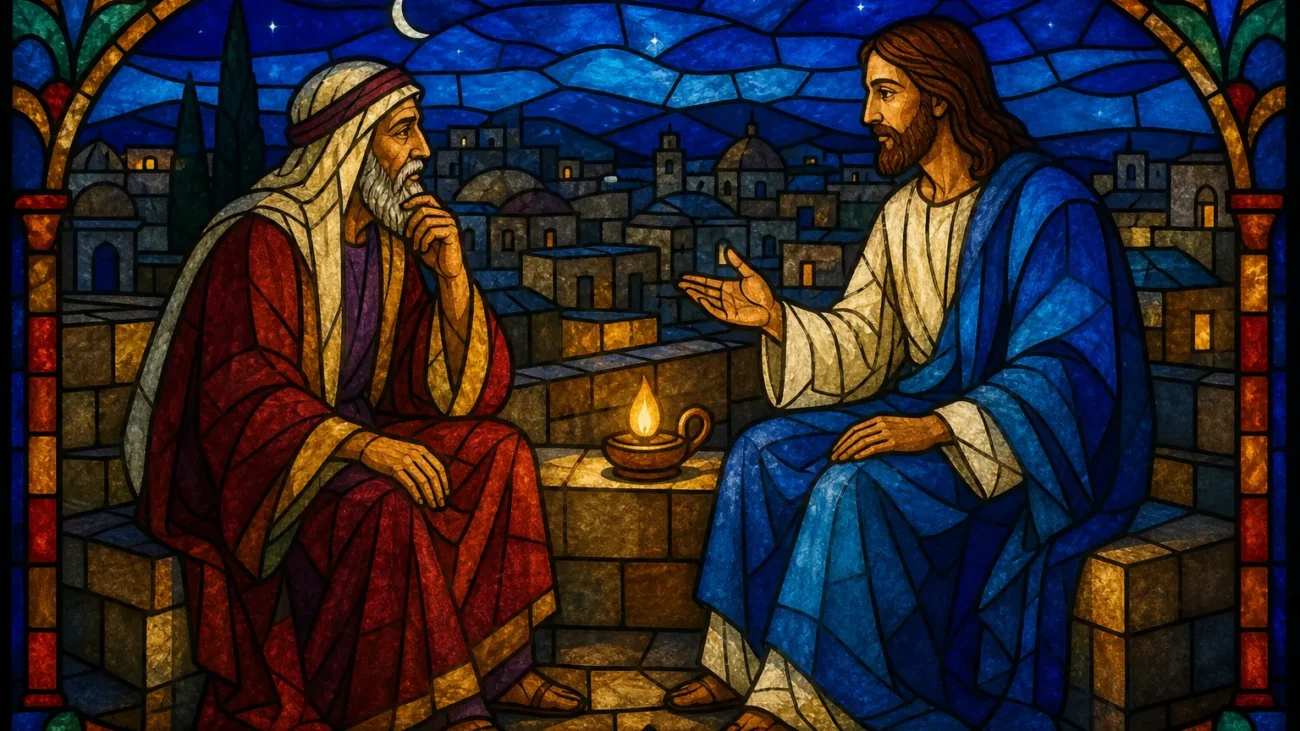
The story of Nicodemus and Jesus appears only in the Gospel of John, yet it stretches across almost the whole book. Nicodemus was a Pharisee and a member of the Sanhedrin, and like Lazarus, he does not appear in the other Gospels. John gives him more than half of chapter 3, then a few verses in chapter 7, and finally a brief but moving scene in chapter 19. As a result, we can follow one man from his first questions in the dark to his care for the body of Jesus. Along the way, his conversation gives us the setting of one of the most loved verses in Scripture.
A Pharisee Who Came to Jesus by Night
John introduces him simply: “There was a man of the Pharisees, named Nicodemus, a ruler of the Jews” (John 3:1). Just before this, Jesus had gone to Jerusalem for the Passover. There he drove the moneychangers from the temple and overturned their tables. Then many people believed in him when they saw the signs he was doing.
Nicodemus refers to those very signs. He opens with respect, calling Jesus “Rabbi” and adding, “we know that thou art a teacher come from God” (John 3:2). However, he comes by night, and John never says why. D. A. Carson notes that suggestions range from a simple memory of the event to rabbis who debated late into the night, or a wish for darkness as cover. Instead, Carson points to the way John uses “night” elsewhere (John 9:4; John 11:10; John 13:30), where it stands for moral and spiritual darkness.
Craig S. Keener reads the detail on two levels. In the story, Nicodemus wants to avoid being seen, much like those who feared expulsion from the synagogue (John 12:42). In addition, the phrase works as a symbol, framing the scene between coming “by night” (John 3:2) and leaving darkness for the light (John 3:21). Similarly, Kenneth E. Bailey contrasts this night visit with the Samaritan woman, who comes at noon, hears, and believes.
Nicodemus and Jesus Talk About Being Born Again
Jesus does not answer the compliment directly. Instead, he goes straight to the heart of the matter: “Except a man be born again, he cannot see the kingdom of God” (John 3:3). The Greek word behind “again” is anōthen, which can also mean “from above.”
Nicodemus replies with a puzzled question about an old man entering his mother’s womb a second time (John 3:4). Yet most theologians think he knew Jesus did not mean a literal rebirth. In fact, Charles Ellicott wrote that “after the method of Rabbinic dialogue, [Nicodemus] presses the impossible meaning of the words in order to exclude it, and to draw forth the true meaning.” In other words, the exchange between Nicodemus and Jesus sets aside the literal sense so that the real one can emerge.
Jesus then explains that a person must be born “of water and of the Spirit” to enter the kingdom of God (John 3:5). He also draws a line between flesh and spirit (John 3:6). Then he gives a picture from daily life. You hear the wind, but you cannot tell where it comes from or where it goes, and the same holds for everyone born of the Spirit (John 3:8).
The Setting of John 3:16 in the Talk Between Nicodemus and Jesus
Still, Nicodemus struggles. He asks, “How can these things be?” (John 3:9). Jesus answers with gentle surprise, perhaps with irony: “Art thou a master of Israel, and knowest not these things?” (John 3:10). Next, he speaks of earthly and heavenly things, and of the Son of man who came down from heaven (John 3:12-13).
Then Jesus reaches back to a scene from Israel’s own story. Just as Moses lifted up the serpent in the wilderness, so the Son of man must be lifted up, so that whoever believes in him may have eternal life (John 3:14-15). Finally, the conversation arrives at the words that so many believers know by heart:
“For God so loved the world, that he gave his only begotten Son, that whosoever believeth in him should not perish, but have everlasting life.” (John 3:16)
This setting matters. Jesus first spoke this verse to one seeking teacher who had come with honest questions. So the most famous summary of God’s love answers the question that Nicodemus and Jesus had been circling: how a person can be born again.
A Voice for Fairness in the Sanhedrin
Nicodemus appears again in John 7. By then, the chief priests and the Pharisees are debating what to do about Jesus. Nicodemus reminds his colleagues that the law requires a hearing before anyone faces judgment. Therefore, he urges them to listen and investigate first.
His colleagues respond with mockery, arguing that no prophet comes from Galilee. Even so, Nicodemus probably held some influence in the Sanhedrin. Because he insisted on a fair hearing, some call him the “defender of Jesus.” The man who once came quietly now speaks up in public, even if briefly.
Nicodemus and Jesus at the Garden Tomb
The last scene comes after the crucifixion. Joseph of Arimathea, a secret disciple who feared the Jewish leaders, asks Pilate for the body of Jesus, and Pilate allows it. Then John adds a striking detail:
“And there came also Nicodemus, which at the first came to Jesus by night, and brought a mixture of myrrh and aloes, about an hundred pound weight.” (John 19:39)
That amount equals about 100 Roman pounds, roughly 33 kilograms or 73 pounds. Clearly, Nicodemus had means. Pope Benedict XVI observed, “The quantity of the balm is extraordinary and exceeds all normal proportions. This is a royal burial.” Together, the two men wrap the body in linen with the spices, following Jewish burial custom (John 19:40).
Near the place of the crucifixion lay a garden with a new tomb where no one had yet been laid. Because of the preparation day and because the tomb was close, they placed Jesus there (John 19:41-42). For this reason, Catholic and Eastern Orthodox traditions regard Nicodemus as a secret disciple, although John never says so directly. Today several churches honor him as a saint, and the Roman Martyrology remembers him on 31 August together with Joseph of Arimathea.
Learning From the Night Visitor
The journey of Nicodemus and Jesus begins in darkness and ends beside a garden tomb. First Nicodemus asks cautious questions, then he speaks up for fairness, and finally he gives generously and openly. His story reminds us that honest questions are welcome before the Lord.
Above all, the words Jesus spoke to him still invite every reader. God so loved the world that he gave his Son, so that whoever believes in him would have everlasting life. Like Nicodemus, we may come slowly, yet the Spirit still moves like the wind, and the light still welcomes those who leave the night behind.
