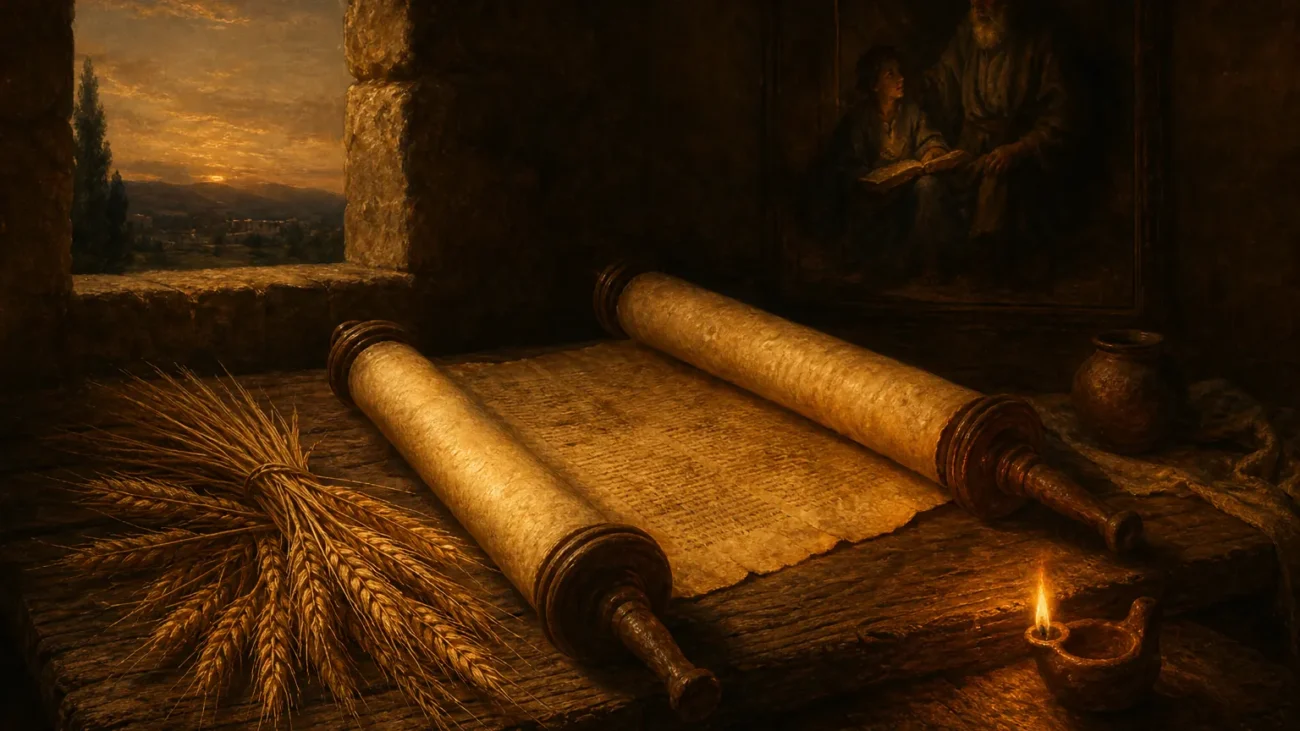
The story of Ruth and Naomi is one of the most tender accounts in the Hebrew Bible. In four short chapters, the Book of Ruth follows a Moabite widow who refuses to abandon her Judean mother-in-law. Her loyalty leads her to Bethlehem, then to the fields of Boaz, and finally into the family line of King David. Along the way, the book introduces the kinsman-redeemer, a relative who steps in to protect a family’s name and land.
A Family Emptied by Famine and Loss
In the days when judges led the tribes of Israel, a famine struck the land. Because of this crisis, Elimelech, a man of Bethlehem in Judah, moved to Moab. He took his wife Naomi and their two sons, Mahlon and Chilion. There Elimelech died. Later his sons married Moabite women: Mahlon wed Ruth, and Chilion married Orpah.
After about ten years, both sons also died. As a result, Naomi found herself in a foreign land with no husband and no sons. The first chapter moves from death to emptiness, and the reader feels the weight of her grief. Yet this low point sets the stage for the faithfulness of Ruth and Naomi to shine.
The book does not name its author. Tradition ascribes it to the prophet Samuel, while a substantial number of scholars date it to the Persian period (c. 550–330 BCE). Some scholars read it as historical fiction. Others, including evangelical scholars, see it as a historical narrative told in the form of a short story.
The Vow That Bound Ruth and Naomi
Naomi heard that the famine in Judah had passed, so she decided to go home. She urged her daughters-in-law to return to their mothers’ houses and marry again. At first, both women refused. However, Naomi reminded them that she would likely have no more sons for them to marry. They all wept, and Orpah finally returned to her people.
Ruth, on the other hand, would not turn back. Her answer has become one of the best-loved declarations of loyalty in Scripture:
“Don’t urge me to leave you, and to return from following you, for where you go, I will go; and where you stay, I will stay. Your people will be my people, and your God my God. Where you die, I will die, and there I will be buried. May Yahweh do so to me, and more also, if anything but death parts you and me.” (Ruth 1:16-17)
These words go far beyond family duty. In fact, Ruth embraced Naomi’s people and Naomi’s God as her own. For this reason, Judaism regards Ruth as a model convert, and rabbinic sources draw several laws of conversion from her declaration. For Christian readers, the bond between Ruth and Naomi offers a living picture of loving-kindness, or hesed, which acts for the good of others.
Gleaning in the Field of Boaz
Ruth and Naomi reached Bethlehem at the beginning of the barley harvest. To support them both, Ruth went out to glean the leftover grain behind the reapers. As it happened, she came to the field of Boaz, a wealthy relative of Elimelech.
When Boaz arrived, he asked about the young woman. Then he told her to stay in his field and not go elsewhere. He also let her drink from the vessels of the female reapers and told her to avoid the men. Ruth asked why he showed such favor to a foreigner. Boaz answered that he had heard how loyal she had been to Naomi.
His generosity did not stop there. At mealtime, he invited Ruth to eat with him. In addition, he told his reapers not to rebuke her and even to pull out barley from their bundles for her. So Ruth gleaned in his fields through the rest of the barley and wheat harvests. Gleaning carried a lower social status and some danger, yet Ruth chose it for the sake of her mother-in-law.
Ruth and Naomi and the Kinsman-Redeemer
Once the harvest ended, Naomi made a plan to secure a future for Ruth and Naomi alike. She advised Ruth to wash, anoint herself and go to the threshing floor where Boaz was winnowing barley. After he lay down, Ruth would uncover his feet and lie there. Ruth did exactly as Naomi said.
At midnight Boaz woke. Ruth asked him to protect her, because he was a goel of her late husband’s family. A goel was a close relative tasked with protecting a kinsman’s rights. In other words, he could act as a redeeming kinsman. Since Elimelech had no heir for his land, custom expected a close relative to marry the widow and carry on the dead man’s name. Readers often link this practice to levirate marriage.
Boaz blessed Ruth and said her latest kindness was greater than the first. He also agreed to do all that the matter required. Yet one problem remained: another relative stood closer in line than Boaz.
Redemption at the City Gate
Early the next morning, Boaz went to the town gate and sat down. When the closer relative arrived, Boaz spoke with him before the elders. The book never names this man; Boaz simply calls him ploni almoni, meaning “so and so.” Boaz explained that Naomi was selling Elimelech’s land, and at first the man agreed to redeem it.
However, the redemption also involved Ruth, so that the name of the dead would live on with his inheritance. The relative then refused, fearing harm to his own estate. As a result, Boaz was free to act. The nearer kinsman took off his sandal and handed it to Boaz, an old custom Israel once used to confirm a redemption or exchange. Boaz then redeemed the land and took Ruth as his wife.
Obed and the Line of King David
Boaz and Ruth married, and the Lord enabled her to bear a son. Then the women of Bethlehem rejoiced with Naomi:
“Blessed be Yahweh, who has not left you today without a near kinsman. Let his name be famous in Israel. He shall be to you a restorer of life, and sustain you in your old age, for your daughter-in-law, who loves you, who is better to you than seven sons, has given birth to him.” (Ruth 4:14-15)
Naomi took the child, laid him in her bosom and became his nurse. Her neighbors named him Obed, saying, “A son is born to Naomi” (Ruth 4:17). The story of Ruth and Naomi began in emptiness, and now it ends in fullness. Finally, the book reveals that Obed “is the father of Jesse, the father of David” (Ruth 4:17). Ruth the Moabite thus became the great-grandmother of King David.
A closing genealogy traces the line from Perez down through Obed to David. Many scholars consider this list a later addition, yet it ties the book into Israel’s history from Genesis to Kings. Similarly, the Gospel of Matthew names Ruth in the genealogy of Jesus, alongside Tamar, Rahab, the wife of Uriah and Mary.
What the Story of Ruth and Naomi Teaches Us
The friendship of Ruth and Naomi reminds us that faithfulness often looks ordinary. Ruth gleaned grain, cared for a grieving widow and kept her word. Boaz noticed that loyalty and answered it with kindness and protection. Through these quiet choices, God turned Naomi’s emptiness into joy.
The women of Bethlehem praised the Lord, who had not left Naomi without a near kinsman. Their words invite us to trust that God sees our losses too. So may we, like Ruth and Naomi, choose steadfast love, and may we wait with hope for the restoration God can bring.
