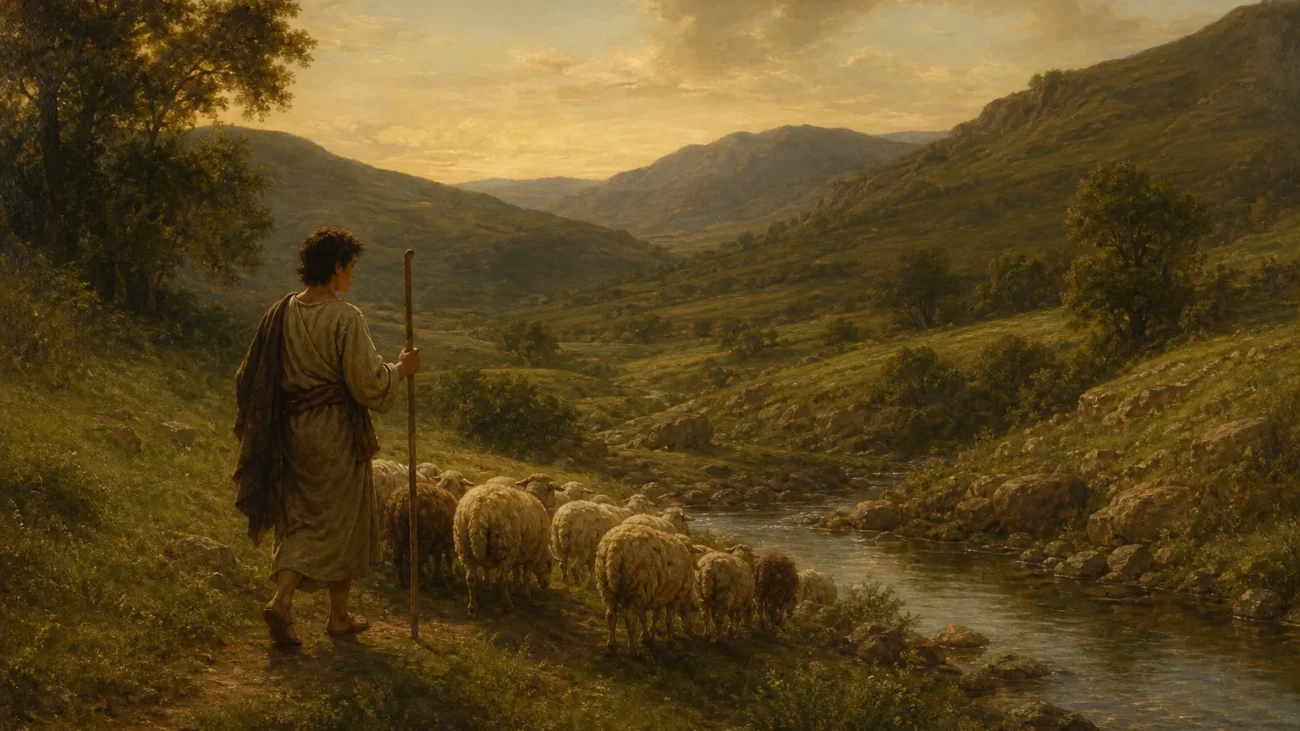
Discovering the full psalm 23 meaning begins with a simple picture: a shepherd watching over his flock. This short song of six verses is one of the most treasured passages in Scripture. Many believers know it by heart. It opens with words of quiet confidence: “Yahweh is my shepherd: I shall lack nothing” (Psalms 23:1). In the Greek Septuagint and the Latin Vulgate, the same psalm is numbered 22. In Latin, it is known by its opening words, Dominus regit me. Let us walk through it verse by verse and see how God cares for his people.
Shepherd Imagery and Psalm 23 Meaning
The idea of God as a shepherd was familiar in ancient Israel and Mesopotamia. For example, King Hammurabi closed his famous law code by calling himself “the shepherd who brings well-being and abundant prosperity.” The people who first sang this psalm already knew such language, and it was easily imported into their worship.
The header of the psalm ascribes it to King David. According to the Hebrew Scriptures, David was a field shepherd in his youth. However, some scholars question this authorship. They suggest other possibilities and often date the psalm to the post-exilic period.
In addition, some commentators see the shepherd picture pervading the entire psalm. A shepherd knows each sheep by name. Thus he is not only a protector but also a caretaker. Sheep are helpless without their shepherd. Without a shepherd, they could fall to a predator like the wolf or die of starvation.
Green Pastures, Still Waters and a Restored Soul
The next verses show the shepherd at work. David writes:
“He makes me lie down in green pastures. He leads me beside still waters. He restores my soul. He guides me in the paths of righteousness for his name’s sake.” (Psalms 23:2-3)
Here God feeds and leads his flock. Each sheep must be personally led to be fed. Likewise, the Lord leads his people to green pastures and still waters.
Notice also the words that close this passage. God guides “for his name’s sake.” Just as the shepherd leads his sheep, the psalm says, “He restores my soul.”
Psalm 23 Meaning in the Darkest Valley
The tone shifts in verse 4. Suddenly, the path leads through shadow:
“Even though I walk through the valley of the shadow of death, I will fear no evil, for you are with me. Your rod and your staff, they comfort me.” (Psalms 23:4)
The rod and staff are also the implements of a shepherd. For Christians, the phrase “the valley of the shadow of death” is often taken as an allusion to the eternal life given by Jesus.
Harold Kushner argues that this verse is the key to the entire psalm. In his view, its message follows from the verses that lead up to it, and its consequences follow from the verses after it. He wrote, “God’s promise was that when we had to face the pain and unfairness of the world as we inevitably would, we would not have to face it alone.” For Kushner, this is the heart of psalm 23 meaning. The psalm itself says: “I will fear no evil, for you are with me.”
A Table, Oil and an Overflowing Cup
Verse 5 paints a picture of abundance:
“You prepare a table before me in the presence of my enemies. You anoint my head with oil. My cup runs over.” (Psalms 23:5)
J. Douglas MacMillan connected the table to the “old oriental shepherding practice” of using little raised tables to feed sheep. Similarly, the anointing oil may refer to an ancient form of backliner: the oil is poured on wounds, and it repels flies. Thus even this verse can be read through a shepherd’s eyes.
The psalm then ends with hope:
“Surely goodness and loving kindness shall follow me all the days of my life, and I will dwell in Yahweh’s house forever.” (Psalms 23:6)
MacMillan said this verse reminded him of two loyal sheepdogs coming behind the flock. What a gentle image! In the psalm, goodness and loving kindness follow the psalmist all the days of his life.
Jesus the Good Shepherd
For Christians, the image of God as a shepherd evokes connections not only with David but also with Jesus. In the Gospel of John, Jesus says:
“I am the good shepherd. The good shepherd lays down his life for the sheep.” (John 10:11)
Jesus then contrasts himself with a hired hand. When the wolf comes, the hired hand flees, because he does not care for the sheep (John 10:12-13). By contrast, Jesus says: “I know my own, and I’m known by my own” (John 10:14).
Furthermore, some see Psalms 22, 23 and 24 together as shepherd psalms. In them, the good shepherd lays down his life for the sheep as a suffering servant and king. Seen this way, the psalm 23 meaning is read alongside the words of Jesus: “I lay down my life for the sheep” (John 10:15).
Psalm 23 Meaning for Every Season of Life
Believers have prayed this psalm in many settings. In Judaism, it is traditionally sung during the third Shabbat meal as well as before the first and second. It is also commonly recited in the presence of a deceased person and at the funeral service. Orthodox Christians typically include it in the prayers of preparation for receiving the Eucharist. In the Catholic Church, it is sung as a responsorial in Masses for the dead. Moreover, in the twentieth century it became particularly associated with funeral liturgies in the English-speaking world. Today, the most widely recognized English version comes from the King James Bible of 1611.
Ultimately, the psalm 23 meaning is personal. The psalm does not say “a shepherd” but “my shepherd.” In green pastures, the Lord gives rest. In the dark valley, he is present. At the table, the cup runs over. Whatever season you face today, this psalm invites you to rest in his care and to remember its promise that goodness and loving kindness shall follow “all the days of my life.”
