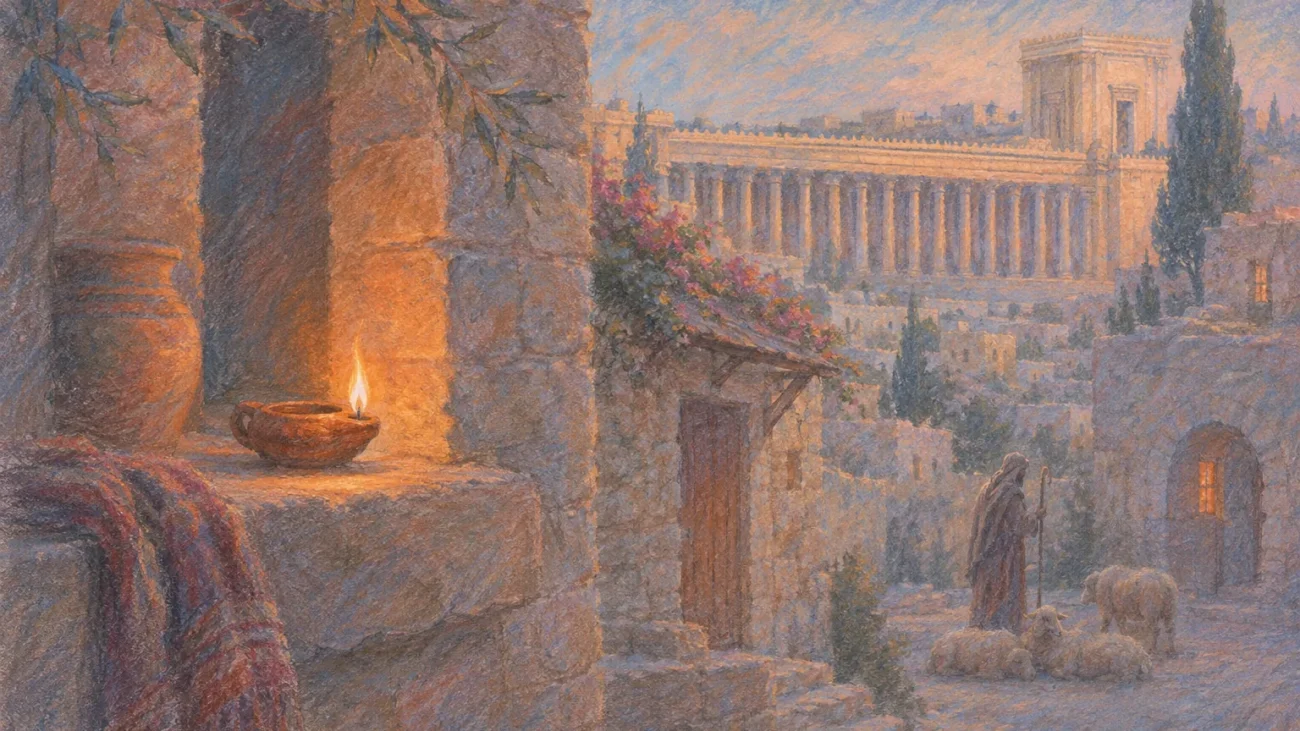
The feast of dedication forms the backdrop for one of the most tender scenes in the Gospel of John. In chapter 10, John pauses to tell us the season, the city and the exact place where Jesus walked. Those small details open a window onto a story that began in the 2nd century BCE. Today, many readers know this festival by its Hebrew name, Hanukkah. In this article, we trace how a defiled Temple became a place of rejoicing again. Then we return to Solomon’s porch to listen to the Shepherd’s words.
What John Records at the Feast of Dedication
John sets the scene with a few short lines:
“And it was at Jerusalem the feast of the dedication, and it was winter. And Jesus walked in the temple in Solomon’s porch.” (John 10:22-23)
First, John names the city: Jerusalem. Next, he names the feast and adds that it was winter. Finally, he places Jesus inside the temple, walking in Solomon’s porch. John does not explain why he mentions the season or the porch. However, each detail ties the moment closely to the festival and to the Temple it honored.
The Hebrew word Hanukkah literally means “dedication.” In fact, the name comes from a Hebrew verb meaning “to dedicate.” So when John speaks of the feast of dedication, he points to the Jewish holiday that remembers how the Maccabees recovered Jerusalem and the Second Temple. The festival begins on the 25th of Kislev and lasts eight nights and days. It is also the only Jewish holiday that starts in one month, Kislev, and ends in another, Tevet. Today it often falls during the Christmas season, which fits John’s simple note that it was winter.
Why the Temple Needed Rededicating
The road to the feast of dedication began with political upheaval. In the 2nd century BC, Judea lay between two powerful kingdoms. The Ptolemaic Kingdom ruled from Egypt, while the Seleucid Empire ruled from Syria. Judea first came under Ptolemaic rule. Around 197 BC, however, it fell to the Seleucids after the Battle of Panium. At the same time, Greek culture pressed hard on Jewish life. Some Jews, mainly from the urban upper class, wanted to set aside Jewish law and live in the Greek way.
Antiochus IV Epiphanes became ruler of the Seleucid Empire in 175 BC. At that time, Onias III held the office of high priest in Jerusalem. Soon, though, the holy office became something to buy. Jason, the brother of Onias, bribed Antiochus to replace him. Later, Menelaus bribed the king in turn and took the office from Jason. Then, in 168 BCE, Antiochus pillaged the Temple and attacked Jerusalem.
According to 1 Maccabees, the king went further still. He made owning the Torah a capital offense and burned the copies he found. He also banned sabbaths and feasts, outlawed circumcision and forbade the traditional sacrifices. Reports even told of an idol of Olympian Zeus on the altar of the Temple. For faithful Jews, the house of God now stood defiled.
The Maccabees Who Recovered Jerusalem
In the narrative of 1 Maccabees, a rural priest named Mattathias the Hasmonean sparked the revolt. He came from Modi’in, and he refused to worship the Greek gods. In a narrower sense, the name Maccabees refers to Judas Maccabeus and his four brothers. Their struggle and victory gave rise to the feast of dedication.
Interestingly, the name Maccabee began as a personal epithet of Judah. One explanation links it to an Aramaic word meaning “the hammer,” a nod to his ferocity in battle. Jewish tradition, by contrast, reads it as an acronym of a battle cry drawn from Exodus 15:11: “Who is like You among the heavenly powers, oh God!” In time, the family’s leaders founded the Hasmonean dynasty, which ruled from 167 BC to 37 BC.
Historians read the conflict in different ways. Many modern scholars see a civil war between traditionalist Jews and Hellenized Jews, which the king then answered with persecution. John J. Collins, for example, stresses that the persecution of people who kept the Torah provoked the revolt. Still others argue that a religious rebellion gradually became a war of national liberation. Whatever the emphasis, the Maccabees regained Jerusalem and rededicated the Temple.
How the Feast of Dedication Became a Festival of Lights
The books of First and Second Maccabees tell the story of the rededication and the lighting of the menorah. The Roman Catholic and Orthodox Churches count these books as part of the Old Testament. However, the Masoretic Text of the Hebrew Bible does not include them. First Maccabees describes an eight-day rededication of the Temple. In addition, both books present the feast as a delayed celebration of the eight-day Feast of Booths, or Sukkot. In fact, the feast began as one “like the days of the festival of Sukkot” (2 Maccabees 10:9).
Second Maccabees also recalls an older story. In it, Nehemiah relit the altar fire through a miracle on the 25th of Kislev. That account seems to explain why Judah Maccabee chose the same date to rededicate the altar. By contrast, the famous miracle of the oil does not appear in 1 Maccabees. Instead, the Talmud, which took written form about 600 years after the events, describes a one-day supply of oil lasting eight days.
Josephus gave the feast another name: “And from then on we celebrate this festival, and we call it Lights.” For this reason, many still call the feast of dedication the Festival of Lights. Each night, families light a nine-branched menorah, using an extra candle called the shamash to light the others. They light one candle on the first night, two on the second, and so on until all eight burn together. Traditionally, worshipers also recite Psalm 30, the “Song of the Dedication of the House.”
The Shepherd’s Voice at the Feast of Dedication
At the feast of dedication, a group gathered around Jesus in Solomon’s porch. They pressed him with a question: “How long dost thou make us to doubt? If thou be the Christ, tell us plainly” (John 10:24). Jesus answered that he had already told them. Moreover, he pointed to his works, which he did in his Father’s name and which bore witness of him.
Then Jesus spoke of his sheep with words of deep comfort:
“My sheep hear my voice, and I know them, and they follow me: And I give unto them eternal life; and they shall never perish, neither shall any man pluck them out of my hand.” (John 10:27-28)
In other words, the security of his people rests in his own hand. Jesus adds that his Father is greater than all, and that no one can pluck them out of the Father’s hand. Finally, he declares, “I and my Father are one” (John 10:30). So at a festival that remembered a recovered Temple, Jesus stood within its courts and spoke of a flock that no one could seize.
A Reflection for Winter Days
The feast of dedication reminds us that God’s people have known seasons of loss and seasons of restoration. The Maccabees saw a defiled altar made holy again. Similarly, John shows Jesus walking in the temple in winter, calmly offering assurance to all who would hear. So when your own days feel cold or uncertain, these verses invite you to listen for the Shepherd’s voice. Above all, they invite you to rest in the hand that no one can open.
