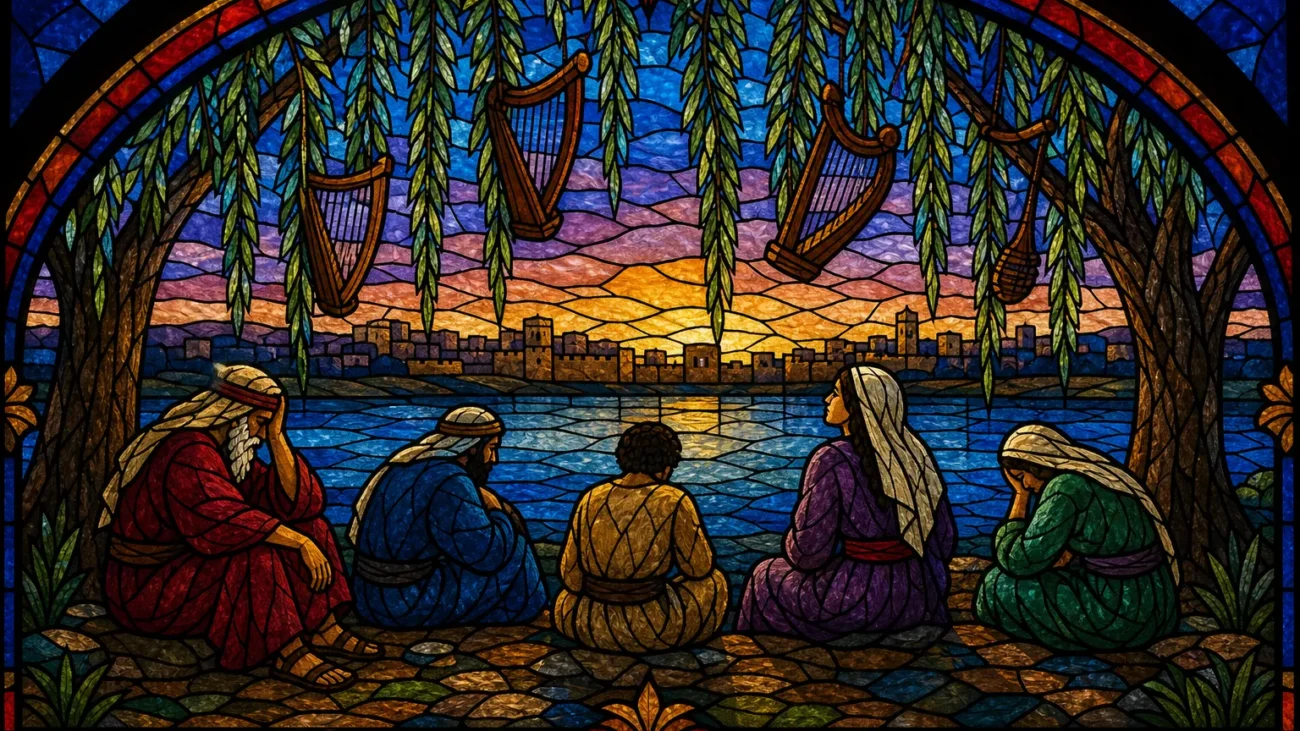
The Babylonian exile marks one of the most painful and formative chapters in the story of God’s people. Between 597 and 587 BC, Nebuchadnezzar II of Babylon carried large numbers of Judeans away from their homeland. In 587 BC his armies burned Jerusalem and Solomon’s Temple. Yet out of that darkness came songs of grief, prophetic words of hope and, finally, a journey home. In this article we trace the history, listen to the exiles’ lament and hear the promise that sustained them.
The Road to the Babylonian Exile
In the late seventh century BC, Judah lived as a client state of Assyria. However, Babylon, once an Assyrian province, rose up and overthrew its masters. Egypt feared this new power and moved north. During that struggle, King Josiah of Judah died fighting the Egyptians at Megiddo in 609 BC. Then, in 605 BC, Nebuchadnezzar II defeated Pharaoh Necho at Carchemish. As a result, King Jehoiakim began paying tribute to Babylon, and some young nobles of Judah went to Babylon.
Soon the court in Jerusalem split into two parties, one favoring Egypt and the other Babylon. In 601 BC, Egypt repulsed Nebuchadnezzar. Jehoiakim then stopped paying tribute, despite strong warnings from the prophet Jeremiah. So Babylon returned. Jehoiakim died during a siege that began in late 598 BC, and his son Jeconiah, also called Jehoiachin, took the throne. The city fell on 2 Adar (March 16) 597 BC.
This first wave of the Babylonian exile took away Jeconiah, his court, craftsmen and leading citizens, including the prophet Ezekiel. The Book of Kings counts about 10,000 deported, while other estimates speak of around 7,000. Remarkably, clay tablets from Nebuchadnezzar’s royal archives list food rations for “Ya’u-kīnu, king of the land of Yahudu” and five of his sons.
The Siege and Fall of Jerusalem in 587 BC
Nebuchadnezzar placed Jeconiah’s uncle Zedekiah on the throne at the age of 21. Yet Zedekiah also rebelled. He stopped the tribute and made an alliance with Pharaoh Hophra, even though Jeremiah and others urged him not to. In January 589 BC, the Babylonian army surrounded Jerusalem once more. Meanwhile, many Judeans fled to Moab, Ammon and Edom.
Throughout the siege, Jeremiah gave the people a hard choice: surrender to the Babylonians and live, or face sword, famine and pestilence (Jeremiah 38:2–3). Some nobles called this treason and lowered him into a muddy cistern. However, a court official named Ebedmelech, a Cushite, bravely appealed to King Zedekiah. With ropes and old rags, he and his men drew the prophet out (Jeremiah 38:7–13). Later, Jeremiah brought Ebedmelech a word of comfort: because he had trusted in the Lord, he would keep his life (Jeremiah 39:15–18).
In the end, the bread in the city ran out. Outside the capital, a soldier wrote to the commander at Lachish that his men were watching for its fire signals “because we cannot see Azeqah.” Finally, after eighteen or thirty months, the Babylonians broke through the walls in the summer month of Tammuz. Scholars debate whether this happened in 587 or 586 BC. Zedekiah fled by night, but the Babylonians caught him on the plains of Jericho. At Riblah he watched his sons die; then his captors blinded him and took him to Babylon.
The Babylonian general Nebuzaradan then completed the destruction. His troops plundered and burned the city and Solomon’s Temple. Archaeology confirms that fire reduced virtually the whole walled city to rubble. In this way the great second wave of the Babylonian exile began, and the independent kingdom of Judah came to an end.
Life in Babylon During the Babylonian Exile
Not everyone left the land. Babylon appointed Gedaliah, a Judean, as governor at Mizpah, and refugees from Moab, Ammon and Edom came home. Sadly, Ishmael son of Nethaniah assassinated Gedaliah, and many survivors fled to Egypt. As a result, Jewish communities soon lived in Judah, in Babylon and in Egypt.
In Babylonia itself, the exiles held on to a strong sense of identity. While they took part in local society, others still knew them as “the people from Judah.” In fact, they continued to regard the captive Jeconiah as their rightful ruler. Still, the pain of the Babylonian exile ran deep, and Psalm 137 gives it a voice:
By the rivers of Babylon, there we sat down, yea, we wept, when we remembered Zion. We hanged our harps upon the willows in the midst thereof. For there they that carried us away captive required of us a song; and they that wasted us required of us mirth, saying, Sing us one of the songs of Zion. How shall we sing the LORD’S song in a strange land? (Psalms 137:1–4)
The psalmist then makes a solemn vow never to forget the holy city:
If I forget thee, O Jerusalem, let my right hand forget her cunning. If I do not remember thee, let my tongue cleave to the roof of my mouth; if I prefer not Jerusalem above my chief joy. (Psalms 137:5–6)
Even far from home, the exiles chose remembrance over forgetting. Their tears show how deeply they loved the place where they had worshiped the Lord.
Jeremiah’s Promise of Seventy Years
Into this sorrow, God spoke through Jeremiah. The prophet who had warned of judgment also carried a message of hope for those in Babylon. The Lord did not hide the length of the trial, yet he promised that it would end:
For thus saith the LORD, That after seventy years be accomplished at Babylon I will visit you, and perform my good word toward you, in causing you to return to this place. For I know the thoughts that I think toward you, saith the LORD, thoughts of peace, and not of evil, to give you an expected end. (Jeremiah 29:10–11)
Notice the order of the promise. First, God speaks of his thoughts of peace. Then he invites his people to pray and to seek him:
Then shall ye call upon me, and ye shall go and pray unto me, and I will hearken unto you. And ye shall seek me, and find me, when ye shall search for me with all your heart. (Jeremiah 29:12–13)
Finally, the passage ends with a pledge to gather the scattered people from all the nations and bring them back to the place from which they had gone into captivity (Jeremiah 29:14). Therefore, the Babylonian exile was never the last word. The same God who had driven them out promised to turn away their captivity.
Cyrus and the Return to Zion
History records how that hope unfolded. In 539 BC, Cyrus the Great of Persia defeated the Babylonians at the Battle of Opis and took Babylon. According to the Book of Ezra, he ended the Babylonian exile in 538 BC and permitted the Judeans to return to Zion and rebuild Jerusalem. Judea became part of a Persian province called Yehud Medinata, “the province of Judah.”
The returning exiles followed two leaders. Zerubbabel came from the royal line of David, and Joshua descended from the former high priests. Work on the Second Temple began around 537 BC, and under Zerubbabel’s leadership the builders completed it in 516 BC. Not all the exiles went back, however. A portion stayed in Mesopotamia and formed a lasting community known as the Golah, which endured until modern times.
Archaeology also shows that a remnant of Judeans kept living in Judah throughout these years, even though Jerusalem lay in ruins. Together, these events left a deep mark on the history of the Jewish people. They also shaped the prophetic writings of the Bible and the further development of Judaism.
What the Babylonian Exile Teaches Us Today
The story of the Babylonian exile moves from loss to lament and then to hope. The exiles wept by the rivers of Babylon, yet they refused to forget Jerusalem. In their darkest years, they held on to a word that spoke of peace and an expected end.
This history invites us to bring our own sorrows honestly before God, as the psalmist did. It also reminds us of the Lord’s invitation in Jeremiah: to call upon him, to pray and to seek him with all our heart. Like the exiles, we can trust that he hearkens to those who seek him, and that his good word does not fail.
