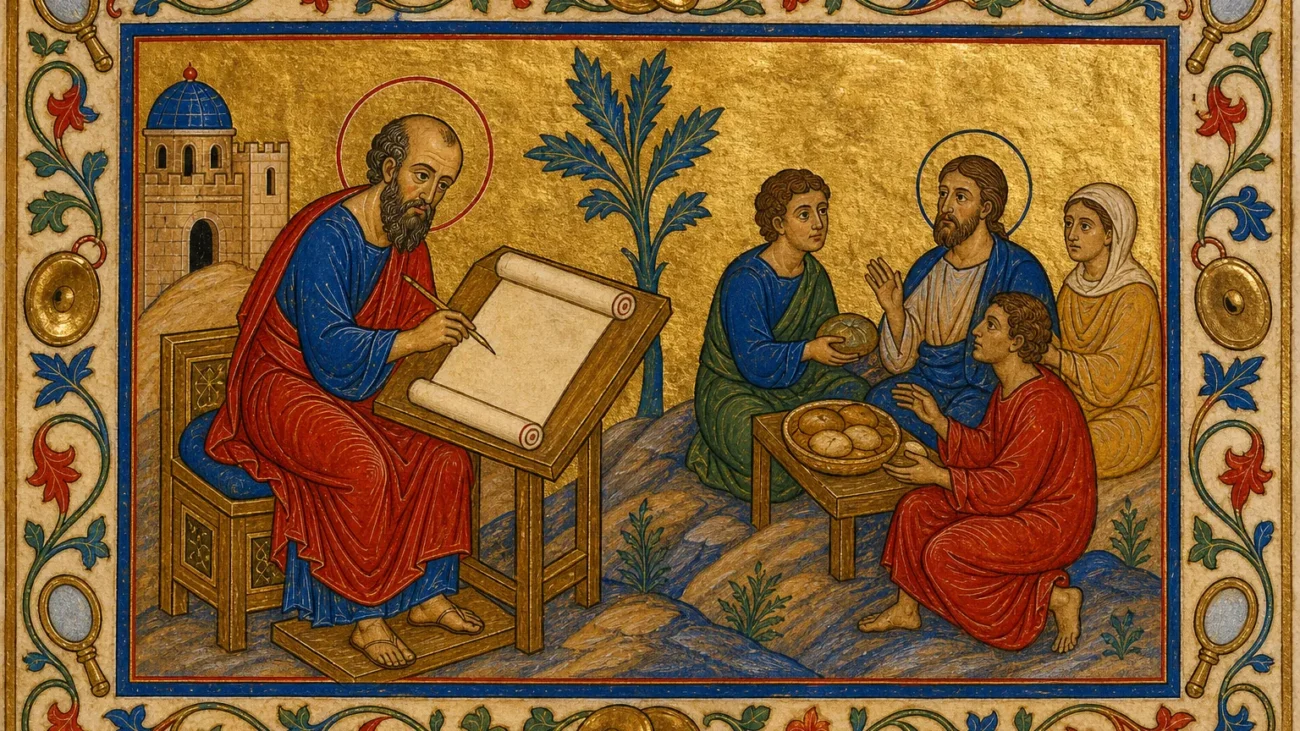
Few chapters of Scripture shine as brightly as 1 Corinthians 13, where Paul sets out his great praise of love. It ranks among the most widely known passages of the New Testament. Yet the chapter is far more than a lovely piece of writing. In fact, Paul wrote it to a real church at Corinth, in the middle of a discussion about real problems in its worship. In this article, we explore its setting, the Greek word behind it, and how its portrait of love can shape our daily walk with Christ.
Reading 1 Corinthians 13 in Its Corinthian Setting
Paul the Apostle wrote this letter at Ephesus in the mid-50s AD. Chapters 12 to 14 form one long discussion of spiritual gifts. The young church at Corinth had fallen into disorder in its worship. Dramatic gifts, such as speaking in tongues, had become marks of status.
Within that discussion, the love chapter supplies the standard for measuring every gift. C. K. Barrett writes that “love provides the scale by which other gifts may be tested and measured.” Similarly, Joseph Fitzmyer calls the chapter “the climax to what Paul has been teaching in chapter 12.” Bridge sentences on either side also bind it to its context. Paul first promises, “I will show you a still more excellent way” (1 Corinthians 12:31). Then he urges, “Pursue love, and earnestly desire the spiritual gifts” (1 Corinthians 14:1).
Scholars also discuss the chapter’s form. Many readers call it a “hymn to love,” but most modern commentators decline that label. Barrett judges it prose, and Fee argues that it is exalted prose rather than a hymn. Others see an encomium, a formal composition in praise of a quality, while Anthony Thiselton declines to fix any single genre label. Barrett and Bruce allow that Paul may have used an earlier piece of his own. However, Fee, Hays, Witherington and Blomberg regard it as composed for its present place, and Thiselton holds that almost every word was chosen with the situation at Corinth in mind.
Agape: The Greek Word Behind the Love Chapter
Paul’s word for love is agape (ἀγάπη). The King James Version renders it “charity,” while most other English translations say “love.” Long before Paul, Greek writers used forms of the word for affection and fondness. Homer already used the verb in the sense of greeting with affection. Other authors applied it to love of a spouse or family, in contrast to eros, an affection of a sexual nature.
In the New Testament, however, agape gains a deeper meaning. It describes the covenant love of God for humans and the love people return to God. It also extends to love for one’s fellow human beings. Twice the New Testament declares, “God is love” (1 John 4:8, 16). This understanding builds on the Hebrew idea of chesed, the loving kindness of God taught throughout the Old Testament.
Jesus himself placed love at the heart of the law. When someone asked him about the great commandment, he answered:
“Thou shalt love the Lord thy God with all thy heart, and with all thy soul, and with all thy mind. This is the first and great commandment. And the second is like unto it, Thou shalt love thy neighbour as thyself. On these two commandments hang all the law and the prophets.” (Matthew 22:37–40)
Without Love, Even the Greatest Gifts Are Empty
Paul opens with three bold conditions. Each names an impressive gift and then strips it of value when love is missing:
“If I speak with the languages of men and of angels, but don’t have love, I have become sounding brass or a clanging cymbal.” (1 Corinthians 13:1)
Next, Paul turns to prophecy, knowledge and faith that could remove mountains. Without love, he says, “I am nothing.” Finally, he imagines giving away all his goods to feed the poor. Even such generosity “profits me nothing” when love is absent. In other words, no gift, however impressive, has any value without love.
Verse 3 also holds the best-known textual variant in the chapter. Some manuscripts read “so that I may boast,” while others read “so that I may be burned.” The two Greek words differ by a single letter. The oldest manuscripts, including Papyrus 46, Codex Sinaiticus and Codex Vaticanus, read “boast.” Bruce Metzger, Fee, Fitzmyer and Thiselton prefer that reading. In contrast, Barrett, Bruce, Conzelmann and Collins keep “be burned.”
Love Is Patient: The Portrait at the Heart of 1 Corinthians 13
In verses 4 to 7, Paul shows love in action. Kenneth Bailey reads the chapter as a ring composition, with the emphasis falling on this central description. Here is how Paul begins it:
“Love is patient and is kind. Love doesn’t envy. Love doesn’t brag, is not proud” (1 Corinthians 13:4)
He goes on to say that love does not behave inappropriately, does not seek its own way, is not provoked and takes no account of evil; it does not rejoice in unrighteousness but rejoices with the truth, and it bears, believes, hopes and endures all things (1 Corinthians 13:5–7). The older English wording is just as memorable: “Charity suffereth long, and is kind” (1 Corinthians 13:4, KJV). Notice that Paul describes love mostly by what it does and what it refuses to do. Love is patient and kind. Moreover, it turns away from envy, bragging and pride. It also takes no account of evil.
These words carried a sharp edge for the Corinthians. Several qualities Paul denies of love, such as envy, boasting, being “puffed up” and self-seeking, match faults he rebuked earlier in the letter. So the chapter also gathers up the letter’s argument to that point. For us, the passage works like a mirror. We can hold our own attitudes up to it and ask where love still needs to grow.
Love Never Fails: Faith, Hope and the Greatest of These
The final movement, verses 8 to 13, shows love outlasting the gifts. “Love never fails,” Paul declares (1 Corinthians 13:8). Prophecies, languages and knowledge will all be done away with or cease. After all, “we know in part and we prophesy in part” (1 Corinthians 13:9). Paul then writes:
“When I was a child, I spoke as a child, I felt as a child, I thought as a child. Now that I have become a man, I have put away childish things.” (1 Corinthians 13:11)
Next come two of the most familiar lines in the English Bible. The older wording says, “For now we see through a glass, darkly; but then face to face” (1 Corinthians 13:12, KJV). Finally, the chapter closes: “But now faith, hope, and love remain—these three. The greatest of these is love” (1 Corinthians 13:13). Faith and hope remain. Yet Paul names love the greatest, and unlike the gifts, love will never end.
Living 1 Corinthians 13 Every Day
The love chapter has shaped Western ethics, Christian liturgy and theological reflection. It has also echoed through literature, music and public life. Fee and Hays note that 1 Clement, written near the end of the first century, already echoes verse 3. Still, Paul first wrote it for a congregation in disorder, not for a display shelf.
Christian love drew notice early on. In the 2nd century, Tertullian recorded what their enemies said about believers: “look how they love one another” (Apology 39). Today, 1 Corinthians 13 invites us to the same kind of witness. We can measure our gifts, our service and our words by the standard of love. Above all, we can pursue love, as Paul urged, and rest in his words that love never fails.
